Trading Oil in Yuan, would it matter at all?

China's Xi calls for oil trade in yuan at Gulf summit in Riyadh.
Death of the dollar stories surface every year. Here is another one that will likely be blown out of proportion in a number of places.
Reuters reports Xi calls for oil trade in yuan at Gulf summit in Riyadh.
President Xi Jinping told Gulf Arab leaders on Friday that China would work to buy oil and gas in yuan, a move that would support Beijing's goal to establish its currency internationally and weaken the U.S. dollar's grip on world trade.
Any move by Saudi Arabia to ditch the dollar in its oil trade would be a seismic political move, which Riyadh had previously threatened in the face of possible U.S. legislation exposing OPEC members to antitrust lawsuits.
China's growing influence in the Gulf has unnerved the United States. Deepening economic ties were touted during Xi's visit, where he was greeted with pomp and ceremony and on Friday met with Gulf states and attended a wider summit with leaders of Arab League countries spanning the Gulf, Levant and Africa.
At the start of Friday's talks, Prince Mohammed heralded a "historic new phase of relations with China", a sharp contrast with the awkward U.S.-Saudi meetings five months ago when President Joe Biden attended a smaller Arab summit in Riyadh.
Asked about his country's relations with Washington in light of the warmth shown to Xi, Foreign Minister Prince Faisal bin Farhan Al Saud said Saudi Arabia would continue to work with all its partners. "We don't see this as a zero sum game," he said.
"We do not believe in polarisation or in choosing between sides," the prince told a news conference after the talks.
Not a zero sum game
It seems that Saudi Arabia understands something that Trump doesn't, that Biden doesn't, and Xi doesn't: Trade is not a zero sum game. There are not big winners and losers as Trump believes.
Second, Reuters reported, a Saudi source told Reuters that a decision to sell small amounts of oil in yuan to China could make sense in order to pay Chinese imports directly, but "it is not yet the right time".
Selling small amounts of anything in yuan does not do anything but allow Xi to gloat over nothing.
New international currency
What if amounts were large?
Sorry, that's the wrong question.
First things first. We need to start with what it would take for the Yuan to become a reserve currency.
What would it take for the Yuan to dethrone the Dollar?
-
China would have to float the yuan.
-
End capital controls.
-
Respect property rights.
-
Have a bond market big enough (China has virtually no gov't bond market).
-
Inspire global trust.
-
Be willing to have trade deficits.
-
Stop export mercantilism.
-
Have a currency market big enough.
At a minimum, China flunks the first seven. Numbers 1, 2, 4, 6, and 7 are serious show stoppers.
Yet, every year, these stories surface. China will back the yuan with gold, China will do set up a BRIC block, China will do this or that (while this and that circulate between gold and other nonsense).
Six and seven are essentially the same point.
For all the pissing and moaning about US dollar privileges, no other country really wants to stop their export mercantilism. The two biggest players are China and Germany. Japan was once a leader in that group and squandered it.
Consumer of last resort
Every country wants the US consumer to remain the consumer of last resort.
Even IF that changes (someone tell me when), there are 5 critical requirements a country must meet (#s 1, 2, 4, 6- 7, 8).
The Yuan will not replace the US Dollar, nor will it be backed by commodities
I have written about this many times.
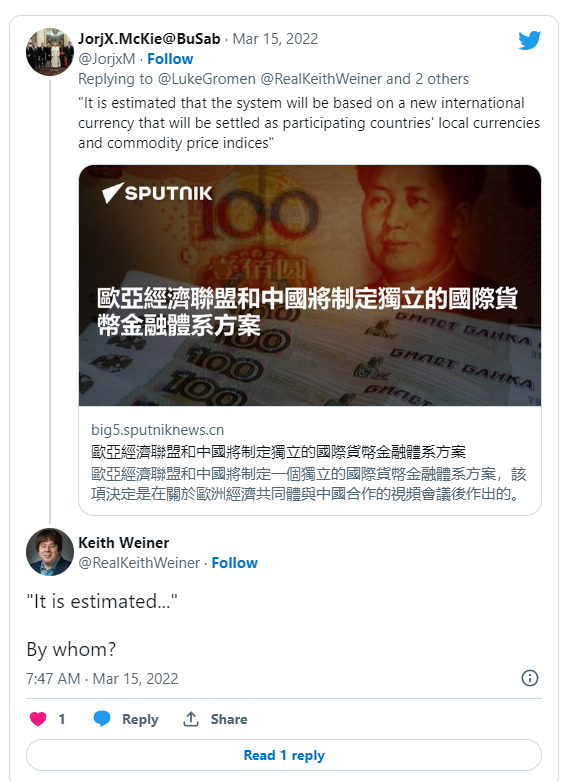
Please consider my March 15, 2022 post The Yuan Will Not Replace the US Dollar, Nor Will It Be Backed by Commodities
Like clockwork, rumors of the dollar's demise surface several times a year. Let's investigate the latest rumors.
Here we go again. Wake me up when China floats the yuan, has a large bond market, and is willing to run trade deficits.
This is precisely what the Saudi source meant by this is "not yet the right time".
Pricing unit is irrelevant
Meanwhile, I assure you oil trades for euros.
Regardless, the trading currency is meaningless. It's the holding currency that matters. Currencies are fungible. It makes no difference where a swap happens.
For example, it makes no difference if Europe sells euros for dollars to buy oil, or if Saudi takes euros and one second later converts them to dollars.
A swap for yuan does not work because the yuan does not float nor is there a big Chinese bond market to challenge US treasuries.
This oil in euros idea spawned endless silliness about oil for euros being the reason for the Gulf Wars.
US Dollar weaponized
Despite my cautions above regarding the yuan specifically, a day of reckoning is coming.
For discussion, please see Unprecedented Fed Action May Have Just Started a Global Currency Crisis
The Federal Reserve Act mandates that the Federal Reserve conduct monetary policy "so as to promote effectively the goals of maximum employment, stable prices, and moderate long-term interest rates."
Click on the link for the complete act. Nowhere does the act give the Fed the right or power to confiscate the reserves of sovereign nations.
But that is exactly what the Fed did.
In one quick order the Fed electronically rendered Russia's foreign dollar reserves worthless, or at least unusable for now.
Currency Crisis
Over the past several years I would occasionally make a statement that were headed for a currency crisis. Every time people would ask "What will that look like?" I would answer, "I don't know."
Today, I have a different answer: "Read this post and understand what's going on." A derivatives blowup of some sort is another possibility.
We are not at a full blown crisis stage yet. And perhaps we do not get there this time.
But when trade wars like these start, history suggests major wars often follow.
Make no mistake, the US is at already war right now, but it's economic. These trade actions and central bank sanctions are the electronic equivalent of a naval blockade.
The Fed took an unprecedented as well as illegal action on Russia that constitutes economic warfare and may easily start a currency crisis or something even worse.
It makes sense for countries to avoid US dollar confiscation. For now, avoiding dollars is still very difficult in practice for reasons stated in this post.
Author

Mike “Mish” Shedlock's
Sitka Pacific Capital Management,Llc
Mike “Mish” Shedlock is a registered investment advisor for SitkaPacific Capital Management.