The dollar is the only winner on the stage today

Outlook:
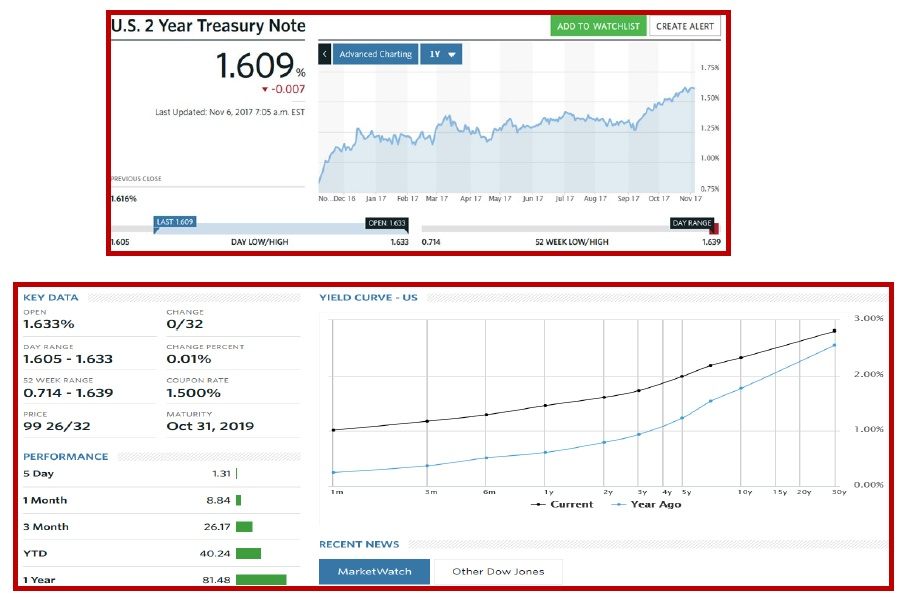
This seems to one of those times when the dollar is stronger despite a dip in yields, at least the 10-year. In fact, today's quote at 2.331% is nearing the recent low of 2.277% on Oct 13, but nowhere close to the spike low at 2.039% from Sept 7. And as analysts like to point out, the 2-year is a better gauge, anyway, and there we see strong support. MarketWatch shows a gain of 39.83 bp year-to-date and 81.07 bp y/y.
Is this sufficient justification for a dollar dally? Yes, probably, especially given that an exodus from emerging market securities of all stripes is just beginning to form. We have not yet seen a rush to the exits, but Venezuela's default coming hot on the heels of troubles in Turkey is probably the beginning of something. Note that the comparable 2-year in Germany is a negative. All the macroeconomic com-parisons in the world favoring the eurozone can't overcome that negative.
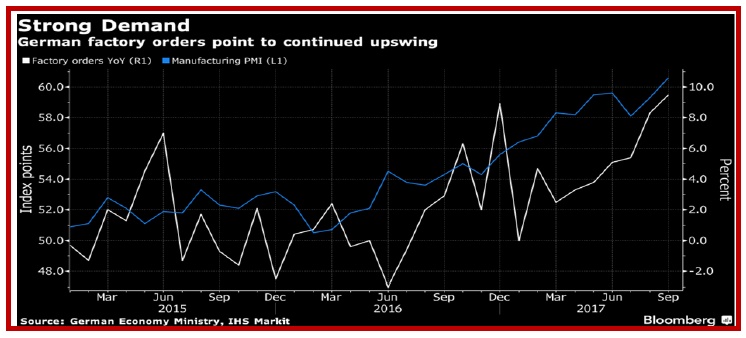
And just look at German growth! The factory orders today suggest that on a macro comparison, Germa-ny is in far better shape than the US. The implication is that a negative 2-year yield is inconsistent with conditions
Elsewhere in the emerging market world, nobody knows the eventual outcome of the Saudi arrests/detainment of dozens of officials, businessmen and princes, but they demonstrate the resolve and claim on power of Prince Salman, who says he wants two things of importance on the global stage—output cuts and non-oil energy independence, and a more moderate version of Islam. Good luck moving from the 8th century to the 21st in one fell swoop. This is a Very Big Deal in the grand scheme of things. It's so big nobody has yet dared to comment on what it might mean and where it might go.
Something else that a Very Big Deal is the UK sinking into irrelevancy. Giving up a seat at the EU ta-ble is a historic move that is like a form of controlled suicide, according to an observer quoted in the NYT. Brexit was revenge for the Tony Blair policies that brought in so many migrants and destroyed forever the self-image of a nation with a strong identity. "Britain — renowned for its pragmatism, its common sense, its political stability and its unabashed devotion to small business ("a nation of shop-keepers") — has become nearly unrecognizable to its European allies. ‘People need to look again at Britain,' said Daniel Brössler, a correspondent for the German daily Süddeutsche Zeitung. ‘It's no longer the country they understood it to be their whole lives.'
"The divorce negotiations with the European Union start another round this week, but they are not go-ing well, to say the least. The most visible fight is over the cost of the divorce. But other difficult and essentially political issues about the authority of the European Court of Justice and a customs border with Ireland must also be clarified before the other 27 member states agree to move on to the next stage, Britain's future relationship with the bloc. That decision next month once seemed pro forma, but no longer, with some even predicting a breakdown in the talks."
As noted above, yesterday BoE chief Carney gave a TV interview yesterday in which he said the BoE can't cut rates if Brexit goes to the worst scenario. Supply will be so constrained that inflation will rise. The current expectation is for two more hikes over the next three years, assuming Brexit goes as planned. But "If we have materially less access than we have now, this economy is going to need to re-orient. During that period of time, it will weigh on growth. This is a fundamental, structural change." Bloomberg adds Carney repeated the economy can grow only about 1.5%, vs. 2.5% before the financial crisis. "Brexit is exacerbating weak productivity growth the U.K. has experienced since the crisis, he said. The central bank predicts that investment will be about 20 percent lower now than it expected be-fore the referendum in June 2016."
Brexit talks resume this Thursday. We have not been following the saga all that closely in part because so many of the players are disagreeable and ridiculous, from Boris to the hapless Corbyn. But now it's going to pay off to attend carefully. If PM May can't recover control from the crowd talking about no deal at all, all is lost. Party splits in another country are always hard for an outsider to fathom, but the no-deal populist version of the future is simply too awful to contemplate. We understand the working class distaste for elite, out-of-touch leadership, but May's efforts to bridge that gap are falling far short from the initial "Brexit means Brexit," meaning acceptance of the popular will. As we have written all along, this is not going to end well. Now we have a catastrophic ending postulated by none other than BoE Gov Carney.
We deduce that the dollar is the only winner on the stage today. The eurozone is trucking along at a zippy pace, but Mr. Draghi promises small and negative rates for more than a year to come. The UK might be falling down a rabbit hole. Japan has the "Japan disease" and no cure in sight. Emerging mar-kets are less appetizing than ever now that the specter of default is back and nobody knows if contagion is around the next corner. There's still the one-man dollar negative of Trump, but Congress says we are getting tax cuts, and analysis saying otherwise is not yet compelling. So that leaves the dollar as a weak safe-haven.
Some say the next crisis will arise from bitcoin and other non-sovereign currencies. We are inclined to agree.
Bitcoin by definition has no "fundamentals"—no P/E, no rate of return, no good faith sovereign back-ing, no utility as food or metals. Like gold, it's not money, since it fails the test of serving as a medium of exchange, although evidently that is changing and some merchants will take fractions of bitcoin in exchange for goods and services. Gold never got to that point.
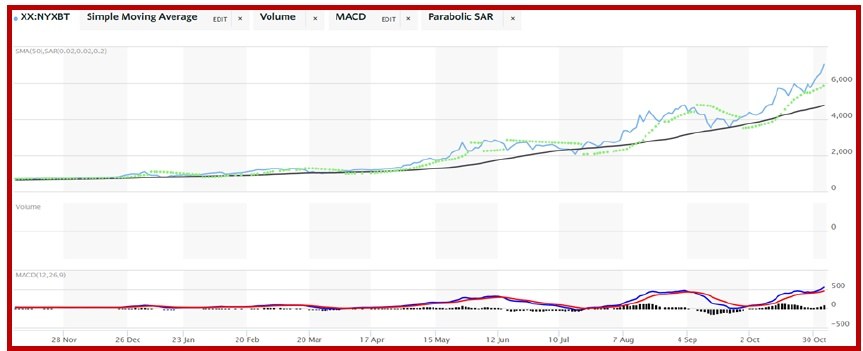
And people will bet on literally anything. Bitcoin is a better's market, but not like dog-racing or poker, because it can be charted. If we have sets of buyers and sellers, plus sufficient liquidity, bitcoin can be traded using technicals alone. In fact, plenty of traders already eschew fundamentals to trade only the chart in many asset classes, including the biggest markets, FX and equities. The absence of fundamen-tals is a fatal flow in establishing anything resembling "fair market value," but it's not a fatal flaw for trading purposes. Besides, fair market value in currencies is 90% bunk, anyway.
See the chart of the NY Bitcoin Index. We can apply any of our standard technical indicators, including our favorite, MACD. We could use the parabolic reversal indicator to sell if and when the current move ends. So far, so good. But we don't have enough history of this "security" to begin to guess how vola-tile it will be and how large the pullbacks and drawdowns. We are reluctantly coming to the conclusion that unless the powers that lie behind bitcoin abscond with the money or there is a tulip-bulb moment, bitcoin is acceptable among the ranks of tradeable "securities."
But don't forget that inside that word securities is the word "security," implying that at least some val-ue is secure. The dictionary definition of security includes freedom from risk, i.e., safety. Security also implies freedom from doubt and possessing "well-founded confidence." Bitcoin and its cousins have none of that.
Prince al-Waleed bin Talal says bitcoin "just doesn't make sense" and is "going to implode one day." You have to wonder if sheer size can do it. A website named visualcapitalist has a chart forwarded by a Reader. It's too big to duplicate here but please go see it. It will blow your mind. Derivatives, including bitcoin, are thousands of times bigger in issuance volume than gold and solver, money supply, real es-tate, central bank balance sheets, and anything else in the financial and economic world you would care to name. We already had one crisis because of derivatives. This chart indicates we are foolish not to expect another.
| Currency | Spot | Current Position | Signal Date | Signal Strength | Signal Rate | Gain/Loss |
| USD/JPY | 113.97 | LONG USD | 10/20/17 | WEAK | 113.35 | 0.55% |
| GBP/USD | 1.3118 | SHORT GBP | 10/03/17 | STRONG | 1.3247 | 0.97% |
| EUR/USD | 1.1605 | SHORT EURO | 10/24/17 | STRONG | 1.1768 | 1.39% |
| EUR/JPY | 132.28 | LONG EURO | 10/20/17 | WEAK | 133.82 | -1.15% |
| EUR/GBP | 0.8846 | SHORT EURO | 10/30/17 | WEAK | 0.8841 | -0.06% |
| USD/CHF | 1.0008 | LONG USD | 09/25/17 | WEAK | 0.9732 | 2.84% |
| USD/CAD | 1.2751 | LONG USD | 09/27/17 | WEAK | 1.2389 | 2.92% |
| NZD/USD | 0.6895 | SHORT NZD | 10/06/17 | STRONG | 0.7088 | 2.72% |
| AUD/USD | 0.7663 | SHORT AUD | 09/25/17 | STRONG | 0.7963 | 3.77% |
| AUD/JPY | 87.35 | SHORT AUD | 10/11/17 | WEAK | 87.35 | 0.00% |
| USD/MXN | 19.0946 | LONG USD | 09/22/17 | WEAK | 17.8066 | 7.23% |
| USD/BRL | 3.2981 | LONG USD | 09/27/17 | WEAK | 3.1670 | 4.14% |
This is an excerpt from “The Rockefeller Morning Briefing,” which is far larger (about 10 pages). The Briefing has been published every day for over 25 years and represents experienced analysis and insight. The report offers deep background and is not intended to guide FX trading. Rockefeller produces other reports (in spot and futures) for trading purposes.
To get a two-week trial of the full reports plus traders advice for only $3.95. Click here!
Author
Barbara Rockefeller
Rockefeller Treasury Services, Inc.
Experience Before founding Rockefeller Treasury, Barbara worked at Citibank and other banks as a risk manager, new product developer (Cititrend), FX trader, advisor and loan officer. Miss Rockefeller is engaged to perform FX-relat