Gold technical analysis: XAU/USD could snowball past its latest 9-month low

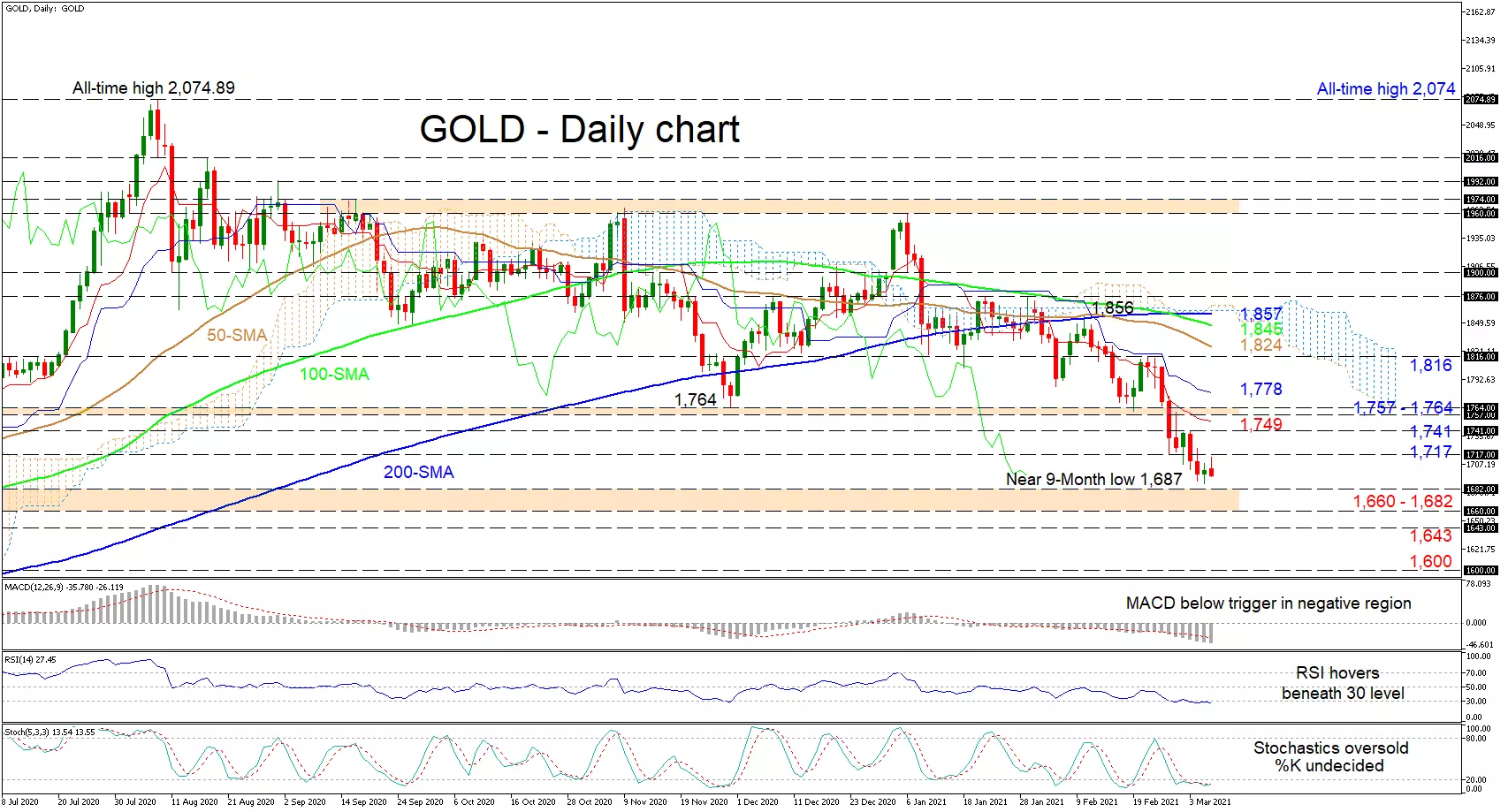
Gold’s negative tendencies are picking up again after the yellow metal found some footing around the level of 1,687, logging a nine-month low, ahead of the significant support zone of 1,660-1,682. The gold scale seems to be tilting increasingly negative, as the bearish Ichimoku lines, which have controlled the commodity from the level of 1,876, are continuing to curb improvements in the price.
The falling 50- and 100-day simple moving averages (SMAs), and their recent bearish crossovers of the 200-day SMA, appear to be bolstering the doom and gloom in the precious metal.
The short-term oscillators are also reflecting stubborn negative sentiment. The MACD is keeping some distance below the zero threshold and is falling underneath its red trigger line, while the RSI, which is trailing beneath the 30 mark, is looking set to dip deeper into oversold territory. The stochastic %K line has yet to signify any pickup in positive momentum, thus the oscillator is giving weight to the downside.
If selling interest persists, the initial deterrent could be the nine-month low of 1,687 ahead of the critical support section of 1,660-1,682, which contains the June 2020 trough of the rally that pushed the commodity to it’s all-time high of 2,074. Should this foundation break apart, the price may dive towards the 1,643 barrier, identified in March 2020, before the bears challenge the 1,600 handle.
Otherwise, if buyers guide the price northwards, first resistance could develop from the 1,717 border ahead of the 1,741 nearby high. Next, the red Tenkan-sen line at 1,749 may provide some friction prior to the key resistance band of 1,757-1,764. Successfully overstepping this too, the bulls may then hit the blue Kijun-sen line at 1,778 before propelling for the 1,816 resistance.
Summarizing, gold’s bearish demeanour could sustain its downward trajectory if the price continues to deteriorate below the SMAs and the Ichimoku lines.
Author

Anthony Charalambous joined XM in 2019 and specializes in preparing daily technical analysis, using his years of trading experience to provide detailed forecasting for all major asset classes such as forex, indices, commodities and equities.