|

SPY breadth and underperforming bonds

S&P 500 defended the post unemployment claims high ground in a no news Friday, market breadth further improved and VIX retreated. Also the opening flush to shake out retail has been weak, and both S&P 500 and Nasdaq overcame Wednesday‘s trappy highs – unlike the Russell 2000. Why did smallcaps have a harder time this week? Following Aug 02 weak non-farm payrolls and Monday‘s rout, odds of 100bp cut by Nov went from 50% a weeka ago to only 13% now, with 75bp newly having 50% odds. Also the 50bp cut for Sep and Nov odds strengthened to 38%, which dampened the appeal of KRE and DIA as well.

Sure, rotation is there – this theme of broadening market breadth ever since the steep recalibration of Jul CPI, is there. In the short-term though, the most interest rate sensitive plays have to wait as good economic news is good for stocks, and slow rise in bond yields isn‘t an issue – the yield curve briefly stopping being inverted, isn‘t concerning as we enter a new week with big inflation data.

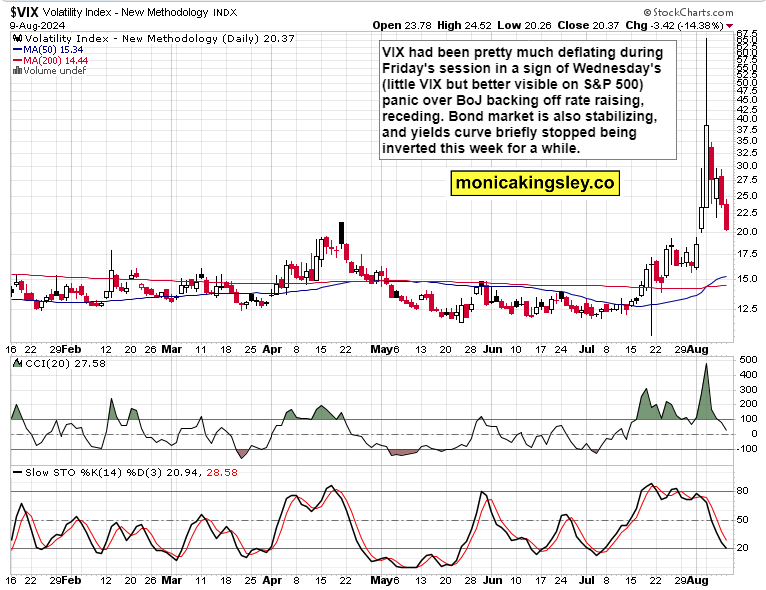
Instead of discussing market breadth and sectoral picks reserved for clients, let‘s feel the evolving bottoming process – including the rising S&P 500 and Nasdaq wedges watchouts – through the VIX and bond market lens. Remembering my Friday‘s words discussing Thursday – „the VIX declined in the end below not just 25, but also 24 – attesting to easing fear in the markets, all accompanied by steeply having risen spread between smart money and dumb money sentiment. Valuable clues.“ And the smart vs. dumb money indicator is one worth paying attention to from medium-term perspective.
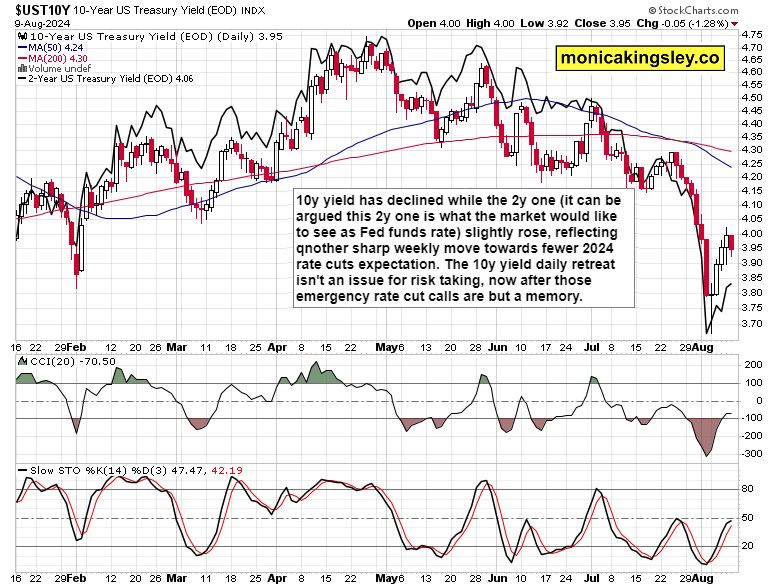
HYG barely rose Friday just as the 10y yield increased, meaning the bond market is at odds with the stock market daily move. Which one has it right in the near and medium term? That‘s also what I answer in the following stock market section.
Author

Monica Kingsley

Monica Kingsley

Monicakingsley

Monica Kingsley is a trader and financial analyst serving countless investors and traders since Feb 2020.


More from Monica Kingsley
Share:

Editor's Picks

GBP/USD defends 1.3300 after strong UK PMI data

Following Thursday's sharp decline, GBP/USD clings to small gains above 1.3300 in the American session on Friday, supported by the upbeat UK Retail Sales and July PMI data. Nevertheless, the pair's upside remains capped as investors cling to a cautious stance amid a further escalation of tensions in the Middle East. The US July PMI data failed to trigger relevant price action.

EUR/USD remains below 1.1400 after mixed US PMIs

EUR/USD pressures daily lows below the 1.1400 mark in the American session on Friday. Mixed S&P Global PMIs, as manufacturing output contracted while services activity expanded in July, triggered no relevant market reaction. The focus remains in Middle East developments and inflation-related concerns.

Gold holds above $4,050 but momentum still missing

Gold builds on its modest intraday bounce and climbs above the $4,050 level on Friday, hitting a fresh daily high amid a modest US Dollar pullback. The fundamental backdrop, however, warrants some caution before confirming that the pullback from an over two-week high, touched on Wednesday, has run its course and positioning for any meaningful upside.

Ethereum: Derivatives interest in ETH improves, but signs of caution remain

Ethereum is hovering slightly below the $1,900 level, down 3% on Thursday following a slight expansion in derivatives interest. The top altcoin's open interest has increased to 14.60 million ETH, marking a 600K ETH increase over the past two days and its highest level since June 7.

XRP retreats as ETF interest cools
Ripple (XRP) slides toward the short-term $1.10 support on Friday, as broader crypto market sentiment weighs on crypto assets. The sell-off mainly stems from fears of inflation in the United States (US) amid the ongoing war in the Middle East and rising Oil prices.
US Dollar mid-year outlook: Exceptional currency, exceptional risks?
The US Dollar enters the second half of 2026 in a markedly different position from a year ago. The King currency has recovered, reflecting persistent US inflation, changing expectations for Fed policy, geopolitical tensions and renewed demand for defensive assets.