Silver demand outstrips supply for third straight year

Silver demand outstripped supply for the third straight year in 2023.
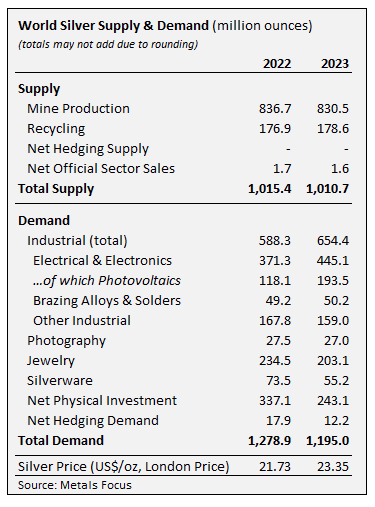
Silver mine output fell by 1 percent to 830.5 million ounces last year, according to the final data released by the Silver Institute.
Meanwhile, total silver demand also dropped, declining about 7 percent to 1.2 billion ounces. But the decline came off a record year in 2022.
Even with softer overall demand, the silver market charted a significant structural deficit of 184.3 million ounces.
This comes on the heels of a 2022 production shortfall that the Silver Institute called “possibly the most significant deficit on record.” It also noted that “the combined shortfalls of the previous two years comfortably offset the cumulative surpluses of the last 11 years.”
Industrial Silver demand sets a record
While silver demand was down in many sectors, industrial demand of 654.4 million ounces set a record in 2023. According to the Silver Institute, ongoing structural gains from green economy applications underpinned these advances.
"Higher than expected photovoltaic (PV) capacity additions and faster adoption of new-generation solar cells raised global electrical & electronics demand by a substantial 20 percent. At the same time, other green-related applications, including power grid construction and automotive electrification, also contributed to the gains.
Chinese silver industrial demand rose by a remarkable 44 percent to 261.2 million ounces, primarily due to growth for green applications.
The green energy revolution is expected to continue to drive industrial silver offtake higher in the years ahead.
Due to its outstanding electrical conductivity, silver is an important element in the production of solar panels. It is used to conduct electrical charges out of the solar cell and into the system. Each solar panel only uses a small amount of silver, but with the demand for solar panels growing exponentially every year, those small amounts of silver add up.
According to a research paper by scientists at the University of New South Wales, solar manufacturers will likely require over 20 percent of the current annual silver supply by 2027. By 2050, solar panel production will use approximately 85–98 percent of the current global silver reserves.
Recession worries would typically dampen industrial demand for silver, but the photovoltaic industry is essentially recession-proof due to support from governments around the world. With battling climate change a priority, it is highly unlikely investment in solar power and other green energy technologies will fall, even during an economic downturn.
Falling investment demand drove the overall drop in silver offtake last year. Physical bar and coin demand fell off by almost one-third to a three-year low of 243.1 million ounces. According to the Silver Institute, all significant markets saw losses, but the decline was particularly acute in Germany (-73 percent). This was due to a Value Added Tax increase to kick off 2023. Most other Western markets also saw steep declines due to cost-of-living issues and range-bound prices. Meanwhile, record-high local silver prices in India drove profit-taking throughout most of the year.
Demand for silver jewelry was also down last year, falling by 13 percent to 203.1 million ounces. The decline was concentrated in India, with demand easing after a record in 2022. Excluding India, total global losses were modest at 3 percent.
Looking ahead at Silver demand in 2024
The Silver Institute projects total silver demand will grow by a healthy 2 percent in 2024.
"Industrial fabrication should post another all-time high, rising by 9 percent, propelled by an anticipated 20 percent gain in the PV market and healthy offtake from other industrial segments. Jewelry and silverware fabrication are predicted to rise by 4 and 7 percent, respectively, while bar & coin demand is forecast to contract by 13 percent.
Meanwhile, supply is projected to contract by about 1 percent.
If the market plays out as expected, we'll see another significant market shortfall this year, totaling somewhere in the neighborhood of 215 million ounces. That would rank as the second-largest market deficit in more than 20 years.
To receive free commentary and analysis on the gold and silver markets, click here to be added to the Money Metals news service.
Author

Mike Maharrey
Money Metals Exchange
Mike Maharrey is a journalist and market analyst for MoneyMetals.com with over a decade of experience in precious metals. He holds a BS in accounting from the University of Kentucky and a BA in journalism from the University of South Florida.
















