|

Portugal: Write-offs are the main tool for the cleaning up of bank balance sheets

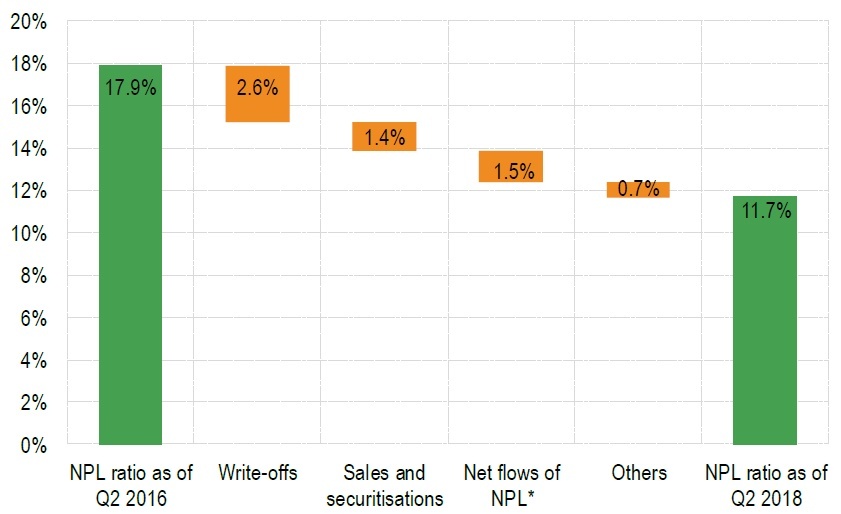
The Portuguese banking system's non-performing loan ratio continued to decline, to 11.7% as of Q2 2018 (and 11.3% as of Q3 2018), after peaking at 17.9% as of Q2 2016. This 6.2 percentage points contraction in the NPL ratio is mainly due to a nearly 40% reduction in non-performing loans outstanding amount, compared to a 2.1% decline in total loans outstanding amount.

According to the Bank of Portugal's data, 42% of the decline in the NPL ratio is due to write-offs. Sales and securitisations accounted for 23% of the ratio's decline. Nearly two thirds of the cleaning up of Portuguese bank balance sheets occurred via the removal of non-performing loans from the banking system.

Moreover, the reclassification of NPL as "performing loans" more than offset the flow of loans that turn non-performing. The net flow of non-performing loans contributed to a 24% reduction in the NPL ratio.
NPL

Breakdown of the decline in the NPL ratio in Portugal between Q2 2016 and Q2 2018 *Net flows of non-performing loans correspond to the difference between loans turning non-performing and NPL reclassified as "performing loans", as well as amortisations and foreclosures. The remaining 0.7% is, for example, linked to net flows of performing loans.

Download The Full Ecoflash

Author

BNP Paribas Team

BNP Paribas Team

BNP Paribas

BNP Paribas Economic Research Department is a worldwide function, part of Corporate and Investment Banking, at the service of both the Bank and its customers.


More from BNP Paribas Team
Share:

Markets move fast. We move first.

Orange Juice Newsletter brings you expert driven insights - not headlines. Every day on your inbox.

By subscribing you agree to our Terms and conditions.

Editor's Picks

EUR/USD trims gains, nears 1.1700

The EUR/USD pair eases in the American afternoon and approaches the 1.1700 mark. The pair surged earlier in the day after the ECB left interest rates unchanged and upwardly revised inflation and growth figures. The US CPI rose 2.7% YoY in November, nearing Fed’s goal.

GBP/USD returns to 1.3370 after BoE, US CPI

The GBP/USD pair jumped towards the 1.3440 early in the day, following the BoE decision to cut rates, and US CPI data, which was much softer than anticipated. The US Dollar, however, managed to regain the ground lost during US trading hours.

Gold extends its consolidative phase around $4,330

The bright metal cannot attract speculative interest on Thursday, despite central banks announcements and the United States latest inflation update. XAU/USD is stuck around $4,330, confined to a tight intraday range.

Crypto Today: Bitcoin, Ethereum hold steady while XRP slides amid mixed ETF flows

Bitcoin eyes short-term breakout above $87,000, underpinned by a significant increase in ETF inflows. Ethereum defends support around $2,800 as mild ETF outflows suppress its recovery. XRP holds above at $1.82 amid bearish technical signals and persistent inflows into ETFs.

Bank of England cuts rates in heavily divided decision

The Bank of England has cut rates to 3.75%, but the decision was more hawkish than expected, leaving market rates higher and sterling slightly stronger. It's a close call whether the Bank cuts again in February or March.

Ripple holds $1.82 support as low retail demand weighs on the token

Ripple (XRP) is trading between a key support at $1.82 and resistance at $2.00 at the time of writing on Thursday, reflecting the lethargic sentiment in the broader cryptocurrency market.












