Nonfarm Payrolls Preview: sour numbers to have limited impact of Fed's decision

The US Nonfarm Payroll monthly report is once again around the corner, with market players heading into it with low expectations amid the hurricanes that tore Texas and Florida in the month, causing extreme damages and halting activity in many sectors for several days. The US economy is expected to have added 90,000 new jobs during September, well below this year's average, although the unemployment rate is expected to remain unchanged at 4.4%. Wages are expected to have posted a modest advance monthly basis, up 0.3% from previous 0.1%, while year-on-year average hourly earnings are seen unchanged at 2.5%. Low wages are a drag on the US economy, as they imply inflation will remain subdued.
Ahead of the event, the ADP employment survey showed that the private sector added 135,000 new jobs in the month, slightly above the expected 125K, but well below previous, downwardly revised to 228K. The reading was the lowest since October 2016, a first sign of warning over the outcome of the Nonfarm Payroll report.
The weekly unemployment claims report came in better-than-expected, giving the greenback a short-term boost ahead of the data, as claims were of 260K in the week ended September 29th, below market's expectations.
Anyway, and despite a possible setback in jobs' creation, the sector had a healthy performance for multiple years, and a noisy report that everyone is already pricing in should have a limited impact on the US Federal Reserve´s decisions. Chances of a rate hike next December stand around 72% ahead of the report. If the numbers are a big disappointment, and particularly with wages down, the greenback could edge lower against the EUR, the JPY and the AUD, the most affected from rising hopes of a rate hike in the US. A strong jobs report, with wages' growth included, on the other hand, should favor the greenback against all of its major rivals, but with the rally being probably less interesting in terms of pips' moves.
EUR/USD levels to watch
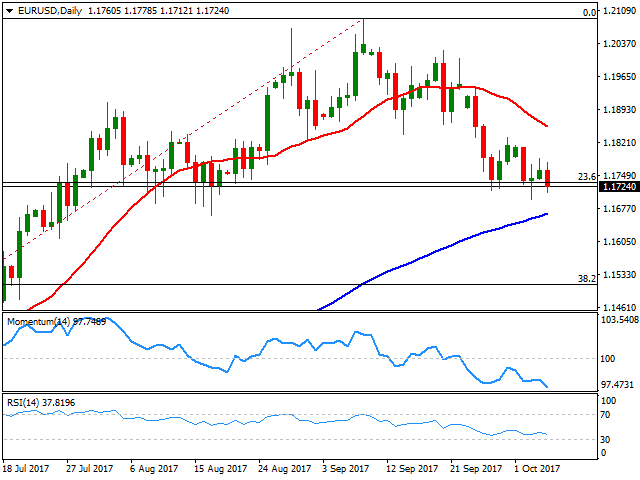
Ever since topping for the year at 1.2092 last September, the EUR/USD pair entered a bearish spiral that is set to continue according to technical readings in the daily chart, although in the wider outlook, the decline is seen as corrective, with the pair currently struggling around the 23.6% of its March/September advance. Nevertheless, technical indicators in the mentioned chart present a strong downward momentum within bearish territory, as the price holds a few pips above its multi-week low of 1.1695 and not far above August low of 1.1660. The 100-DMA converges with this low, making this level a critical support, as a break below it will open doors for a test of the 38.2% retracement of the same rally around 1.1520, en route to 1.1460 a major static support, a possible bearish target for the upcoming week.
In the same chart, the weekly high was set at 1.1814, while the 20-DMA heads lower at 1.1856, being the main resistance levels in the case of a highly disappointing report. To turn positive and resume its former bullish trend, the pair would need at least to close the week above 1.1920, highly unlikely at this point.
Author

Valeria Bednarik
FXStreet
Valeria Bednarik was born and lives in Buenos Aires, Argentina. Her passion for math and numbers pushed her into studying economics in her younger years.















