Nonfarm Payrolls Preview: Layoffs spreading or another blockbuster month? Three scenarios for the US Dollar
- Economists expect the United States to report 200,000 job gains in December 2022.
- Tech layoffs may have affected the broader economy, hurting the labor market and weighing the US Dollar.
- The Nonfarm Payrolls has beaten expectations in the past eight releases.

Time for a reality check? Higher inflation and rising interest rates have hit the housing sector – and maybe it is time to hit the labor market. On the other hand, Nonfarm Payrolls (NFP) have exceeded economists' estimates in the past eight months, so another positive surprise cannot be ruled out.
The US jobs report release for December 2022 – to be published by the US Bureau of Labor Statistics (BLS) on Friday, January 6th at 13.30 GMT – is the first top-tier release of 2023 and a critical one, as the Federal Reserve (Fed) faces a dilemma about tightening its monetary policy. Here are three scenarios.
1) Around 200,000, within expectations
Economists expect an increase of 200,000, which would be lower than the 263,000 reported for November but still represent a healthy expansion in the labor market. Before the pandemic, American jobs grew by just under 200,000 a month.
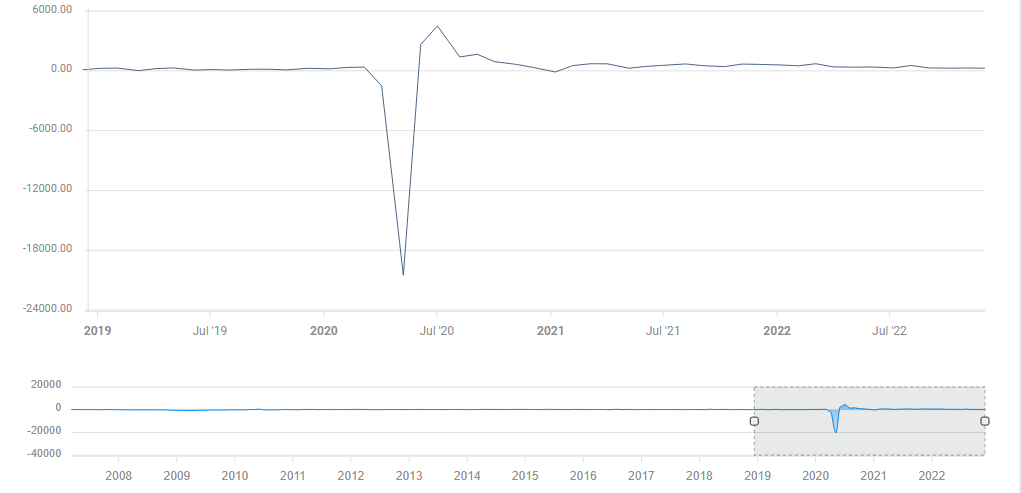
Source: FXStreet
While such expansion is positive for workers, in the current tight labor market, it would be too high for the Fed. The central bank is focused on "non-shelter core services inflation." This mouthful of a term refers to price rises that are 1) Not Energy and Food, but volatile items affected by global markets 2) Not Housing, which is updated with a lag 3) And not Goods’ prices, which are falling.
This non-shelter core services inflation refers to activities such as accounting, gardening, hairdressing, medical visits, etc – inflation related to wages, which are on the up. To see salary growth cooling, the labor market would need to expand at a pace of under 100,000 or even suffer job losses.
In such an "as-expected" scenario, markets would wobble, and the US Dollar could gain some ground in response to uncertainty about the Fed's next moves. The Greenback attracts safe-haven flows. However, many investors would likely keep their powder dry ahead of next week's all-important Consumer Price Index (CPI) report.
The Dollar could reverse its gains after the initial knee-jerk reaction.
I give this scenario a low probability, as the NFP rarely meets expectations and tends to defy reality.
2) The upbeat scenario, another 250K+ report
America's job market is on fire – that has been the message from Nonfarm Payrolls, weekly jobless claims and also the JOLTs job openings reports. There are still some 1.7 vacancies for every jobseeker, and shortages refuse to relent. That is the reason for expecting a stronger-than-expected NFP.
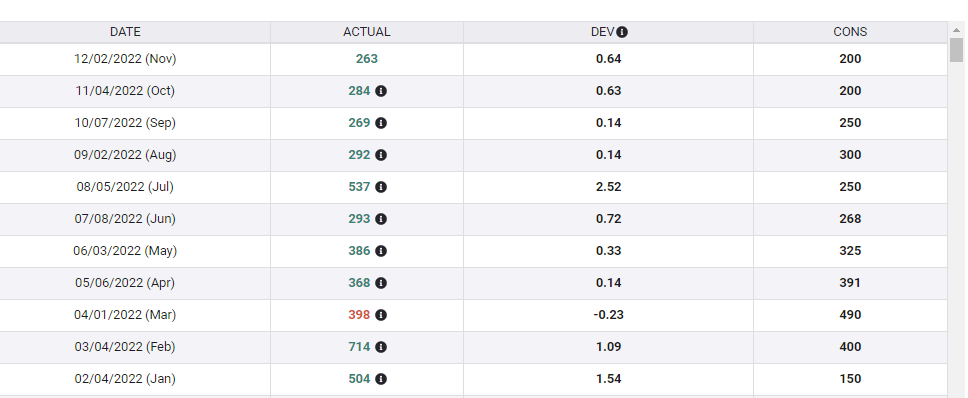
Another reason is the chart below:
Source: FXStreet
The headline Nonfarm Payrolls beat expectations in almost all of 2022's releases. The only miss, so far, was back in March, but since then eight consecutive reports beat estimates. Will economists be proven too pessimistic once again?
The consistently low weekly jobless claims figures point to another upbeat report, defying projections of around 200,000 jobs gained – just like in the publications for October and November.
I give this scenario a medium probability, mostly based on the data's winning streak. But there is other data to look at.
3) The gloomy scenario, sub-100K or worse
It is not only Facebook's parent company – some 100,000 were laid off in the tech sector in recent months. Some find it hard to shed tears for highly paid programmers, and some have surely found other jobs. Nevertheless, their layoffs also affect other people in the industry and beyond. This accumulation might begin showing up in the data.
Another reason to expect a weaker outcome stems from the discrepancy between the two surveys the Bureau of Labor Statistics publishes within the Nonfarm Payrolls report. The Establishment Survey is behind the headline NFP, and it has been robust. On the other hand, the Household Survey is used for calculating the Unemployment Rate, and has shown little job growth since March 2022.
The jobless rate is only at 3.7%. Still, it comes on top of a drop in the participation rate related to lingering long COVID, early retirement and perhaps leftovers of "The Great Resignation."
Will the Establishment Survey get closer with the Household Survey and show not-that-great job growth? It hasn't happened so far, but revisions of previous figures could show a less-flattering outcome.
If the United States reports an increase of fewer than 100,000 jobs or even a loss of positions, the US Dollar will dive and stocks will rally on hopes of an early end to the Fed's tightening cycle. Price action would be swift without waiting for inflation figures. It would put jobs more firmly in the spotlight.
This scenario is highly probable as job gains exceeding pre-pandemic levels cannot run forever.
Final Thoughts
The last Nonfarm Payrolls for 2022 is critical for the Fed's next meeting, and perhaps this report will be gloomy, a fitting end to the festive season. Nevertheless, surprises in both directions are common.
I highly recommend lowering leverage around this event, which can turn into a "whipsaw effect" – an initial reaction in one direction and then a full reversal of that move.
Author

Yohay Elam
FXStreet
Yohay is in Forex since 2008 when he founded Forex Crunch, a blog crafted in his free time that turned into a fully-fledged currency website later sold to Finixio.