NFPs and Scalping

Non-Farm Payrolls (NFPs) are probably the most important leading indicator in the US economy, in anticipation of CPI and GDP results. The predominant measure of economic performance, as elaborated in various previous posts, is consumption and investment. The more people are employed, the more a nation will spend and hence the higher economic growth will be, as measured by GDP. In addition, the higher the employment in a country, the more likely it is for firms and entrepreneurs to invest, as demand for the goods and services they will produce will be higher, and hence the higher aggregate investment will be. In contrast, if less people are employed then spending will be much less, demand will drop, and investment will be much lower.
The NFPs provide exactly this type of information. The indicator measures the change in the number of employed people across all US sectors, excluding farming. The reason for excluding the farming sector is that it is, almost by definition, affected by factors which are not due to economic conditions, such as weather and seasonality in crops. In addition, the agricultural sector has only a small contribution to the overall US GDP. With regards to its importance, it is not just that NFPs have a strong fundamental interpretation. In addition, the fact that it comes out just a few days into a new month allows us to use it as a leading indicator for the future of the US economy. To this end, volatility tends to be very high during the time when NFPs are out.
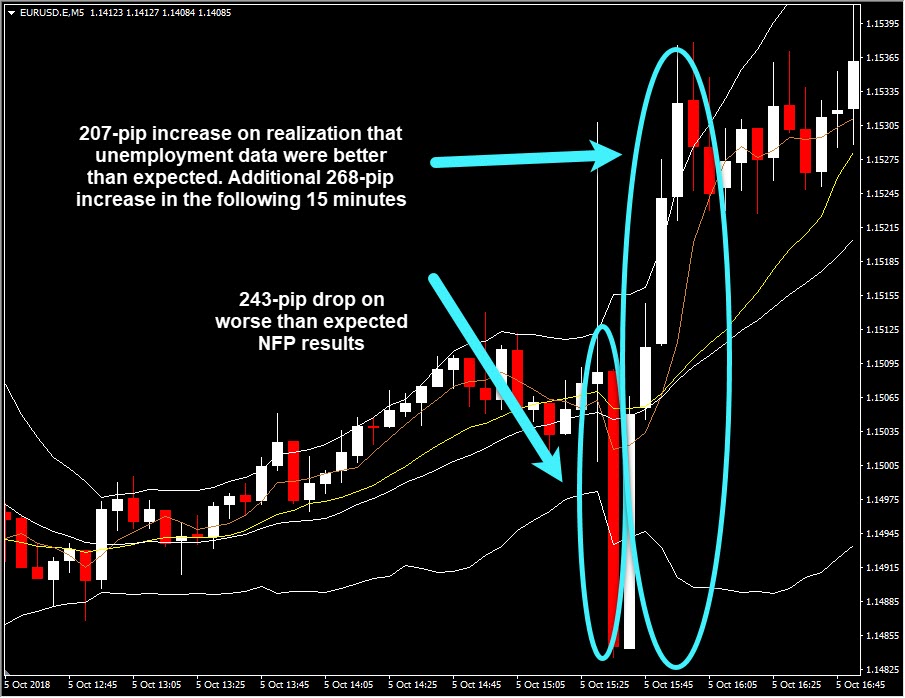
Let’s have a look at what happened in the latest NFP release. The first image of this post, using a 5-minute frequency, suggests that as NFPs came out worse than expected, at 134,000 compared to expectations of 185,000, due to the hurricane season. As a result, the Dollar dipped, but only for a while as markets then saw that the unemployment rate was lower than expected, leading to a Dollar appreciation of 243 pips, just 10 minutes after the announcement. Following that rather unexpected reaction, markets realized that NFPs matter more than the unemployment rate and the Euro started to rally, by a total of 473 pips. This pattern is also evident in the 1-minute chart below.
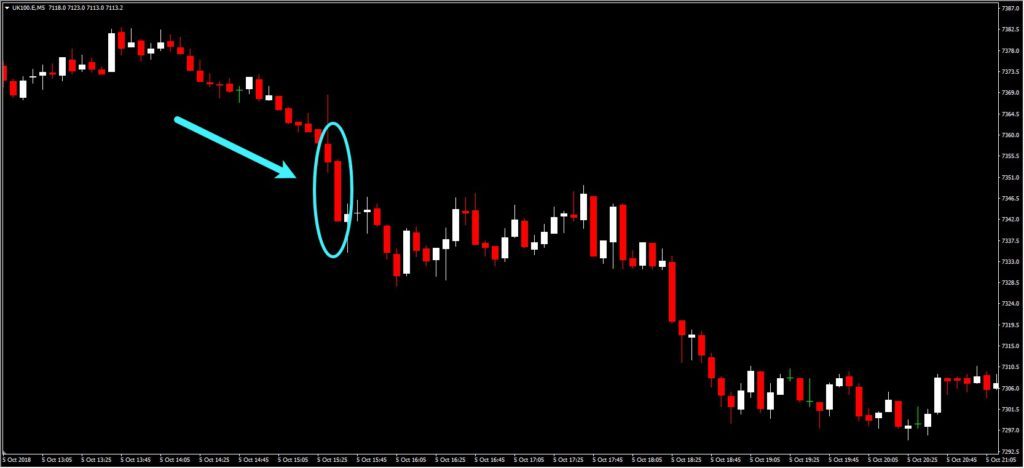
The stock market also moved strongly upon the event, as the USA100 dropped by 0.2% just five minutes after the reaction. As the index showed, the stock market was faster to interpret the negative news, as the reaction was negative and persistent, reaching 0.6% by GMT 18:00 on the same day. As such, day traders could also take advantage of this development. In general, all US-related markets react heavily to NFP releases. However, the amount of the reaction depends on whether the NFP release and the other labour market data point to the same direction or whether they differ. As such, traders need to conduct proper risk management so that they are able to cover their losses if the market suddenly moves against them.

Author

With more than 4 years of experience at the Central Bank of Cyprus where he obtained hands-on experience with real-life economics, Dr Nektarios Michail is a supporter of a balanced approach between science and art when it comes to