|

Largest increase in margin debt since 2007 fuels stock market

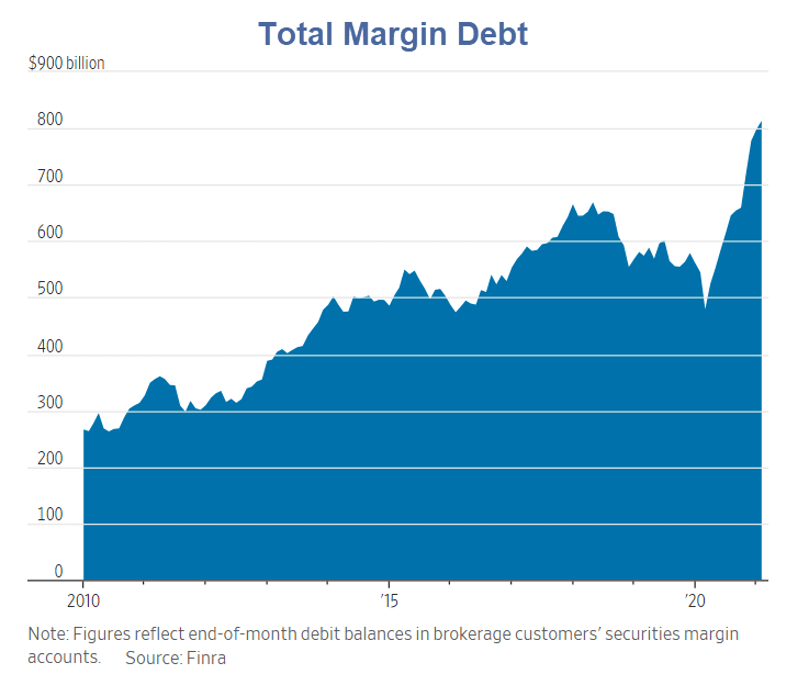
Margin debt is on the fastest rise since 2007 and before that, 1999, right before the dotcom bubble burst.

Everything Rally 

The "Everything Rally" is underway, fueled by borrowed money.

As of late February, investors had borrowed a record $814 billion against their portfolios, according to data from the Financial Industry Regulatory Authority, Wall Street’s self-regulatory arm. That was up 49% from one year earlier, the fastest annual increase since 2007, during the frothy period before the 2008 financial crisis. Before that, the last time investor borrowings had grown so rapidly was during the dot-com bubble in 1999.

Best Quotes

  • “It fuels bull markets and it exacerbates bear markets and to a certain extent you put it on the list of irrational exuberance,” said Edward Yardeni, president of consulting firm Yardeni Research. “The further that this stock market goes, the higher that margin debt will go, and when something blows up that will be one of the factors for why stocks are going down.” 
  • “Speculative short-term trading is always risky, but mixing it with unfamiliar products and markets, leverage, and advice from anonymous individuals is a recipe for disaster,” the CFTC said.
  • “The lack of transparency in this market makes it not possible for the average market participant to know what is going on,” said Josh Galper, managing principal of Finadium, a research and advisory firm. 

The article points out that some of the borrowing may be for other things such as vacations.

Regardless, it's very risky business.

Once again people have been trained that stocks only go up. 

Author

Mike “Mish” Shedlock's

Mike “Mish” Shedlock's

Sitka Pacific Capital Management,Llc

Mike “Mish” Shedlock is a registered investment advisor for SitkaPacific Capital Management.

More from Mike “Mish” Shedlock's
Share:

Editor's Picks

GBP/USD treads water just below 1.3300

GBP/USD alternates gains with losses just below 1.3300 the figure on Tuesday. Indeed, Cable struggles to build recovery momentum as the Greenback benefits from a cautious market mood ahead of the Fed’s meeting on Wednesday and the BoE’s gathering on Thursday.

EUR/USD turns positive past 1.1370

EUR/USD rebounds from earlier multi-week lows and flirts with the 1.1380 zone, up marginally for the day on Tuesday. Uncertainty surrounding the US-Iran conflict weighs on risk sentiment and caps the pair’s upside, while investors avoid taking large positions ahead of the highly anticipated Fed meeting on Wednesday.

Gold closes in on $4,000 ahead of FOMC decision

Gold (XAU/USD) maintains its offered on Tuesday and declines toward the $4,000 psychological level. This follows the previous day's failure to find acceptance above the $4,100 mark and suggests that the path of least resistance for the bullion remains to the downside amid a bullish US Dollar (USD), which draws support from escalating geopolitical tensions ahead of the cricital FOMC meeting.

Bitcoin slips below $64,000 as risk-off sentiment grips markets
Bitcoin (BTC) is extending its correction, trading below $64,000 at the time of writing on Tuesday after losses of over 2.5% the previous day. Institutional demand shows early signs of weakness, with spot Exchange Traded Funds (ETFs) recording a mild outflow on Monday, marking three consecutive days of withdrawals.
Indian Rupee outlook: Downtrend set to persist – Just at a slower pace
The Indian Rupee just endured its most brutal six-month stretch in years, battered by a perfect storm of global shocks. From United States (US)-India trade uncertainty to surging Oil prices and the significant outflow of Foreign Institutional Investment (FII) from the Indian stock market, every event brought nothing but pain for the Indian currency.
US Dollar mid-year outlook: Exceptional currency, exceptional risks?
The US Dollar enters the second half of 2026 in a markedly different position from a year ago. The King currency has recovered, reflecting persistent US inflation, changing expectations for Fed policy, geopolitical tensions and renewed demand for defensive assets.