|

IMF Cuts 2019 Global Growth Forecasts Again: "We Have No Idea," Says Lagarde

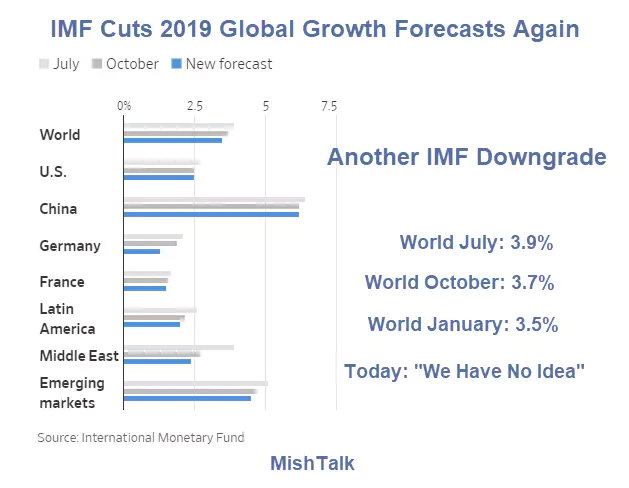
For the fourth time since October, the IMF revised its global growth forecast lower.

The Wall Street Journal reports IMF Lowers 2019 Global Growth Forecast.

The global economy is starting the year on weaker footing, according to new quarterly forecasts from the International Monetary Fund.

The global economy is starting the year on weaker footing, according to new quarterly forecasts from the International Monetary Fund.

That report was on January 21. For details, see the IMF's World Economic Outlook Update, January 2019.

Today, Lightening Bolts and Clouds

Please consider IMF Warns of Global Economic "Storm" as Growth Undershoots.

Last month, the IMF lowered its global economic growth forecast for this year from 3.7 percent to 3.5 percent.

Lagarde cited what she called "four clouds" as the main factors undermining the global economy and warned that a "storm" might strike.

The risks include "trade tensions and tariff escalations, financial tightening, uncertainty related to (the) Brexit outcome and spillover impact and an accelerated slowdown of the Chinese economy", she said.

Lagarde said trade tensions -- mainly in the shape of a tariff spat between the United States and China, the world's two biggest economies -- are already having a global impact.

"We have no idea how it is going to pan out and what we know is that it is already beginning to have an effect on trade, on confidence and on markets," she said, warning governments to avoid protectionism.

Lagarde also pointed to the risks posed by rising borrowing costs within a context of "heavy debt" racked up by governments, firms and households.

"When there are too many clouds, it takes one lightning (bolt) to start the storm," she said.

"We Have No Idea"

The IMF is perpetually far behind the curve. It never sees the clouds or the lightening bolts in real time.

It's refreshing to hear Lagarde say "we have no idea". The IMF should say that every month.

Author

Mike “Mish” Shedlock's

Mike “Mish” Shedlock's

Sitka Pacific Capital Management,Llc

Mike “Mish” Shedlock is a registered investment advisor for SitkaPacific Capital Management.

More from Mike “Mish” Shedlock's
Share:

Editor's Picks

AUD/USD sticks to positive bias above 0.7100; lacks bullish conviction

AUD/USD trades with a positive bias for the second straight day, holding above 0.7100 in the Asian session on Friday as softer US bond yields keep US Dollar bulls on the back foot. Furthermore, hawkish RBA Governor Bullock's comments boost rate hike bets and support the Aussie. However, the Fed's hawkish outlook, along with geopolitical uncertainties, limits USD losses and caps the pair.

USD/JPY approaches 158.00 as Japanese Yen resumes decline

USD/JPY is resuming its upside in the European session on Friday, refreshing two-week highs and nearing 158.00. The Japanese Yen extends losses, despite the Bank of Japan's (BoJ) expected rate hike to 1.25% and hawkish Governor Ueda's comments, as two surprise dissents against the rate hike weigh on it.

Gold keeps the bid tone in place; still below $4,400

Gold adds to the optimism seen in the second half of the week, trading with decent gains just below the $4,400 mark per troy ounce on Friday. The precious metal’s advance finds traction in declining crude oil prices and fresh selling pressure on the US Dollar.

Why altcoin season isn't coming back — and what stole its capital
If, after two years of being frozen in ice, Katara and Sokka woke you up to the crypto market, it would seem like 100 years have passed. With Bitcoin soaring to record highs just over a year ago, everyone expected a routine altcoin season, where investors take profits from the top crypto to chase higher returns in altcoins.
BoJ Recap: Not as hawkish as expected

The BoJ raised its short-term interest-rate target to 1.25% from 1.00% in a 7-2 vote, marking another step in the normalisation of monetary policy and widely matching what everyone has been expecting for weeks. Governor Kazuo Ueda said the policy phase had changed.

BoJ Recap: Not as hawkish as expected

The Bank of Japan (BoJ) raised its short-term interest-rate target to 1.25% from 1.00% in a 7-2 vote, marking another step in the normalisation of monetary policy and widely matching what everyone has been expecting for weeks.













