Gold’s double bottom not enough for an outlook reversal [Video]
![Gold’s double bottom not enough for an outlook reversal [Video]](https://editorial.fxstreet.com/images/Markets/Commodities/Metals/Gold/gold-on-weight-scale-gm165418687-21879510.jpg)
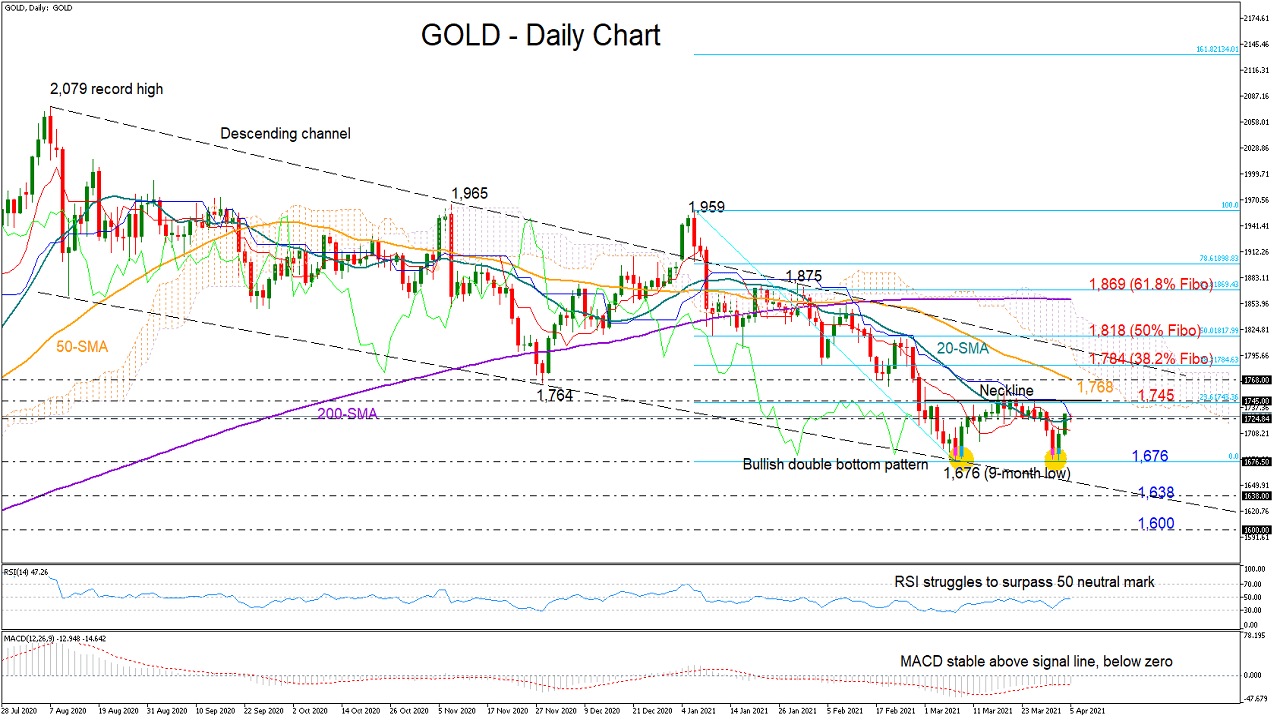
Gold has created a potential double bottom pattern around 1,676, raising hopes that a bullish trend reversal could be in progress. Traders, however, should be cautious as the blue Kijun-sen line continues to cap upside corrections, while the RSI seems to be struggling to crawl above its 50 neutral mark despite its rebound off the oversold area. The MACD keeps hovering above its red signal line and within the negative region, backing that narrative too.
A confirmation of the bullish structure could come above the 1,745 neckline, where the 23.6% Fibonacci of the 1,959 – 1,676 down leg is placed. Still, such an action may not be enough to reverse the downward pattern in the broader picture unless the price rallies beyond its previous high of 1,875, crossing above the 61.8% Fibonacci, too. Before that, the 50-day simple moving average (SMA) at 1,768, the upper band of the descending channel near the 38.2% Fibonacci of 1,784, and the 50% Fibonacci of 1,818 could set a rocky path ahead.
It is also worthy to note that the distance between the 50- and 200-day SMAs keeps widening following the bearish intersection between the lines in mid-February.
Alternatively, only a break below 1,676 is needed to extend the ongoing downtrend towards the lower band of the channel around 1,650. If the latter fails to act as support, with the yellow metal tumbling below 1,638 too, the next pivot point could occur near the 1,600 round-level.
In brief, gold is trying to set the stage for a bullish trend reversal through a double bottom pattern. An outlook upgrade, however, may be a tough task in the bigger picture, as the price should push harder to advance above 1,875 in order to achieve it.
Author

Christina joined Trading Point in May 2017. She holds a master degree in Economics and Business from the Erasmus University Rotterdam with a specialization in International economics.