Gold Weekly Forecast: XAU/USD looks at US inflation data for further upside amid overbought conditions
- Gold closed the third consecutive week in positive territory.
- XAU/USD technical outlook points to extremely overbought conditions.
- February inflation data will be featured in the US economic calendar next week.

Gold (XAU/USD) gathered bullish momentum and reached a new record high above $2,180 this week, boosted by falling US Treasury bond yields and the broad-based selling pressure surrounding the US Dollar (USD). The pair stays technically overbought ahead of next week’s key inflation data from the US.
Gold price posted largest one-week gain since October
After ending the previous week on a bullish note by surging nearly 2% on Friday, Gold started the new week on a firm footing. After XAU/USD climbed above $2,100, technical buyers showed interest and helped the pair push higher.
The data from the US showed on Tuesday that the ISM Services PMI edged lower to 52.6 in February from 53.4 in January. The Prices Paid Index, the inflation component of the PMI survey, dropped to 58.6 from 64, while the Employment Index slumped to 48 and highlighted a decline in service sector payrolls. The benchmark 10-year US Treasury bond yield broke below 4.2% and the USD came under selling pressure after this data, allowing Gold to preserve its bullish momentum.
Federal Reserve (Fed) Chairman Jerome Powell presented the semi-annual Monetary Policy Report and testified before the House Financial Services Committee on Wednesday. Powell repeated that incoming data will determine when they will start reducing the policy rate and explained that they would like to have greater confidence inflation will move sustainably toward 2% before taking a policy action. When asked about the economic outlook, Powell said that there was no reason to think the economy was "in or facing a significant near-term risk of recession." Although Powell refrained from providing a fresh clue regarding the timing of the policy pivot, he didn’t shut the door to a rate cut in June. In turn, risk flows dominated the financial markets mid-week, triggering another leg of broad USD weakness, which led to an extended uptrend in Gold.
Early Thursday, China, the world’s biggest consumer of Gold, reported that the trade surplus widened to $125.16 billion in the January-February period from $75.43 billion in December. This reading surpassed the market expectation of $103.7 billion and allowed XAU/USD to stretch higher during the Asian trading hours. In the second half of the day, the 10-year US yield dropped to its weakest level in a month below 4.1% after the US Bureau of Labor Statistics (BLS) revised the fourth-quarter Unit Labor Costs lower to 0.4% from 0.5% in the initial estimate. Additionally, the US Department of Labor reported that there were 217,000 Initial Jobless Claims in the week ending March 12, matching the previous week’s print. Gold closed the seventh consecutive trading day in positive territory on Thursday and reached a new all-time high above $2,160.
Nonfarm Payrolls in the US rose by 275,000 in February, the BLS reported on Friday. This reading surpassed the market expectation of 200,000. On a negative note, January’s increase of 353,000 was revised lower to 229,000. Other details of the jobs report showed that the Unemployment Rate rose to 3.9% from 3.7%, while the Labor Force Participation Rate held steady at 62.5%. The USD came under renewed selling pressure with the initial reaction and Gold advanced beyond $2,180.
Gold price could have a short-lasting reaction to inflation data
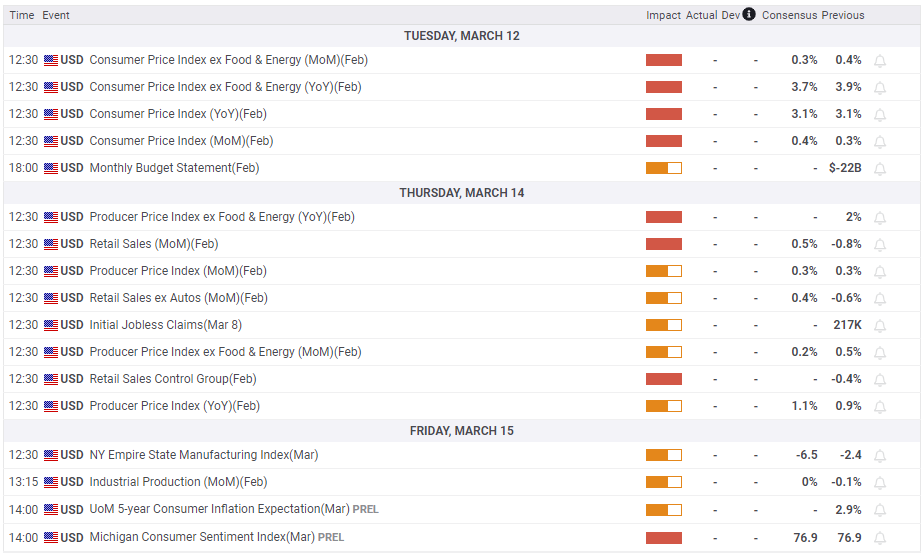
The BLS will release Consumer Price Index data for February on Tuesday. On a monthly basis, the CPI and the Core CPI, which excludes volatile food and energy prices, are forecast to rise 0.4% and 0.3%, respectively.
The CME FedWatch Tool shows that markets are pricing in a nearly 80% probability that the Fed will lower the policy rate in June, while the odds of a 25 basis points rate reduction in May holds around 25%.
Ahead of the June meeting, investors will have three more CPI releases, excluding February, to assess. Hence, the February CPI reading is unlikely to alter the market positioning in a significant way. Only a monthly Core CPI print close to 0% could revive expectations for a rate cut in May and further weigh on the USD. Although a strong Core CPI increase in February is unlikely to make market participants lean toward a no-change in the Fed interest rate in June, the initial reaction could trigger a downward correction in XAU/USD, given the USD’s oversold nature.
The US economic docket will feature February Retail Sales on Thursday and the Fed will publish February Industrial Production data on Friday.
In the meantime, the Fed will be in the blackout period ahead of the March 19-20 monetary policy meeting. Following Tuesday’s inflation data, investors could shift focus to technical developments in XAU/USD for trading opportunities.
Gold price technical outlook
Gold broke above the upper limit of the ascending regression channel coming from October and the Relative Strength Index (RSI) indicator on the daily chart rose to its highest level since August 2020 above 80, highlighting extremely overbought conditions. Although it might be risky to bet against Gold in the current market environment, investors could look for opportunities to liquidate their long positions. The $2,140 level (former record-high) aligns as first support before $2,120 (upper limit of the ascending channel) and $2,100 (psychological level, midpoint of the ascending channel).
It’s difficult to set bullish targets for XAU/USD because it’s trading in uncharted territory. On the upside, the $2,200 round level could act as a psychological resistance.

Author

Eren Sengezer
FXStreet
As an economist at heart, Eren Sengezer specializes in the assessment of the short-term and long-term impacts of macroeconomic data, central bank policies and political developments on financial assets.