Gold Weekly Forecast: XAU/USD sets fresh highs as investors focus on geopolitics
- Gold hit yet another historic peak following a short-lasting correction.
- XAU/USD ignores rising US yields and broad USD strength.
- The technical outlook shows that Gold remains extremely overbought.

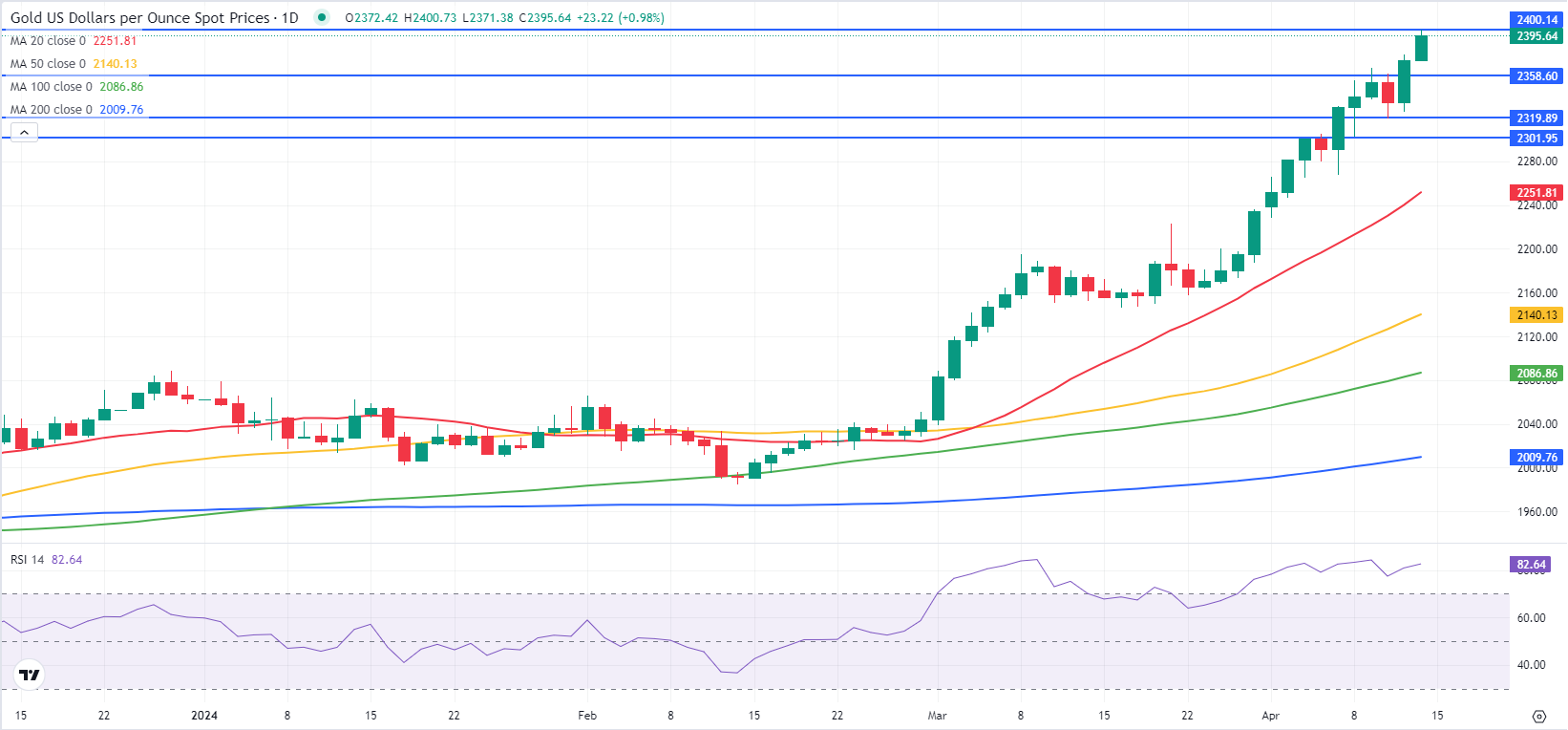
Gold price (XAU/USD) looked like it was on the verge of a deep correction on Wednesday but it gathered bullish momentum in the second half of the week, advancing to a fresh all-time high above $2,400. In the absence of high-tier data releases from the US, growth data from China and geopolitical developments could impact Gold’s valuation next week.
Gold rally continued despite surging US yields this week
Gold started the new week on a bullish note and closed the first two trading days of the week in positive territory. As the trading action remained relatively subdued ahead of the key inflation data from the US, however, XAU/USD’s gains remained limited.
The US Bureau of Labor Statistics (BLS) reported on Wednesday that annual inflation, as measured by the change in the Consumer Price Index (CPI), rose to 3.5% in March from 3.2% in February. This reading came in above the market expectation of 3.4%. Details of the report showed that the CPI and the core CPI, which excludes volatile food and energy prices, both increased 0.4% on a monthly basis. The benchmark 10-year US Treasury bond yield surged to its highest level since mid-November above 4.5% and the USD Index climbed to five-month tops above 105.00 after inflation readings, triggering a downward correction in Gold.
The probability of the Federal Reserve (Fed) leaving the policy rate unchanged in June jumped to nearly 80% from 40% before the CPI data release, according to the CME FedWatch Tool. In turn, XAU/USD fell nearly 1% and registered daily losses on Wednesday, just for the second day in the last two weeks.
Although the USD preserved its strength on Thursday, escalating geopolitical tensions allowed Gold to regather bullish momentum. Iran has promised to retaliate, blaming Israel for the attack on its consulate in Syria earlier in the month and reviving fears over a deepening conflict in the Middle East.
The European Central Bank (ECB) maintained its key rates after the April policy meeting on Thursday. Citing three sources, Reuters reported that on Thursday that ECB policymakers were on track to lower the policy rate in June. The sharp upsurge seen in the XAU/EUR pair showed that Gold captured capital outflows out of the Euro. The pair trades at a record high above €2,200 and it’s up about 9% in April after gaining nearly 10% in March.
As markets sought refuge ahead of the weekend, Gold continued to push higher and rose above $2,400. In addition to risk-aversion, central bank buying is thought to be another driver behind Gold’s unprecedented rally. “The fundamentals underpinning the current rally include growing geopolitical risk, steady central bank buying and resilient demand for jewelry and bars and coins,” World Gold Council said in its monthly report published earlier this week.
Gold investors stay focused on geopolitics
Retail Sales for March will be the only noteworthy data featured in the US economic calendar next week. On a monthly basis, Retail Sales are forecast to rise 0.3% following the 0.6% increase recorded in February. In case there is a negative print, the immediate reaction could cause the USD to weaken slightly.
In the Asian session on Tuesday, Gross Domestic Product (GDP) data for the first quarter from China will be watched closely by market participants. The Chinese economy is forecast to grow at an annual rate of 5%, down from the 5.2% expansion registered in the fourth quarter of 2023. A disappointing GDP print from China, the world’s biggest consumer of Gold, could cause concerns over the yellow metal’s demand outlook and limit XAU/USD’s upside in the short term.
Meanwhile, investors will remain focused on geopolitical developments. A de-escalation of the conflict in the Middle East could trigger a deep correction in Gold. On the other hand, XAU/USD is likely to continue to find support in a risk-averse market environment, even if the USD continues to outperform its rivals on growing expectations for a delay in the Fed policy pivot.

Gold technical outlook
Gold remains extremely overbought, with the Relative Strength Index (RSI) indicator on the daily chart holding well above 70. This week’s action, however, reaffirmed that investors have been paying little to no attention to technical developments. It’s not an easy task to set up bullish targets for Gold, given that it continues to trade in uncharted territory. In case the precious metal stabilizes above $2,400 and confirms that level as support, buyers could have confidence for another leg higher toward the next psychological level at $2,500.
On the downside, interim support is located at $2,360 (static level, former resistance) before $2,320 (April 10 low) and $2,300 (psychological level, static level).
Gold FAQs
Gold has played a key role in human’s history as it has been widely used as a store of value and medium of exchange. Currently, apart from its shine and usage for jewelry, the precious metal is widely seen as a safe-haven asset, meaning that it is considered a good investment during turbulent times. Gold is also widely seen as a hedge against inflation and against depreciating currencies as it doesn’t rely on any specific issuer or government.
Central banks are the biggest Gold holders. In their aim to support their currencies in turbulent times, central banks tend to diversify their reserves and buy Gold to improve the perceived strength of the economy and the currency. High Gold reserves can be a source of trust for a country’s solvency. Central banks added 1,136 tonnes of Gold worth around $70 billion to their reserves in 2022, according to data from the World Gold Council. This is the highest yearly purchase since records began. Central banks from emerging economies such as China, India and Turkey are quickly increasing their Gold reserves.
Gold has an inverse correlation with the US Dollar and US Treasuries, which are both major reserve and safe-haven assets. When the Dollar depreciates, Gold tends to rise, enabling investors and central banks to diversify their assets in turbulent times. Gold is also inversely correlated with risk assets. A rally in the stock market tends to weaken Gold price, while sell-offs in riskier markets tend to favor the precious metal.
The price can move due to a wide range of factors. Geopolitical instability or fears of a deep recession can quickly make Gold price escalate due to its safe-haven status. As a yield-less asset, Gold tends to rise with lower interest rates, while higher cost of money usually weighs down on the yellow metal. Still, most moves depend on how the US Dollar (USD) behaves as the asset is priced in dollars (XAU/USD). A strong Dollar tends to keep the price of Gold controlled, whereas a weaker Dollar is likely to push Gold prices up.
Author

Eren Sengezer
FXStreet
As an economist at heart, Eren Sengezer specializes in the assessment of the short-term and long-term impacts of macroeconomic data, central bank policies and political developments on financial assets.