Gold Weekly Forecast: Further gains hinge on US interest-rate outlook as Fed officials return to stage
- Gold snapped a three-week losing streak after finding support near $2,300.
- The near-term technical outlook is yet to point to a buildup of bullish momentum.
- Comments from Fed policymakers will be scrutinized by market participants next week.

Gold (XAU/USD) registered limited gains this week, supported by safe-haven flows and soft inflation data from the US. In the absence of high-impact macroeconomic data releases ahead, investors will pay close attention to technical developments in XAU/USD and comments from Federal Reserve (Fed) officials.
Gold buyers hesitate to bet on a decisive rally
Following the sharp decline seen in the previous Friday on strong labor market data from the US, Gold corrected higher and closed in positive territory on Monday. As markets adopted a cautious stance ahead of key macroeconomic events from the US, XAU/USD registered small gains on Tuesday.
The Bureau of Labor Statistics reported on Wednesday that inflation in the US, as measured by the change in the Consumer Price Index (CPI), edged lower to 3.3% on a yearly basis in May from 3.4% in April. The annual core CPI, which excludes volatile food and energy prices, rose 3.4%, compared to analysts' estimate of 3.5%. On a monthly basis, the CPI stood unchanged, while the core CPI was up 0.2%. Gold gathered bullish momentum and climbed above $2,340 as the USD came under heavy selling pressure with the immediate reaction to soft inflation readings.
Later in the American session, the Fed announced that it left the policy rate unchanged at 5.25%-5.5%, as widely anticipated. The revised Summary of Economic Projections published alongside the policy statement, the so-called dot plot, implied one 25 basis points (bps) rate cut in 2024, less than the three cuts projected by the same officials in March. According to the underlying details of the dot plot, four of 19 policymakers saw no rate cuts in 2024, seven projected a 25 bps reduction, while eight marked down a 50 bps cut in the policy rate. The hawkish revision to the SEP helped the USD find support and caused Gold to pull away from daily highs.
In the post-meeting press conference, Fed Chairman Jerome Powell acknowledged the encouraging inflation data for May but said that they need to see more "good data" to bolster their confidence on inflation sustainably moving toward the 2% target. Powell refrained from offering any clues on the timing of a policy pivot, reiterating the data-dependent approach to policy.
As the USD continued to erase the losses it suffered following the CPI data, Gold lost its traction on Thursday and stretched lower. In the second half of the day, the BLS announced the Producer Price Index (PPI) rose 2.2% on a yearly basis in May. On a monthly basis, the PPI declined 0.2%, while the core PPI remained unchanged. Other data from the US showed that the number of first-time applications for unemployment benefits jumped to 242,000 in the week ending June 8 from 229,000 a week earlier. Although disappointing data releases capped the USD’s rebound, XAU/USD failed to gather recovery momentum.
XAU/USD regained its traction on Friday even as the USD gathered bullish momentum. The risk-averse market atmosphere helped Gold find demand. Additionally, the precious metal captured capital outflows out of the Euro (EUR) amid growing political concerns following the European Parliament election. After posting losses for three consecutive weeks, XAU/EUR surged higher and gained more than 2% this week.
Gold investors will scrutinize comments from Fed officials
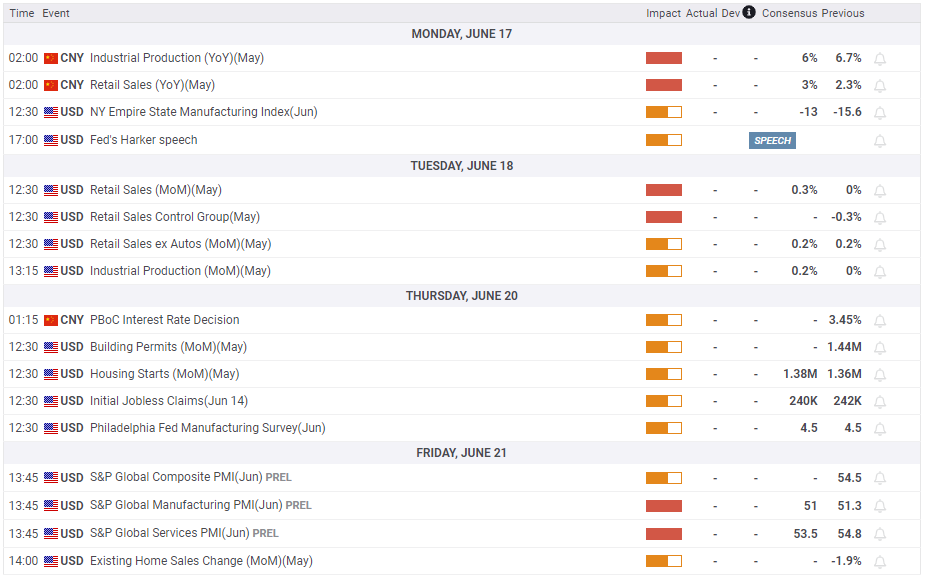
Industrial Production and Retail sales figures from China could drive Gold’s valuation at the beginning of the week. In case these data come in better than expected, XAU/USD could edge higher on growing optimism for an improving demand outlook.
On Tuesday, the US Census Bureau will release May Retail Sales and the Fed will publish Industrial Production data for May. The market reaction to Retail Sales data is likely to be straightforward, with a disappointing reading hurting the USD and helping Gold gain traction and an upbeat print having the opposite impact.
On Friday, S&P Global will publish preliminary Manufacturing, Services and Composite PMI data for June. In May, PMI surveys showed that business activity in the private sector continued to expand at a moderate pace. If the Composite PMI drops into contraction territory below 50, the USD could come under selling pressure ahead of the weekend.
With the Fed’s blackout period coming to an end after the June policy meeting, policymakers will be allowed to comment on the policy outlook. The CME FedWatch Tool shows that markets are pricing in a nearly 70% probability of at least a 25 bps rate cut in September. In case Fed officials push back against the market expectation of a policy pivot before the end of the year, US Treasury bond yields could push higher and make it difficult for XAU/USD to keep its footing. On the other hand, Gold is likely to attract buyers if policymakers voice support for rate two cuts, in September and December.
Gold technical outlook
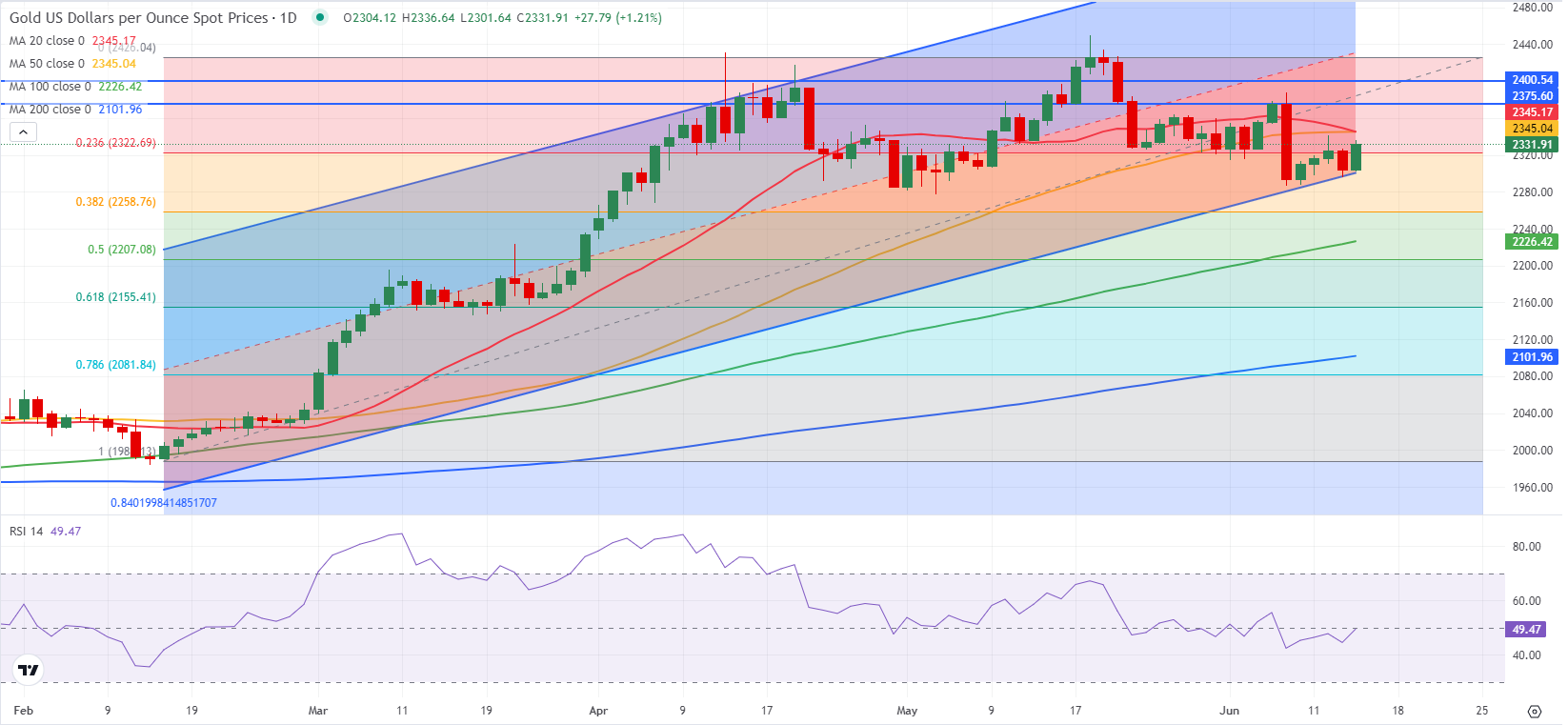
Although Gold managed to stay within the ascending regression channel coming from mid-February, the Relative Strength Index (RSI) indicator on the daily chart is yet to rise above 50 in a decisive way, reflecting the lack of bullish momentum.
On the upside, the 20-day and the 50-day Simple Moving Averages (SMA) form a first resistance at $2,345. In case XAU/USD flips that level into support, technical buyers could take action. In this scenario, $2,380 (static level) could be seen as the next hurdle before $2,400 (psychological level, static level).
Looking south, $2,300 (psychological level, lower limit of the ascending channel) aligns as first support. If Gold falls below this level and fails to reclaim it, $2,260 (Fibonacci 38.2% retracement of the mid-February-June uptrend) and $2,230 (100-day SMA) could be set as the next bearish targets.
Gold FAQs
Gold has played a key role in human’s history as it has been widely used as a store of value and medium of exchange. Currently, apart from its shine and usage for jewelry, the precious metal is widely seen as a safe-haven asset, meaning that it is considered a good investment during turbulent times. Gold is also widely seen as a hedge against inflation and against depreciating currencies as it doesn’t rely on any specific issuer or government.
Central banks are the biggest Gold holders. In their aim to support their currencies in turbulent times, central banks tend to diversify their reserves and buy Gold to improve the perceived strength of the economy and the currency. High Gold reserves can be a source of trust for a country’s solvency. Central banks added 1,136 tonnes of Gold worth around $70 billion to their reserves in 2022, according to data from the World Gold Council. This is the highest yearly purchase since records began. Central banks from emerging economies such as China, India and Turkey are quickly increasing their Gold reserves.
Gold has an inverse correlation with the US Dollar and US Treasuries, which are both major reserve and safe-haven assets. When the Dollar depreciates, Gold tends to rise, enabling investors and central banks to diversify their assets in turbulent times. Gold is also inversely correlated with risk assets. A rally in the stock market tends to weaken Gold price, while sell-offs in riskier markets tend to favor the precious metal.
The price can move due to a wide range of factors. Geopolitical instability or fears of a deep recession can quickly make Gold price escalate due to its safe-haven status. As a yield-less asset, Gold tends to rise with lower interest rates, while higher cost of money usually weighs down on the yellow metal. Still, most moves depend on how the US Dollar (USD) behaves as the asset is priced in dollars (XAU/USD). A strong Dollar tends to keep the price of Gold controlled, whereas a weaker Dollar is likely to push Gold prices up.
Author

Eren Sengezer
FXStreet
As an economist at heart, Eren Sengezer specializes in the assessment of the short-term and long-term impacts of macroeconomic data, central bank policies and political developments on financial assets.