Gold Weekly Forecast: Struggling for momentum as traders trim Federal Reserve rate cut bets
- Gold fell sharply after breaking below $2,400, snapped a two-week winning streak.
- The near-term technical perspective highlights a loss of bullish momentum.
- PCE inflation data and comments from Fed officials could drive XAU/USD’s action next week.

After setting a new all-time high at the beginning of the week at $2,450, Gold (XAU/USD) staged a deep correction and extended its slide after breaking below $2,400 on Wednesday. Comments from Federal Reserve (Fed) policymakers and the US Personal Consumption Expenditures (PCE) Price Index data for April scheduled next week could affect XAU/USD’s price action.
Technical sellers took action after Gold dropped below $2,400
News of Iran’s President Ebrahim Raisi and Foreign Minister Hossein Amir-Abdollahian dying in a helicopter crash in Iran's East Azerbaijan caused geopolitical tensions to escalate at the beginning of the week. As a result, Gold benefited from safe-haven flows and touched a new record high of $2,450 in the early trading hours of the Asian session. As market mood started to improve later in the day, however, XAU/USD retraced a large portion of its daily rally and closed modestly higher on Monday.
In the absence of high-impact data releases, hawkish comments from Federal Reserve (Fed) policymakers helped the US Dollar (USD) stay resilient against its rivals on Tuesday, making it difficult for Gold to keep its footing. Atlanta Fed President Raphael Bostic said that the Fed has to be cautious about the first interest rate move, adding that it may need to be later in order to not stoke pent-up exuberance for investment and other spending. Meanwhile, Fed Governor Christopher Waller noted that he needs to see several more months of good inflation data before being comfortable to support an easing in the monetary policy.
On Wednesday, Gold continued to stretch lower, pressured by the recovering US Treasury bond yields. After dropping below the key $2,400 level, technical sellers took action and caused XAU/USD to push lower. Later in the day, the minutes of the Federal Reserve's April 30-May 1 policy meeting showed that some policymakers were willing to reconsider rate increases if necessary, not allowing Gold to recover.
The data published by S&P Global showed on Thursday that the business activity in the private sector expanded at its strongest pace in more than two years in May. S&P Global Composite PMI rose to 54.4 from 51.3 in April, while the Services PMI and Manufacturing PMI improved to 54.8 and 50.9, respectively. Commenting on the surveys’ findings, “the US economic upturn has accelerated again after two months of slower growth, with the early PMI data signalling the fastest expansion for just over two years in May,” said Chris Williamson, Chief Business Economist at S&P Global Market Intelligence and added: “The data put the US economy back on course for another solid GDP gain in the second quarter.” The USD continued to gather strength following the PMI data and Gold slumped to its weakest level in two weeks below $2,330 in the American session.
The modest improvement seen in risk mood capped USD's gains and helped Gold find a foothold heading into the weekend.
Gold investors shift focus to more Fedspeak, key inflation data
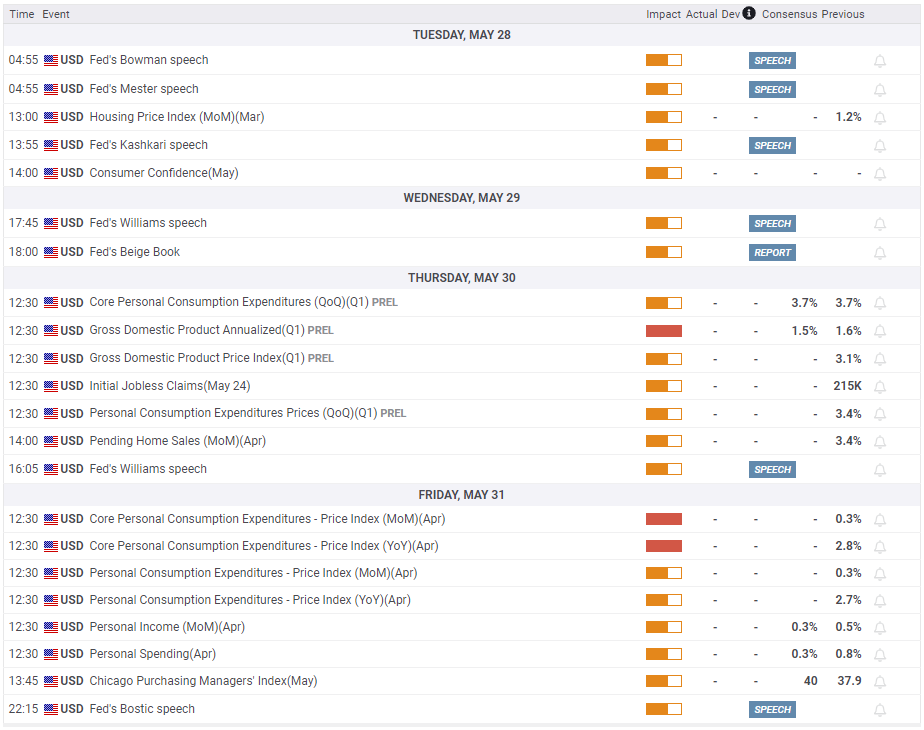
The US economic docket will not offer any high-impact data releases in the first half of next week. Hence, market participants will pay close attention to comments from Fed policymakers. The CME FedWatch Tool currently shows markets are pricing in a nearly 50% probability that the Fed will leave the policy rate unchanged in September. In case Fed officials signal that they are likely to wait until toward the end of the year and look for several consecutive months of favorable inflation data before lowering the policy rate, the market positioning suggests that the USD could gather further strength and drag XAU/USD lower.
On Thursday, the US Bureau of Economic Analysis (BEA) will release the second estimate of the first-quarter Gross Domestic Product data. A positive revision to this data could support the USD.
The Personal Consumption Expenditures (PCE) Price Index data for April, the Fed’s preferred gauge of inflation, will be published by the BEA on Friday. On a monthly basis, the core PCE Price Index rose 0.3% in March. An increase of 0.4% or higher in the monthly core PCE Price Index in April could feed into expectations for a no change in the Fed policy rate in September and provide a boost to the USD heading into the weekend. On the other hand, a reading at or below 0.2% could revive optimism about disinflationary progress resuming and fuel a leg higher in Gold.
Gold technical outlook
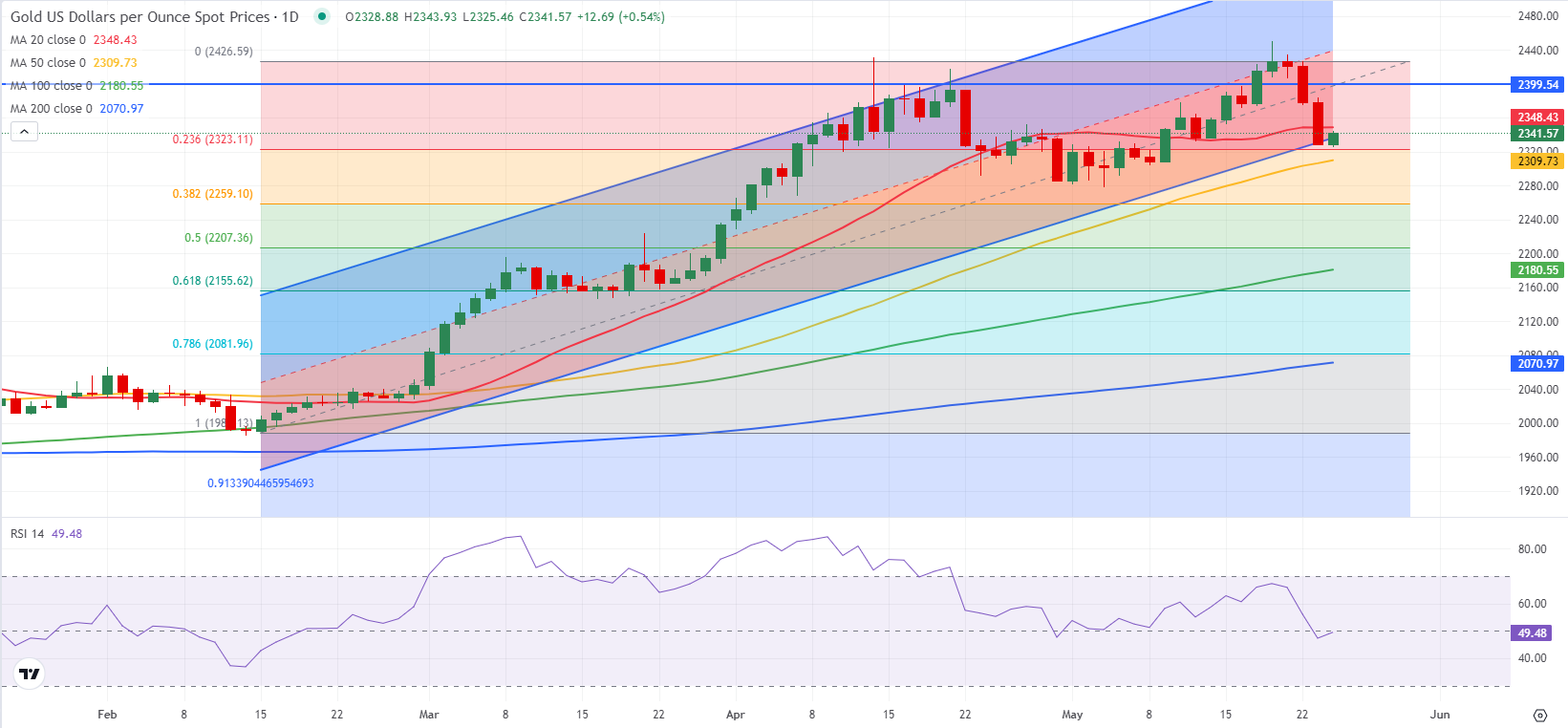
On the daily chart, the Relative Strength Index (RSI) indicator declined toward 50 and Gold fell to the lower limit of the ascending regression channel coming from mid-April, reflecting the loss of bullish momentum.
On the downside, immediate support is located at $2,320 (Fibonacci 23.6% retracement from the mid-April movement) before $2,310-$2,300 (50-day Simple Moving Average (SMA), psychological level) and $2,260 (Fibonacci 38.2% retracement).
On the other side, $2,400 (psychological level, static level) aligns as strong resistance before $2,440-$2,450 (mid-point of the ascending channel, all-time high).
Gold FAQs
Gold has played a key role in human’s history as it has been widely used as a store of value and medium of exchange. Currently, apart from its shine and usage for jewelry, the precious metal is widely seen as a safe-haven asset, meaning that it is considered a good investment during turbulent times. Gold is also widely seen as a hedge against inflation and against depreciating currencies as it doesn’t rely on any specific issuer or government.
Central banks are the biggest Gold holders. In their aim to support their currencies in turbulent times, central banks tend to diversify their reserves and buy Gold to improve the perceived strength of the economy and the currency. High Gold reserves can be a source of trust for a country’s solvency. Central banks added 1,136 tonnes of Gold worth around $70 billion to their reserves in 2022, according to data from the World Gold Council. This is the highest yearly purchase since records began. Central banks from emerging economies such as China, India and Turkey are quickly increasing their Gold reserves.
Gold has an inverse correlation with the US Dollar and US Treasuries, which are both major reserve and safe-haven assets. When the Dollar depreciates, Gold tends to rise, enabling investors and central banks to diversify their assets in turbulent times. Gold is also inversely correlated with risk assets. A rally in the stock market tends to weaken Gold price, while sell-offs in riskier markets tend to favor the precious metal.
The price can move due to a wide range of factors. Geopolitical instability or fears of a deep recession can quickly make Gold price escalate due to its safe-haven status. As a yield-less asset, Gold tends to rise with lower interest rates, while higher cost of money usually weighs down on the yellow metal. Still, most moves depend on how the US Dollar (USD) behaves as the asset is priced in dollars (XAU/USD). A strong Dollar tends to keep the price of Gold controlled, whereas a weaker Dollar is likely to push Gold prices up.
Author

Eren Sengezer
FXStreet
As an economist at heart, Eren Sengezer specializes in the assessment of the short-term and long-term impacts of macroeconomic data, central bank policies and political developments on financial assets.

















