Gold Weekly Forecast: Dovish Fed bets encourage bulls
- Gold gathered bullish momentum and climbed above $2,400 on broad-based USD weakness.
- Investors expect the Fed to reduce the policy rate in September after soft inflation data.
- XAU/USD could target a new all-time high once $2,400 is confirmed as support.

After struggling to find demand at the beginning of the week, Gold (XAU/USD) turned north and reached its highest level in over a month above $2,420 on Thursday. Key data releases from China and comments from Federal Reserve (Fed) officials ahead of the blackout period could drive the yellow metal price’s action next week.
Gold surges higher as soft US inflation data drags US yields lower
Following the previous Friday’s upsurge that was fuelled by the soft US jobs data, Gold started the new week on the back foot and lost over 1% on Monday. Reports of the People’s Bank of China (PBoC), the Chinese central bank, pausing Gold purchases for the second straight month in June caused XAU/USD to turn south. Additionally, easing geopolitical tensions and growing optimism about a ceasefire-hostage deal between Israel and Hamas caused Gold to lose interest as safe haven.
On the first day of his two-day Congressional testimony on Tuesday, Federal Reserve Chairman Jerome Powell told the Senate Banking Committee that more good data would strengthen their confidence in inflation, repeating that it would not be appropriate to reduce the policy rate until they have more confidence. Commenting on the latest jobs report, "the most recent labor market data sent a pretty clear signal that the labor market has cooled considerably," Powell noted. These remarks failed to trigger a significant market reaction, but the modest selling pressure surrounding the USD helped XAU/USD stage a rebound.
Powell refrained from delivering any fresh hints on the policy outlook on the second day of his testimony on Wednesday. The improving risk mood, as highlighted by the Nasdaq Composite and S&P 500 hitting new all-time highs, made it difficult for the USD to find demand. In turn, Gold extended its recovery ahead of Thursday’s key inflation data.
The US Bureau of Labor Statistics reported that inflation in the US, as measured by the change in the Consumer Price Index (CPI), softened to 3% on a yearly basis in June. The annual core CPI, which excludes volatile food and energy prices, rose 3.3% in the same period, below the market forecast and May's increase of 3.4%. On a monthly basis, the CPI declined 0.1%, while the core CPI was up 0.1%. The benchmark 10-year US Treasury bond yield declined below 4.2% with the immediate reaction, and the USD came under heavy selling pressure. As a result, Gold gathered bullish momentum and climbed above $2,420 for the first time since late May.
Gold corrected lower on Friday but managed to stabilize above $2,400 after briefly dipping below this level with the immediate reaction to stronger-than-forecast Producer Price Index (PPI) data for June.
Gold awaits Chinese data, Fedspeak
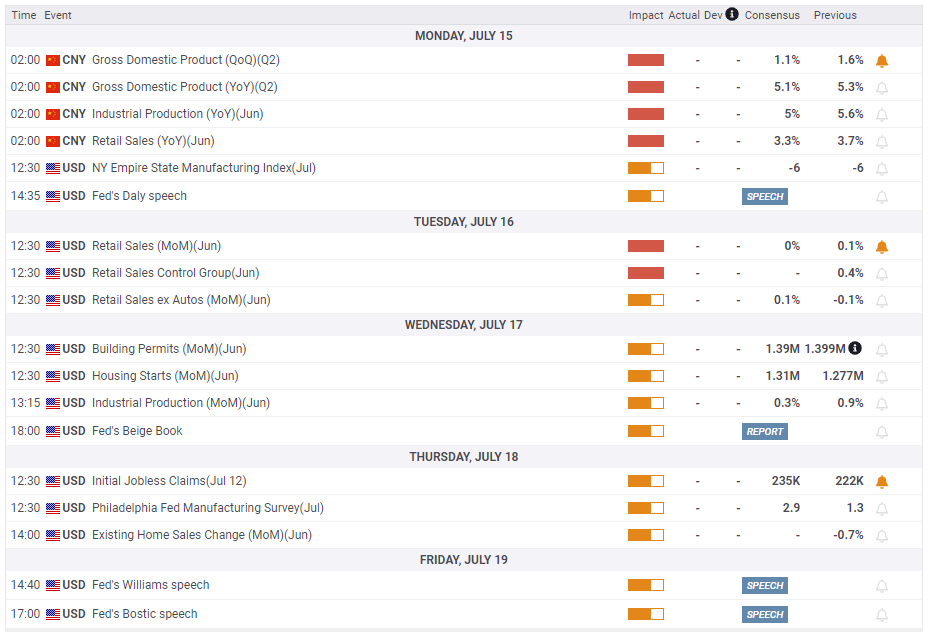
Market participants will pay close attention to Gross Domestic Product (GDP) data from China at the beginning of the week. The Chinese economy is forecast to expand at an annual rate of 5.1% in the second quarter, down slightly from the 5.3% growth recorded in the first quarter. A stronger-than-forecast GDP reading from China could revive optimism about Gold’s demand outlook and help XAU/USD push higher.
According to the Xinhua news agency, China's Communist Party will hold a long-delayed third plenum from July 15 to 18. Markets expect a series of economic reforms, with a focus on property policies, to be announced following this meeting. In case markets turn risk-positive after this event, Gold could gain traction.
June Retail Sales will be the only high-tier data release featured in the US economic docket on Tuesday. A significant decline in this data could put additional weight on the USD’s shoulders, while a positive surprise could help the currency find support and limit XAU/USD’s upside with the immediate reaction.
Investors will also focus on comments from Fed officials before the blackout period starts ahead of the July 30-31 policy meeting. Following the June inflation data, the probability of the Fed leaving the policy rate unchanged in September dropped below 10%, according to the CME FedWatch Tool. In case Fed officials push back against this expectation by downplaying the soft CPI readings, the USD could regather its strength and cause XAU/USD to correct lower. On the other hand, the market positioning suggests that the USD doesn’t have a lot of room left on the downside, even if policymakers confirm an interest rate reduction in September.
Gold technical outlook
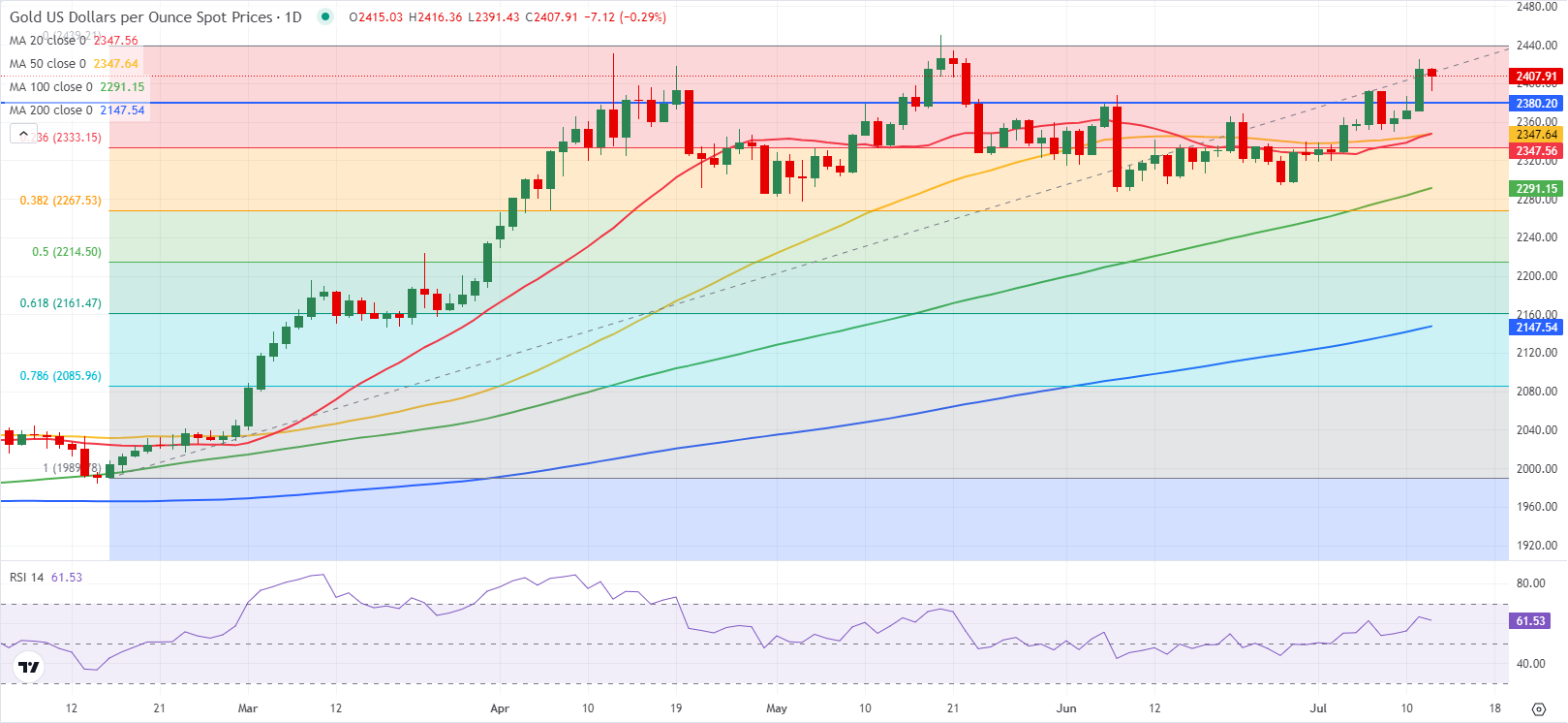
The Relative Strength Index (RSI) indicator on the daily chart rose to 60, and Gold price closed above the 50-day and the 20-day Simple Moving Averages (SMA) for eight consecutive trading days, reflecting a buildup of bullish momentum.
In case XAU/USD stabilizes above $2,400 (psychological level, static level) and continues to use this level as support, it could target the all-time high of $2,450 set in May ahead of next psychological resistance at $2,500.
On the downside, the first support aligns at $2,350, where the 20-day SMA and the 50-day SMAs converge. In case XAU/USD makes a daily close below this level, technical sellers could show interest. In this scenario, $2,300 (psychological level, static level) could be seen as the next support before $2,290 (100-day SMA).
Gold FAQs
Gold has played a key role in human’s history as it has been widely used as a store of value and medium of exchange. Currently, apart from its shine and usage for jewelry, the precious metal is widely seen as a safe-haven asset, meaning that it is considered a good investment during turbulent times. Gold is also widely seen as a hedge against inflation and against depreciating currencies as it doesn’t rely on any specific issuer or government.
Central banks are the biggest Gold holders. In their aim to support their currencies in turbulent times, central banks tend to diversify their reserves and buy Gold to improve the perceived strength of the economy and the currency. High Gold reserves can be a source of trust for a country’s solvency. Central banks added 1,136 tonnes of Gold worth around $70 billion to their reserves in 2022, according to data from the World Gold Council. This is the highest yearly purchase since records began. Central banks from emerging economies such as China, India and Turkey are quickly increasing their Gold reserves.
Gold has an inverse correlation with the US Dollar and US Treasuries, which are both major reserve and safe-haven assets. When the Dollar depreciates, Gold tends to rise, enabling investors and central banks to diversify their assets in turbulent times. Gold is also inversely correlated with risk assets. A rally in the stock market tends to weaken Gold price, while sell-offs in riskier markets tend to favor the precious metal.
The price can move due to a wide range of factors. Geopolitical instability or fears of a deep recession can quickly make Gold price escalate due to its safe-haven status. As a yield-less asset, Gold tends to rise with lower interest rates, while higher cost of money usually weighs down on the yellow metal. Still, most moves depend on how the US Dollar (USD) behaves as the asset is priced in dollars (XAU/USD). A strong Dollar tends to keep the price of Gold controlled, whereas a weaker Dollar is likely to push Gold prices up.
Author

Eren Sengezer
FXStreet
As an economist at heart, Eren Sengezer specializes in the assessment of the short-term and long-term impacts of macroeconomic data, central bank policies and political developments on financial assets.

















