Gold Weekly Forecast: US data and Fedspeak could test buyer commitment
- Gold closed the week hitting a fresh all-time high despite markets doubting a large Fed rate cut in September.
- XAU/USD technical outlook suggests that the bullish bias remains intact.
- Investors will scrutinize PMI data and comments from Fed officials next week.

Gold (XAU/USD) reached a new record high of $2,500 despite struggling to gather bullish momentum in the first half of the week. Macroeconomic data releases from the US and Federal Reserve (Fed) Chairman Jerome Powell’s speech at the Jackson Hole Symposium next week could trigger the next big action in Gold.
Gold touches new record high on Friday
Following the rebound seen in the second half of the previous week, Gold preserved its bullish momentum on Monday and closed above $2,470. In the absence of high-tier macroeconomic data releases, the pullback seen in the US Treasury bond yields helped XAU/USD push higher at the beginning of the week. In the meantime, Gold benefited from high geopolitical tensions as the Israeli Defense Minister said over the weekend that they were still expecting Iran to launch an attack despite calls from Western nations to refrain from retaliation.
On Tuesday, the data from the US showed that the Producer Price Index (PPI) rose 0.1% on a monthly basis in July as expected. Markets largely ignored this data and Gold went into a consolidation phase, closing the day virtually unchanged.
The Bureau of Labor Statistics (BLS) reported on Wednesday that inflation in the US, as measured by the change in the Consumer Price Index (CPI), declined to 2.9% on a yearly basis in July from 3% in June. The core CPI, which excludes volatile food and energy prices, rose 3.2% on a yearly basis, while the CPI and the core CPI both increased 0.2% on a monthly basis. These figures came largely in line with market expectations but the probability of the Fed lowering the policy rate by 50 basis points in September declined below 40% from 52% ahead of the data release, per CME Group FedWatch Tool. As bets for a big rate cut faded, Gold erased a portion of its weekly gains.
More upbeat macroeconomic data releases from the US on Thursday caused investors to leaven further into a 25 bps Fed rate cut in September and made it difficult for Gold to gather bullish momentum. The Department of Labor reported that the weekly Initial Jobless Claims declined by 7,000 to 227,000 in the week ending August 10, while other data showed that Retail Sales rose 1% on a monthly basis in July, beating the market expectation for an increase of 0.3%. The odds of a 50 bps Fed rate cut in September fell below 30% after these releases.
As risk flows started to dominate the action in financial markets on Friday, the USD struggled to find demand, allowing XAU/USD to regain its traction and reach a new record high of $2,500.
Gold investors await US data, Fed Chairman Powell’s appearance at Jackson Hole
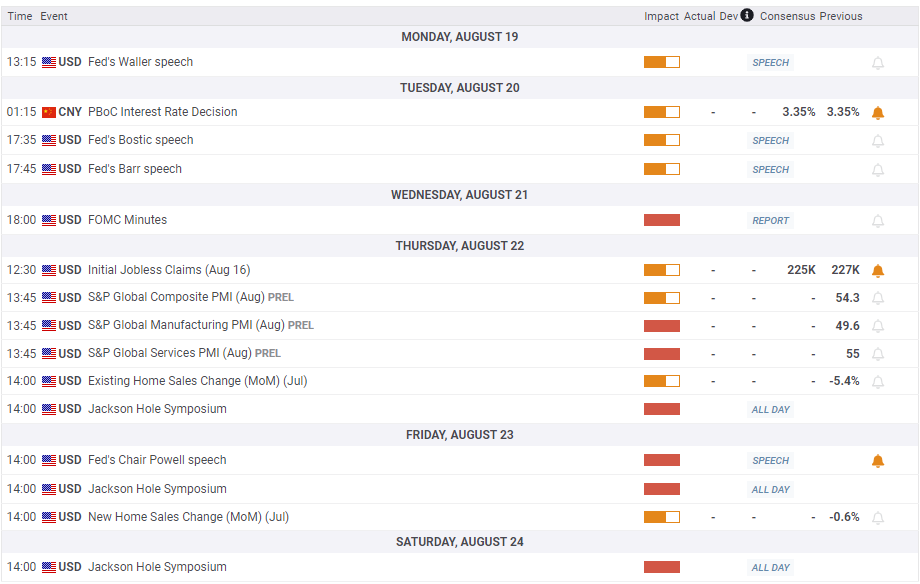
The US economic calendar will not feature any high-tier data releases in the first half of the week. On Wednesday, the Fed will publish the minutes of its July 30-31 meeting. In the post-meeting press conference, Fed Chairman Jerome Powell acknowledged that there was a “real discussion” about cutting the policy rate at the July meeting. Investors will scrutinize remarks surrounding the rate cut discussions. In case the publication shows that several policymakers advocated for a surprise rate cut in July, the USD could come under renewed selling pressure.
On Thursday, S&P Global will release the preliminary Manufacturing and Services Purchasing Managers Index (PMI) data for August. In case the S&P Global Services PMI falls into the contraction territory by coming in below 50, it could revive concerns over an economic downturn in the US and weigh on the USD, helping XAU/USD push higher.
The 2024 Jackson Hole Economic Policy Symposium titled "Reassessing the Effectiveness and Transmission of Monetary Policy" will be held on August 22-24. Fed Chairman Jerome Powell will deliver a speech at the second day of the event on Friday.
Even if Powell confirms a rate cut in September, it is unlikely to trigger a market reaction, since such a decision is already fully priced in. Powell could push back against market expectations about the Fed possibly lowering the policy rate by 50 bps at a future meeting and note that they are likely to ease policy at a steady pace. In this scenario, US T-bond yields could stretch higher and cause Gold to edge lower.
In a recently published report, TD Securities senior commodity strategist Daniel Ghali noted that the positioning in Gold markets is becoming technically bearish with Commodity Trading Advisors (CTAs) remaining “max-long.”
“Several of the major cohorts in Gold markets are now facing buying exhaustion, whereas the narrative that propelled prices to these all-time highs now appears stale. The risk of a positioning washout is at its highest levels of the year,” Ghali noted and added:
“A repricing in Fed expectations could be the catalyst to shake-out some complacent length, potentially catalyzing subsequent liquidations with several major cohorts simultaneously vulnerable. Jackson Hole is the next potential catalyst, but Nonfarm [Payrolls] data on the following week will be key.”
Gold technical outlook
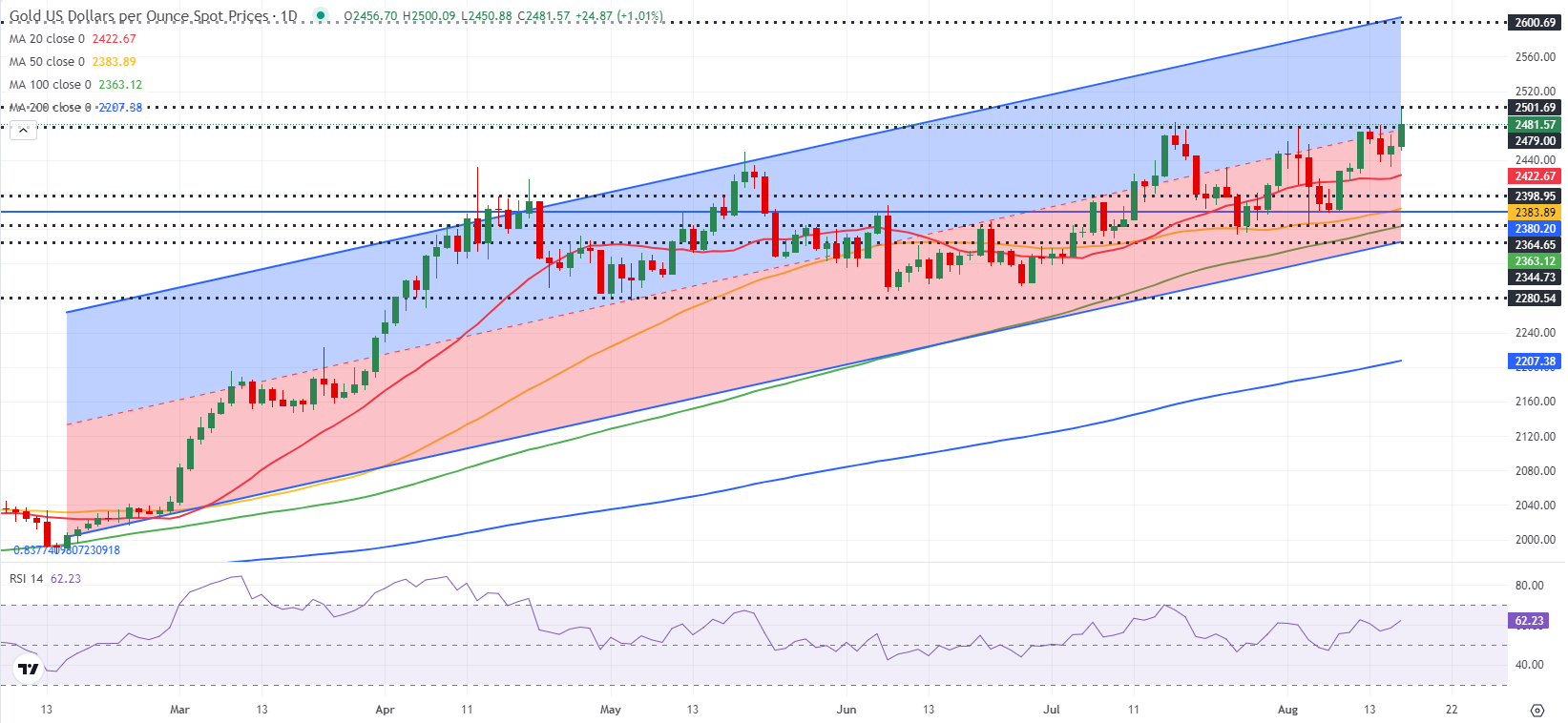
The Relative Strength Index (RSI) indicator on the daily chart stays above 60, suggesting that the bullish bias remains intact.
On the upside, $2,500 (psychological level, static level, record high) could act as the next resistance. In case Gold manages to flip this level into support, the upper limit of the ascending channel could be seen as the next bullish target at $2,600.
Technical sellers could show interest if Gold drops into the lower half of the ascending regression channel by returning below $2,480 and using this level as resistance. In this scenario, the 20-day Simple Moving Average (SMA) could be seen as next support at $2,425 before $2,400 (psychological level, static level). A daily close below the latter could open the door for an extended correction toward the 100-day SMA, currently located at $2,380.
Gold FAQs
Gold has played a key role in human’s history as it has been widely used as a store of value and medium of exchange. Currently, apart from its shine and usage for jewelry, the precious metal is widely seen as a safe-haven asset, meaning that it is considered a good investment during turbulent times. Gold is also widely seen as a hedge against inflation and against depreciating currencies as it doesn’t rely on any specific issuer or government.
Central banks are the biggest Gold holders. In their aim to support their currencies in turbulent times, central banks tend to diversify their reserves and buy Gold to improve the perceived strength of the economy and the currency. High Gold reserves can be a source of trust for a country’s solvency. Central banks added 1,136 tonnes of Gold worth around $70 billion to their reserves in 2022, according to data from the World Gold Council. This is the highest yearly purchase since records began. Central banks from emerging economies such as China, India and Turkey are quickly increasing their Gold reserves.
Gold has an inverse correlation with the US Dollar and US Treasuries, which are both major reserve and safe-haven assets. When the Dollar depreciates, Gold tends to rise, enabling investors and central banks to diversify their assets in turbulent times. Gold is also inversely correlated with risk assets. A rally in the stock market tends to weaken Gold price, while sell-offs in riskier markets tend to favor the precious metal.
The price can move due to a wide range of factors. Geopolitical instability or fears of a deep recession can quickly make Gold price escalate due to its safe-haven status. As a yield-less asset, Gold tends to rise with lower interest rates, while higher cost of money usually weighs down on the yellow metal. Still, most moves depend on how the US Dollar (USD) behaves as the asset is priced in dollars (XAU/USD). A strong Dollar tends to keep the price of Gold controlled, whereas a weaker Dollar is likely to push Gold prices up.
Author

Eren Sengezer
FXStreet
As an economist at heart, Eren Sengezer specializes in the assessment of the short-term and long-term impacts of macroeconomic data, central bank policies and political developments on financial assets.