Gold Weekly Forecast: Geopolitics, US data to drive action in holiday-shortened week
- Gold gathered bullish momentum and rose above $2,700 following a two-week decline.
- The near-term technical outlook points to a bullish shift.
- Key inflation data from the US and geopolitical headlines could continue to impact Gold prices.

Gold (XAU/USD) reversed its direction after posting large losses for two consecutive weeks and reclaimed $2,700, boosted by increasing safe-haven demand on escalating geopolitical tensions. Key inflation data from the US and headlines surrounding the Russia-Ukraine war could influence Gold’s valuation next week.
Gold capitalizes on risk-off flows
Gold started the week on a firm footing and gained nearly 2% on Monday, snapping a six-day losing streak in the process. Escalating geopolitical tensions following news of US President Joe Biden authorizing Ukraine to use powerful long-range American weapons to strike inside Russia allowed Gold to capitalize on safe-haven flows.
“The change comes largely in response to Russia's deployment of North Korean ground troops to supplement its own forces, a development that has caused alarm in Washington and Kyiv,” Reuters reported, citing a US official and a source familiar with the decision.
In response, Russia announced on Tuesday that it updated its nuclear doctrine. Kremlin spokesman Dmitry Peskov noted that any attack on Russia by a non-nuclear state with the participation of a nuclear state would be considered a joint attack. Gold preserved its bullish momentum following the news and closed in positive territory. In the absence of high-impact macroeconomic data releases, XAU/USD extended its weekly uptrend and gained 0.7% on Wednesday.
Ukraine President Volodymyr Zelenskiy said on Thursday that Russia used a new missile in an attack on Ukraine. He said experts are conducting an investigation to identify the type of missile but added that the speed and the altitude suggested that it was an intercontinental ballistic missile. As the Russia-Ukraine conflict forced investors to stay away from risk-sensitive assets, Gold continued to push higher on Thursday and reached a 10-day high above $2,670.
XAU/USD extended its uptrend on Friday and climbed to a two-week high above $2,700. Russia reportedly identified a US missile base in Poland as a priority target, fuelling fears over a deepening crisis between Russia and Western nations. Later in the day, the data from the US showed that the S&P Global Composite PMI rose to 55.3 in November's flash estimate from 54.1 in October, showing that the business activity in the US' private sector continued to expand at an accelerating pace. Assessing the survey's findings, "the prospect of lower interest rates and a more probusiness approach from the incoming administration has fueled greater optimism, in turn helping drive output and order book inflows higher in November," Chris Williamson, Chief Business Economist at S&P Global Market Intelligence said. Gold retreated below $2,700 with the immediate reaction as the upbeat PMI data helped the USD gather strength.
Gold investors await US inflation data
The economic calendar will feature high-tier data releases next week but the trading action is likely to turn subdued in the second half of the week, with the stock and bond markets in the US remaining closed on Thursday and operating for a half-day on Friday in observance of the Thanksgiving holiday.
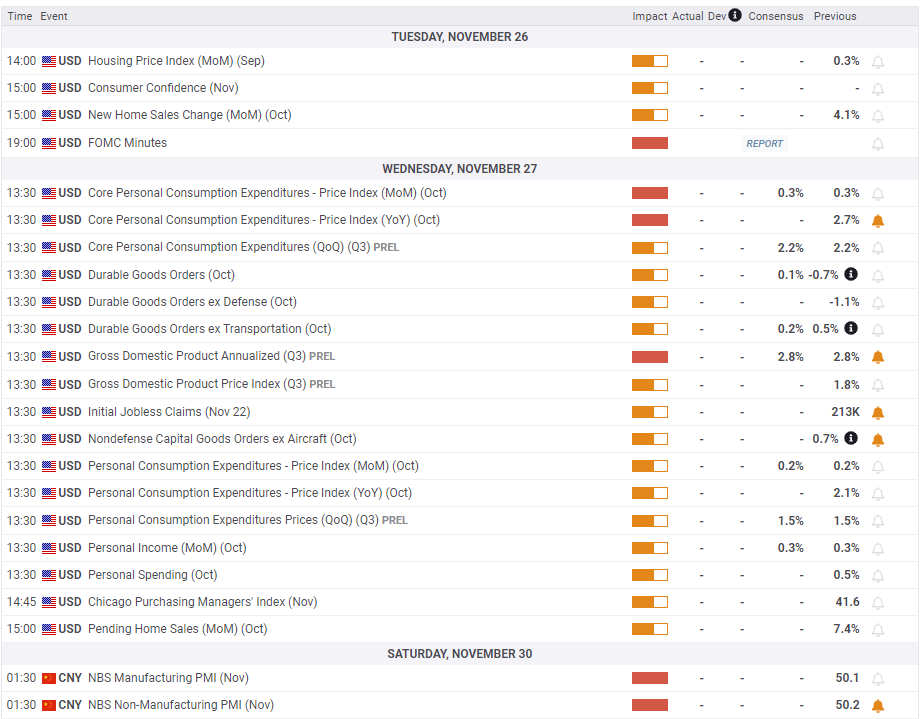
On Tuesday, the Federal Reserve (Fed) will release the minutes of the September policy meeting. Following Fed Chairman Jerome Powell’s cautious comments on further policy easing earlier in the month, investors started to reassess the probability of another 25 basis points (bps) rate cut in December.
According to the CME FedWatch Tool, markets are currently pricing in about a 40% probability of the Fed holding the policy rate unchanged at the last meeting of the year. If the FOMC Minutes suggest that policymakers are willing to opt for one more rate reduction in 2024, the immediate reaction could cause the USD to come under pressure, opening the door for another leg higher in XAU/USD. On the other hand, Gold could correct lower in case the publication shows that Fed officials prefer to see further evidence of either disinflation and/or weakening in the labor market before lowering the policy rate again.
The US Bureau of Economic Analysis (BEA) will publish revisions to the third-quarter Gross Domestic Product (GDP) and release the Personal Consumption Expenditures (PCE) Price Index data for October, the Fed’s preferred gauge of inflation, on Wednesday.
The monthly core PCE Price Index reading, which is not distorted by base effects and excludes volatile food and energy prices, could trigger a short-lasting market reaction. Investors expect the monthly core PCE Price Index to rise 0.3% in October to match September’s increase. A stronger-than-forecast print could boost the USD with the initial reaction and drag Gold lower. On the flip side, a print of 0.2% or lower could have the opposite effect on XAU/USD’s action.
In the meantime, investors will continue to scrutinize developments surrounding the Russia-Ukraine conflict. A de-escalation of geopolitical tensions could trigger a sharp downward correction in XAU/USD.
Gold technical outlook
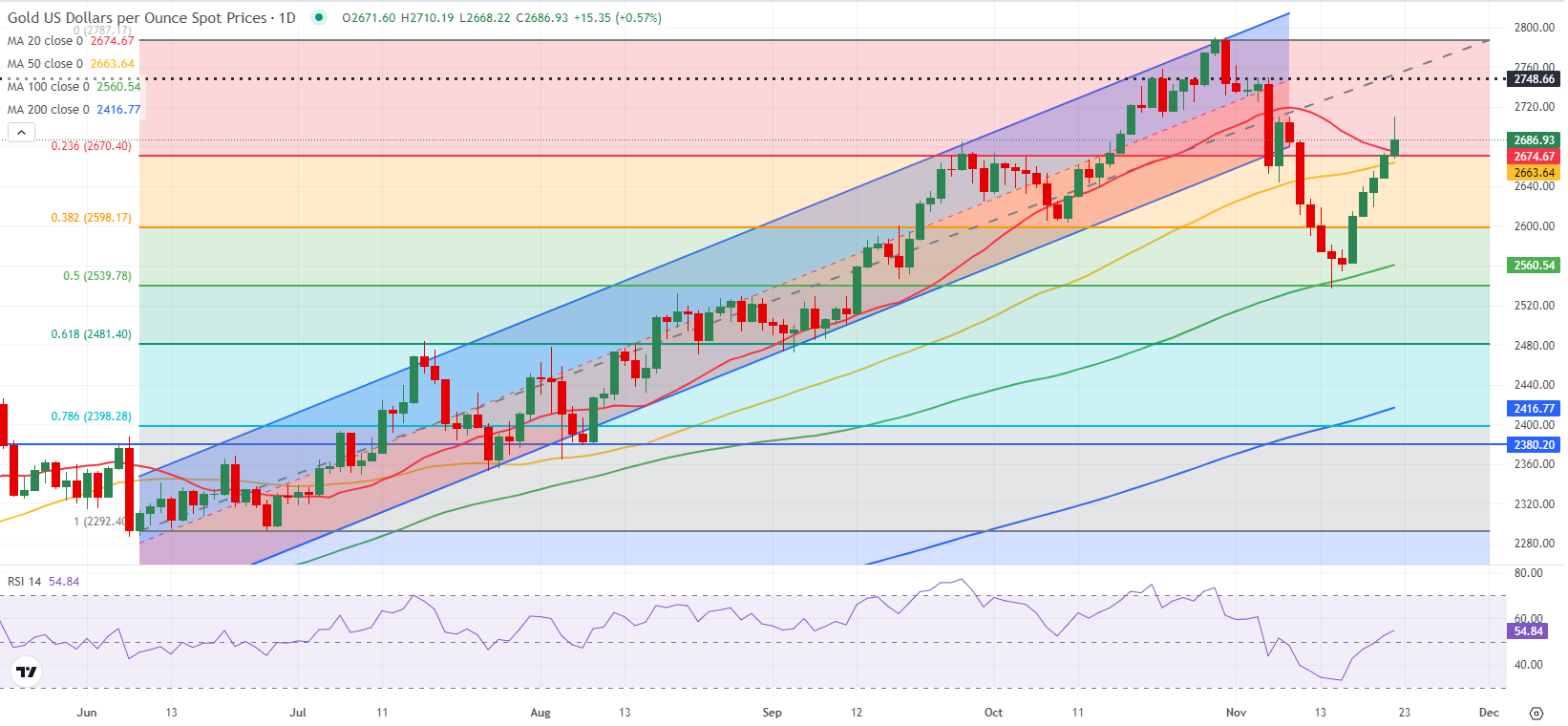
The Relative Strength Index (RSI) indicator on the daily chart recovered above 50 and Gold closed the week above the 20-day and the 50-day Simple Moving Averages (SMA), highlighting a buildup of bullish momentum.
On the upside, $2,750 (static resistance) aligns as immediate resistance before $2,790 (static level) and $2,800 (round level). Looking south, the first support area could be spotted at $2,680-$2,670 (20-day SMA, 50-day SMA, Fibonacci 23.6% retracement of the uptrend coming from June) ahead of $2,600 (Fibonacci 38.2% retracement) and $2,560 (100-day SMA).
Gold FAQs
Gold has played a key role in human’s history as it has been widely used as a store of value and medium of exchange. Currently, apart from its shine and usage for jewelry, the precious metal is widely seen as a safe-haven asset, meaning that it is considered a good investment during turbulent times. Gold is also widely seen as a hedge against inflation and against depreciating currencies as it doesn’t rely on any specific issuer or government.
Central banks are the biggest Gold holders. In their aim to support their currencies in turbulent times, central banks tend to diversify their reserves and buy Gold to improve the perceived strength of the economy and the currency. High Gold reserves can be a source of trust for a country’s solvency. Central banks added 1,136 tonnes of Gold worth around $70 billion to their reserves in 2022, according to data from the World Gold Council. This is the highest yearly purchase since records began. Central banks from emerging economies such as China, India and Turkey are quickly increasing their Gold reserves.
Gold has an inverse correlation with the US Dollar and US Treasuries, which are both major reserve and safe-haven assets. When the Dollar depreciates, Gold tends to rise, enabling investors and central banks to diversify their assets in turbulent times. Gold is also inversely correlated with risk assets. A rally in the stock market tends to weaken Gold price, while sell-offs in riskier markets tend to favor the precious metal.
The price can move due to a wide range of factors. Geopolitical instability or fears of a deep recession can quickly make Gold price escalate due to its safe-haven status. As a yield-less asset, Gold tends to rise with lower interest rates, while higher cost of money usually weighs down on the yellow metal. Still, most moves depend on how the US Dollar (USD) behaves as the asset is priced in dollars (XAU/USD). A strong Dollar tends to keep the price of Gold controlled, whereas a weaker Dollar is likely to push Gold prices up.
Author

Eren Sengezer
FXStreet
As an economist at heart, Eren Sengezer specializes in the assessment of the short-term and long-term impacts of macroeconomic data, central bank policies and political developments on financial assets.