Gold Price Weekly Forecast: XAU/USD closes in on key support area that could trigger a rebound
- Gold price closed every day of this week in negative territory.
- XAU/USD faces strong support area slightly below $1,800.
- Performance of US T-bond yields could impact XAU/USD's action next week.

Gold price stayed under persistent bearish pressure this week as the latest macroeconomic data releases from the US reaffirmed the Federal Reserve's willingness to keep its monetary policy tight. XAU/USD extended its slide toward $1,800 on Friday and closed the fourth straight week in negative territory. The ISM's PMI surveys and the action in the US bond markets will be watched closely by market participants as the pair closes in on key support levels.
What happened last week?
XAU/USD fluctuated in a very tight range on Monday as trading conditions remained thin with US markets staying closed in observance of Presidents' Day.
On Tuesday, S&P Global's PMI surveys revealed a rebound in the private sector's business activity in major economies and triggered a rally in global bond yields. Services PMI in the US rose to 50.5 in early February from 46.8 in January and Composite PMI improved to 50.2 from 46.8.
Commenting on PMI surveys' findings, Chris Williamson, Chief Business Economist at S&P Global Market Intelligence, said accelerating service sector price growth could stoke concerns over a 'wage-price spiral' and add to calls for higher interest rates. With the benchmark 10-year US Treasury bond yield rising nearly 3% post-PMI on Tuesday, Gold price declined to $1,830.
Although XAU/USD managed to stage a correction in the first half of the day on Wednesday, it came under renewed bearish pressure during the American trading hours.
Minutes of the FOMC's first policy meeting acknowledged that a few participants favoured raising the policy rate by 50 basis points (bps). Considering that the policy meeting took place before the impressive January jobs report and relatively strong monthly Consumer Price Index (CPI) data, this comment in the statement reassured markets that policymakers are still not even close to considering rate cuts. Moreover, the publication showed that policymakers saw upside risks to inflation amid reopening China and the ongoing Russia-Ukraine conflict. In turn, the US Dollar (USD) preserved its strength and forced the pair to stretch lower.
On Thursday, the US Bureau of Economic Analysis (BEA) reported that it revised the annualized real Gross Domestic Product (GDP) growth for the fourth quarter to 2.7% from 2.9% in its initial estimate. Other data from the US revealed that weekly Initial Jobless Claims stayed below 200,000 for the sixth straight week. As the 10-year US T-bond yield held comfortably above 3.9% after these data, Gold price struggled to gain traction.
The BEA announced on Friday that the Core Personal Consumption Expenditures (PCE) Price Index, the Fed's preferred gauge of inflation, edged higher to 4.7% in January from 4.6% (revised from 4.4%) in December. On a monthly basis, Core PCE inflation rose 0.6%. Both of these readings came in higher than analysts' estimates and the USD extended its weekly rally ahead of the weekend, forcing XAU/USD to stay on the back foot.
Next week
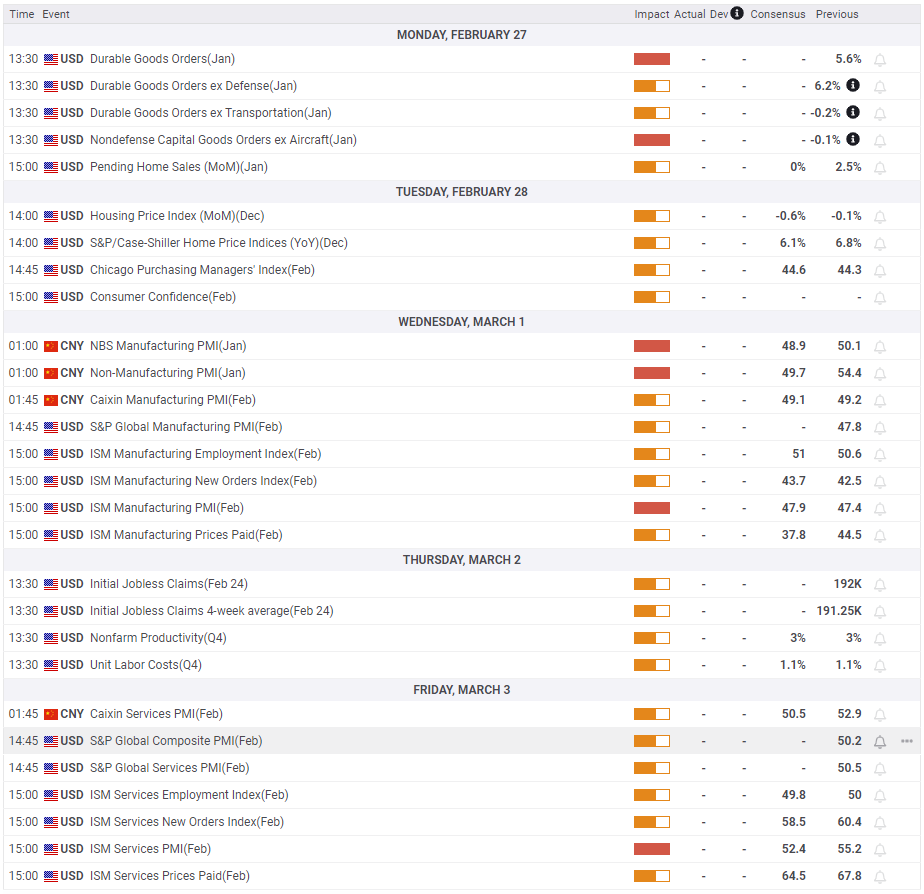
On Monday, the US Census Bureau will release the Durable Goods Orders data for January. Since the beginning of the month, upbeat macroeconomic data releases from the US have been supporting the USD and a similar market reaction could be expected. Nevertheless, this data by itself is unlikely to impact the Fed's policy outlook in a significant way.
On Tuesday, the Conference Board's Consumer Confidence Survey for February will be looked upon for fresh impetus. Rather than the headline Consumer Confidence Index, the one-year consumer inflation expectations could trigger a reaction. In January, this component of the survey climbed to 6.8% from 6.6% in December. In case there is a pullback in this figure, the USD could lose interest and help XAU/USD stage a short-term recovery and vice versa.
The ISM will publish the Manufacturing PMI and the Services PMI on Wednesday and Friday, respectively.
If the ISM's Services PMI report reaffirms that rising wage costs are feeding into accelerating price pressures in the sector, the USD is likely to hold its ground against its rivals. Hence, the Prices Paid Index component will be watched closely by market participants.
It's worth noting, however, that the CME Group FedWatch Tool shows that markets are fully pricing in at least two more 25 basis points Fed rate hikes, in March and May. Additionally, the probability of the Fed holding the policy rate unchanged in June stands at 25%.
The market positioning suggests that the USD doesn't have a lot of room on the upside, at least until the February jobs report and inflation data confirm or refute one more 25 bps hike in June.
Once again, investors will be watching the US Treasury bond yields next week. 4% aligns as key resistance for the 10-year US T-bond yield and there could be a technical correction if that level stays intact. In that scenario, Gold price could turn north due to the inverse-correlation with the US yields.
Gold price technical analysis
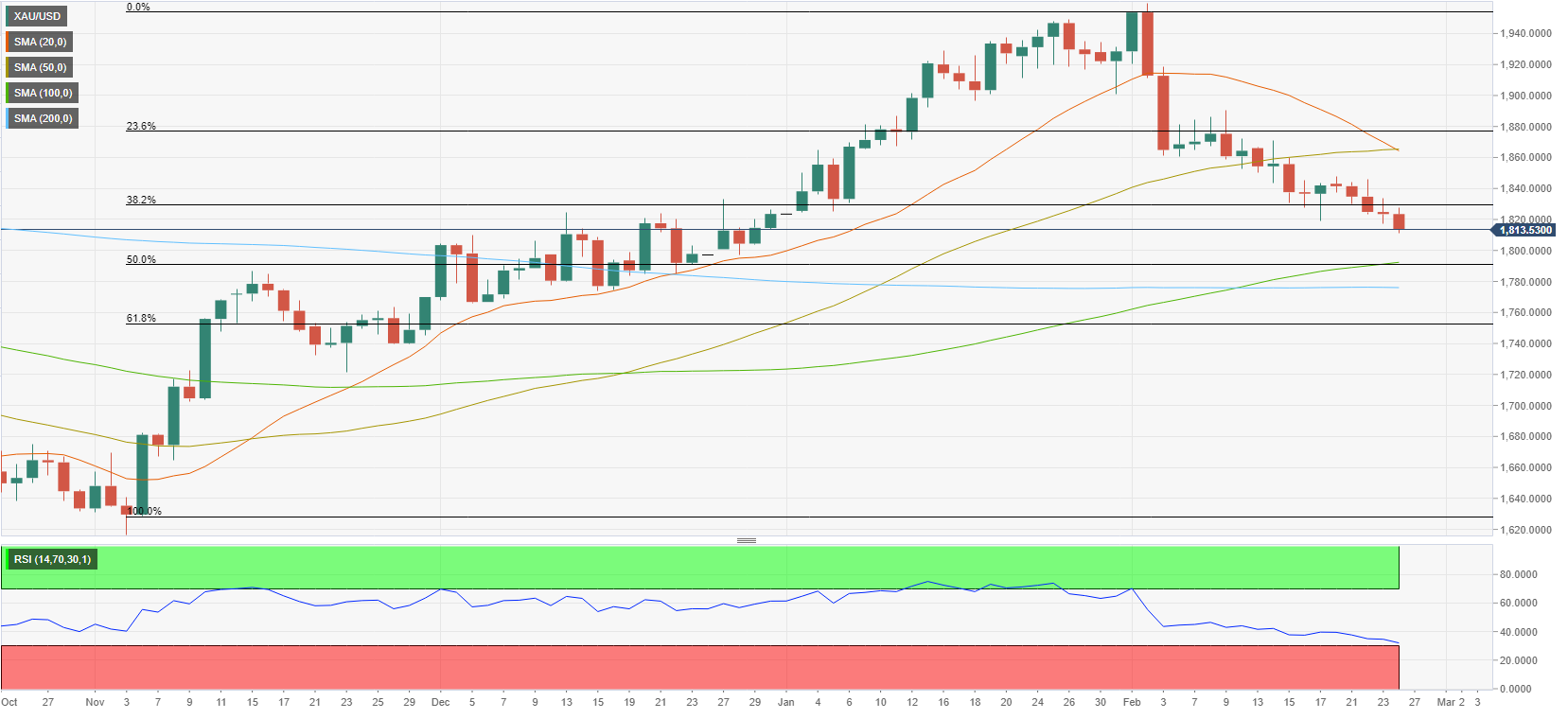
The Relative Strength Index (RSI) indicator on the daily chart stays near 30, suggesting the XAU/USD is about to turn technically oversold. On the downside, $1,800 (psychological level) aligns as interim support ahead of $1,790 (100-day Simple Moving Average (SMA)) and $1,780 (200-period SMA). In case the pair continues to push lower toward those levels, the daily is RSI will likely start signalling oversold conditions. In that scenario, sellers could move to the sidelines and wait for a technical correction.
On the upside, $1,830 (Fibonacci 38.2% retracement level of the latest uptrend, former support) aligns as key resistance. With a daily close above that level, additional recovery gains toward $1,860 (20-day SMA, 50-day SMA) and $1,880 (Fibonacci 23.6% retracement).
Gold price forecast poll
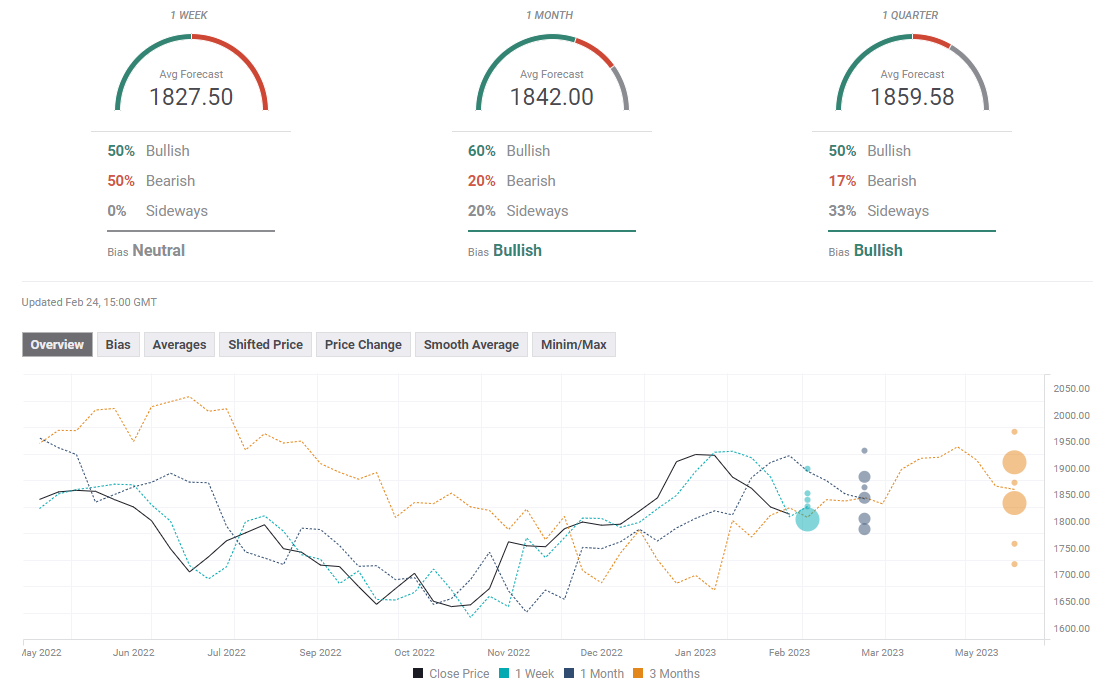
FXStreet Forecast Poll points to a mixed short-term outlook with half of the experts adopting a bearish bias in the one-week view and the other half seeing Gold price rebounding next week. The one-month outlook remains bullish, with the average target sitting at $1,842.
Author

Eren Sengezer
FXStreet
As an economist at heart, Eren Sengezer specializes in the assessment of the short-term and long-term impacts of macroeconomic data, central bank policies and political developments on financial assets.














