Gold Price Weekly Forecast: Oversold conditions could help XAU/USD find a foothold
- Gold continued to stretch lower as bond yields pushed higher.
- Near-term technical picture points to oversold conditions for XAU/USD.
- September inflation data could trigger the next big action in the pair.

Gold price extended its slide and declined more than 1% this week after losing 3% in the previous one. Surging global bond yields continued to weigh heavily on XAU/USD as markets assessed the potential impact of the latest strong US macroeconomic data releases on the Federal Reserve’s (Fed) policy outlook. Next week’s economic docket will feature the all-important Consumer Price Index (CPI) data from the US, which could confirm or deny another Fed rate increase in 2023.
What happened last week?
Although the US Congress avoided a government shutdown at the last minute by extending the current budget until November 17, markets remained risk-averse to start the new week. The uncertainty surrounding US politics triggered another leg of US Treasury bond sell-off and the yield attached to the 10-year bonds rose more than 2% on Monday, causing XAU/USD to close in negative territory. Meanwhile, the data from China showed over the weekend that the private sector continued to lose growth momentum in September, with Caixin Manufacturing PMI and Services PMI declining to 50.6 and 50.2, respectively.
The number of job openings on the last business day of August jumped to 9.6 million from 8.8 million in July, the US Bureau of Labor Statistics (BLS) reported on Tuesday. This reading highlighted tight labor market conditions and attracted hawkish Fed bets. In turn, US yields continued to push higher and didn’t allow Gold to stage a rebound.
Uninspiring macroeconomic data from the US made it difficult for the USD to gather further strength and helped XAU/USD find support mid-week. Employment in the US private sector rose by 89,000 in September, Automatic Data Processing (ADP) reported on Wednesday. This reading followed the 180,000 increase recorded in August and missed the market expectation of 153,000 by a wide margin. Other data revealed that the ISM Services PMI edged slightly lower to 53.6 in September from 54.5 in August to match analysts’ forecast. On a concerning note, the New Orders Index of the survey fell sharply to 51.8 from 57.5. In the absence of high-impact data releases, XAU/USD continued to fluctuate in a tight channel at around $1,820 on Thursday.
Nonfarm Payrolls (NFP) in the US rose by 336,000 in September, the BLS’ announced in the jobs report on Friday. Additionally, July and August NFP prints got revised up by 79,000 and by 40,000, respectively. "With these revisions, employment in July and August combined is 119,000 higher than previously reported." the BLS noted. The USD gathered strength in the American session following a two-day correction and capped XAU/USD’s upside ahead of the weekend.
Next week
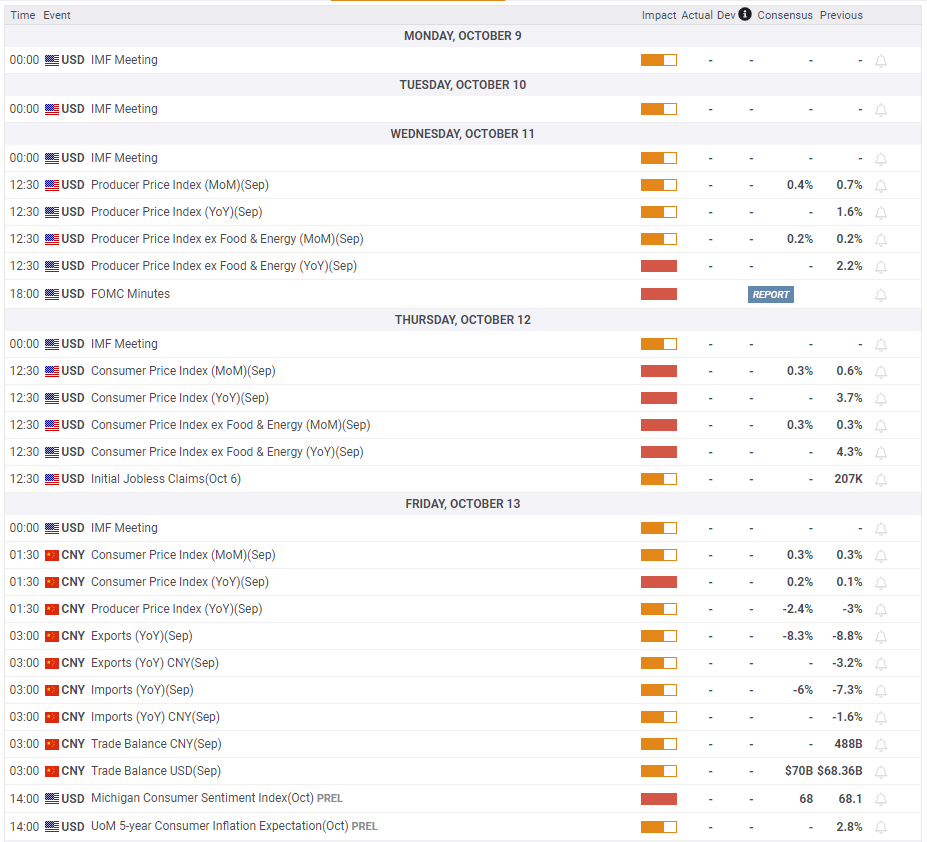
The market action is likely to turn subdued early next week with American investors enjoying a three-day weekend. On Wednesday, the Fed will release the minutes of the September policy meeting.
The Summary of Economic Projections confirmed in September that policymakers saw it appropriate to raise the policy rate by another 25 basis points before the end of the year. Since the minutes will not account for the sharp upsurge seen in US Treasury bond yields since then, any hawkish remark could be ignored by investors. While speaking at the Economic Club of New York, San Francisco Fed President Mary Daly said that there was no need to do additional tightening following the recent rise in US T-bond yields.
September’s inflation report from the US will be watched closely by market participants on Thursday. The Consumer Price Index (CPI) and the Core CPI, which excludes volatile food and energy prices, are both expected to rise 0.3% on a monthly basis. In September, Oil prices rose more than 8%. Hence, a bigger-than-forecast increase in monthly CPI might not be a big surprise. Moreover, Oil prices are down nearly 10% in October, suggesting that the impact of rising energy prices on CPI inflation is likely to be short-lived. If the Core CPI, however, comes in at 0.5% or higher, the initial reaction could provide a boost to the USD and put pressure on XAU/USD. On the other hand, a soft inflation reading at or below market expectations could attract dovish Fed bets and help Gold turn north.
On Friday, September Trade Balance and CPI data from China will be featured in the economic calendar. In case there is an expansion in China’s trade surplus alongside a noticeable increase in monthly CPI, which would highlight improving consumer activity, Gold could gather strength during the Asian trading hours.
Investors will also scrutinize comments from Fed policymakers next week. If officials acknowledge that increasing yields could allow them to hold the policy rate steady for the rest of the year, XAU/USD could gain traction. Conversely, the benchmark 10-year US T-bond yield could continue to stretch higher toward 5% if policymakers downplay the rise in yields and reiterate the need for additional tightening. According to the CME Group FedWatch Tool, markets are pricing in a 64% probability that the Fed will leave the policy rate in the current range of 5.25%-5.5% for the rest of the year. The market positioning suggests that the USD faces a two-way risk depending on the direction investors lean to.
Gold technical outlook
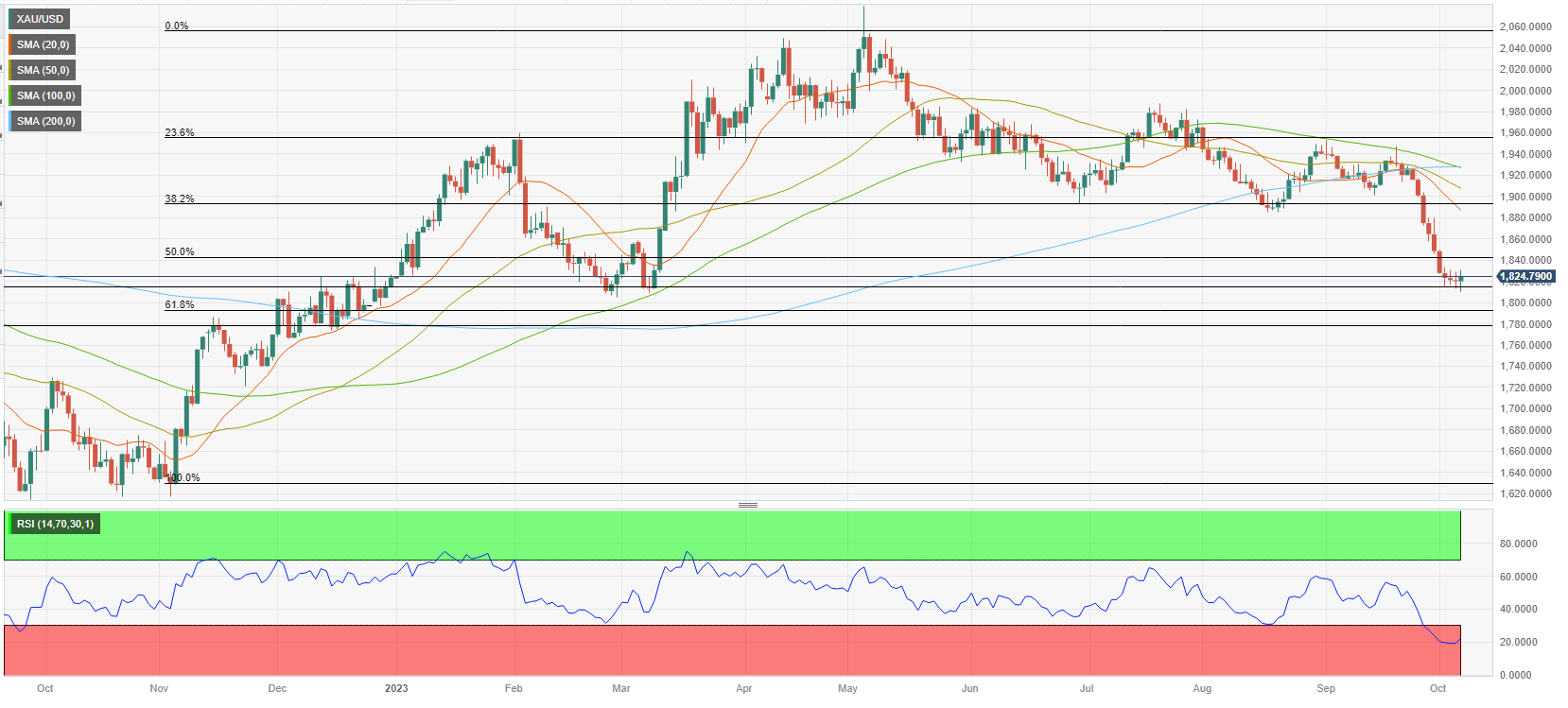
The Relative Strength Index (RSI) indicator on the daily chart declined below 20 this week to highlight extremely oversold conditions for XAU/USD. The last time the RSI dropped below this level, at the end of 2016, Gold staged a rebound and gained more than 4% in the first week of 2017. Sellers could move to the sidelines and allow the pair to make an upside correction before deciding whether Gold has more room on the downside.
The $1,840 level (Fibonacci 50% retracement of the long-term uptrend) aligns as first resistance. A daily close above this threshold could open the door for an extended recovery toward the $1,890-$1,900 range (Fibonacci 38.2% retracement, 20-day Simple Moving Average (SMA), psychological level).
On the downside, interim support seems to have formed at $1,815 ahead of $1,800 (psychological level, Fibonacci 61.8% retracement). In case the latter fails, technical sellers could take action and cause XAU/USD to decline toward next static support at $1,780.
Gold forecast poll
Author

Eren Sengezer
FXStreet
As an economist at heart, Eren Sengezer specializes in the assessment of the short-term and long-term impacts of macroeconomic data, central bank policies and political developments on financial assets.

















