Gold Price Forecast: XAU/USD striving for a weekly close above $2,000
- Gold price consolidates Thursday’s two-way price action ahead of US PCE inflation on Friday.
- US Dollar licks wound alongside US Treasury bond yields amid improving market mood.
- Gold price confirmed a Bull Flag on the daily chart, with RSI still pointing to more gains.

Gold price is treading water above $1,980 early Friday, taking a breather after Thursday’s volatile trading. Markets weigh a likely Japanese FX intervention, strong United States (US) Gross Domestic Product (GDP) data, lingering Middle East concerns and upbeat Amazon.com Inc earnings, as the focus shifts to the US inflation data.
Gold price keeps the winning streak intact
Gold price is extending its upbeat momentum into the third day in a row, capitalizing on an improved market mood, which is capping any upside attempts in the United States Dollar (USD) and the US Treasury bond yields.
Investors are rejoicing solid post-market US tech earnings. Shares of Amazon.com Inc jumped after the e-commerce giant surpassed analysts’ expectations for revenue and earnings in the third quarter, pointing to a Wall Street on Friday.
The market optimism is seen as traders shrug off the latest developments surrounding the Middle East conflict. The US launched military strikes on two facilities in eastern Syria early Friday on President Joe Biden’s orders. The facilities were reportedly used by Iran’s Islamic Revolutionary Guard Corps.
As Israel prepares for the ground invasion of Gaza, The Israel Defense Forces said they conducted an overnight raid in northern Gaza, “as part of preparations for the next stages of combat.”
Moving on, Gold price will stay afloat on underlying geopolitical tensions and US government shutdown worries, even as the US Congress has a new Speaker of the House, Mike Johnson. The broader sentiment, geopolitical updates, end-of-the-week flows and the bond market action will be key to the Gold price direction.
Markets are likely to pay limited attention to the US Personal Consumption Expenditures - Price Index, as Thursday’s US Q3 GDP report already included quarterly PCE inflation figures.
The US GDP rose at a 4.9% annualized pace in the third quarter, ahead of the 4.2% estimate. “The sharp increase came due to contributions from consumer spending, increased inventories, exports, residential investment and government spending,” per CNBC News.
A resilient US economy backed the “Fed’s view of higher interest rates for longer,” However, the data failed to inspire the US Dollar and the US Treasury bond yields. Meanwhile, Gold price extended its corrective decline from weekly highs of $1,994 in an initial reaction to the US growth numbers but managed to find its feet to settle marginally higher on Thursday.
Gold price technical analysis: Daily chart
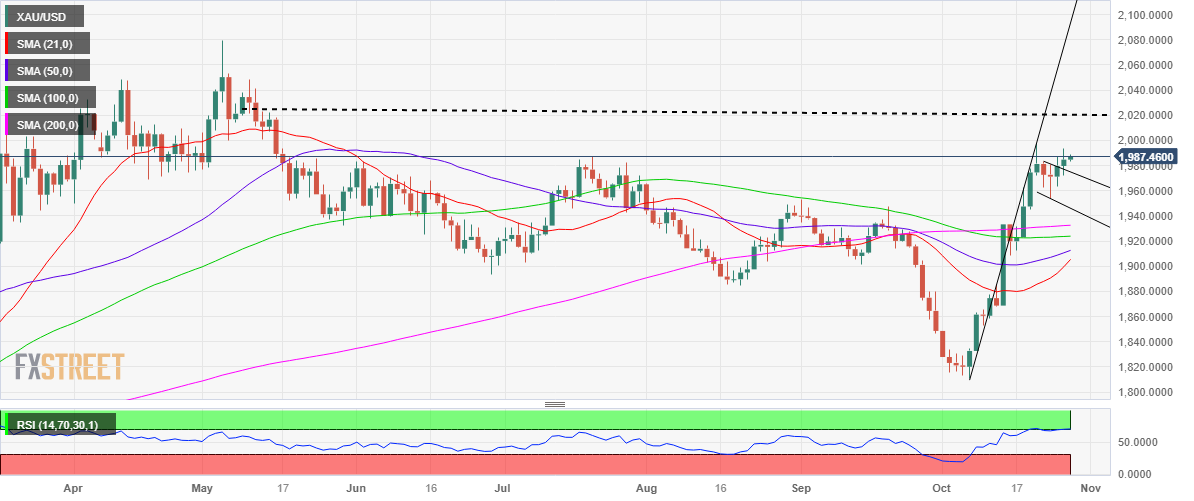
Gold price is gathering pace before the next push higher, as the Bull Flag remains in play and keeps buyers hopeful.
The 14-day Relative Strength Index (RSI) indicator is peeping into overbought territory, pointing to more upside potential.
The immediate resistance for Gold price is aligned at the five-month highs of $1,997, above which acceptance above the $2,000 barrier is critical on a weekly closing basis to unleash additional gains.
The next relevant topside hurdle is seen at around $2,020, mid-May highs.
Alternatively, a rejection again near the multi-month hiigh of $1,997 could reinforce Gold sellers, triggering a sharp correction toward the previous day’s low of $1,972.
A sustained move below the latter will prompt Gold sellers to test the static support at $1,963. Further south, the $1,950 psychological level will be put to the test again.
Premium
You have reached your limit of 3 free articles for this month.
Start your subscription and get access to all our original articles.
Author

Dhwani Mehta
FXStreet
Residing in Mumbai (India), Dhwani is a Senior Analyst and Manager of the Asian session at FXStreet. She has over 10 years of experience in analyzing and covering the global financial markets, with specialization in Forex and commodities markets.