Gold Price Forecast: XAU/USD set to extend record-rally beyond $2,800 as Trump’s tariffs loom
- Gold price consolidates at fresh record highs of $2,800 early Friday.
- Renewed Trump’s tariff threats spark the safe-haven appeal of Gold price.
- The Dollar lacks bullish conviction amid disappointing US growth figures.
- The daily technical setup points to more gains in the offing for Gold buyers.

Gold price is battling $2,800, sitting at its highest level on record early Friday. Renewed US Dollar selling and US President Donald Trump’s tariff threats help keep Gold price afloat ahead of the US core Personal Consumption Expenditures (PCE) Price Index release.
Gold price eyes higher highs as Trump’s tariffs loom
President Trump’s latest tariff warnings keep investors on the edge, fuelling fresh demand for traditional safe havens such as the Japanese Yen, Gold and US government bonds. In his latest post on X, the 47th US President reiterated his threat of imposing 100% tariffs on BRICS nations if they try to replace the US Dollar with a new currency in international trade.
Earlier in Thursday’s American trading, Trump noted that the US is set to impose a flat 25% import tax on February 1 "because of fentanyl" on all goods crossing the border into the US from Canada or Mexico while adding that “we're in the process of doing a China tariff.”
Resurgent demand for the traditional store of value keeps the record-setting rally in Gold price alive and kicking as the US Dollar (USD) struggles amid the ongoing pressure on the USD/JPY pair. The Japanese Yen capitalizes on risk-off flows and hot Tokyo Consumer Price Index (CPI) inflation data, which bolstered further Bank of Japan (BoJ) interest rate hike bets.
Traders now look to the US core PCE Price Index data, the Federal Reserve’s (Fed) preferred inflation measure, for fresh insights on the central bank’s next policy move, especially after the American economy showed a bigger-than-expected slowdown in the final quarter of 2024.
US Gross Domestic Product (GDP) rose at an annualized pace of 2.3% in the fourth quarter, the Commerce Department said, falling short of the 2.6% increase expected after reporting a growth of 3.1% in the third quarter.
The US Dollar tracked the US Treasury bond yields lower on disappointing US growth figures as the data revived dovish Fed expectations. However, Trump’s tariff threats lent some support to the Greenback in late American trading. However, that failed to deter Gold buyers as a flight to safety theme remained in vogue.
With tariffs likely to be announced over the weekend on Canada, Mexico and China, Gold price will remain the go-to asset due to its status as a safe-haven and an inflation hedge. Trump’s trade policies are prerceived as inflationary.
Gold price technical analysis: Daily chart
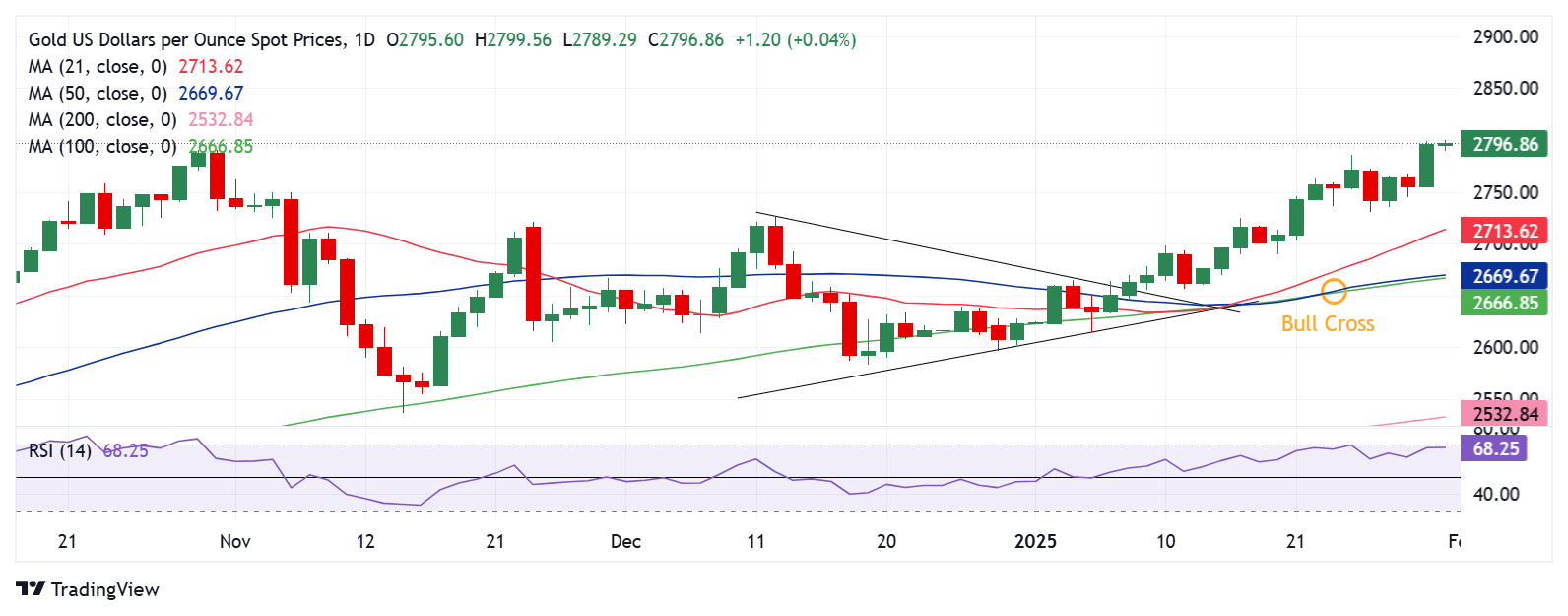
Gold price stands tall near fresh record highs after closing Thursday well beyond the symmetrical triangle target of $2,785 or the previous all-time high of $2,790.
The 14-day Relative Strength Index (RSI) is currently near 68, suggesting that there is more room to the upside before Gold price enters the overbought territory at 70.
Adding credence to the bullish potential, the 50-day Simple Moving Average (SMA) and 100-day SMA Bull Cross confirmed last week remains in play.
Gold price needs a sustained move above the $2,800 level to target next topside barrier at $2,850.
On the downside, the immediate support will be seen at the previous day’s low of $2,754.
Sellers will then aim for this week’s low of $2,731, folowed by the 21-day SMA at $2,714.
US-China Trade War FAQs
Generally speaking, a trade war is an economic conflict between two or more countries due to extreme protectionism on one end. It implies the creation of trade barriers, such as tariffs, which result in counter-barriers, escalating import costs, and hence the cost of living.
An economic conflict between the United States (US) and China began early in 2018, when President Donald Trump set trade barriers on China, claiming unfair commercial practices and intellectual property theft from the Asian giant. China took retaliatory action, imposing tariffs on multiple US goods, such as automobiles and soybeans. Tensions escalated until the two countries signed the US-China Phase One trade deal in January 2020. The agreement required structural reforms and other changes to China’s economic and trade regime and pretended to restore stability and trust between the two nations. However, the Coronavirus pandemic took the focus out of the conflict. Yet, it is worth mentioning that President Joe Biden, who took office after Trump, kept tariffs in place and even added some additional levies.
The return of Donald Trump to the White House as the 47th US President has sparked a fresh wave of tensions between the two countries. During the 2024 election campaign, Trump pledged to impose 60% tariffs on China once he returned to office, which he did on January 20, 2025. With Trump back, the US-China trade war is meant to resume where it was left, with tit-for-tat policies affecting the global economic landscape amid disruptions in global supply chains, resulting in a reduction in spending, particularly investment, and directly feeding into the Consumer Price Index inflation.
Author

Dhwani Mehta
FXStreet
Residing in Mumbai (India), Dhwani is a Senior Analyst and Manager of the Asian session at FXStreet. She has over 10 years of experience in analyzing and covering the global financial markets, with specialization in Forex and commodities markets.

















