Gold Price Forecast: XAU/USD sellers keep sight on $2,223 and the Fed decision
- Gold price licks wounds near four-week lows ahead of US jobs data, Fed decision.
- US Dollar rebounded with US Treasury bond yields on Tuesday, as risk-off flows underpinned.
- Further downside looks likely for Gold price amid bearish RSI on the daily chart.

Gold price is catching a breather early Wednesday, having hit a four-week low at $2,285 on Tuesday. Traders refrain from placing fresh directional bets on Gold price, anticipating the all-important US Federal Reserve (Fed) interest rate decision due later in the day.
Gold price looks vulnerable, as the Fed verdict looms
The Fed is widely expected to hold the Fed Funds Rate steady in the range of 5.25% to 5.5% at its May policy meeting. However, the path forward on the interest rates is likely to be laid out in the policy statement and Fed Chair Jerome Powell’s press conference will set the tone for Gold markets in the coming weeks.
Markets are pricing in the first Fed rate cut in September but the chances of that have been slashed to about 47% from over 60% seen a week ago, according to the CME Group’s FedWatch Tool.
The revival in the hawkish Fed expectations has been due to the recent hot US inflation data, further endorsed by a bigger-than-expected increase in the US Employment Cost Index (ECI) for the first quarter of this year. Data published by the US Labor Department's Bureau of Labor Statistics (BLS) on Tuesday showed that the ECI, the broadest measure of labor costs, increased by 1.2% last quarter after rising by 0.9% in the fourth quarter.
Strong ECI data fuelled a big rally in the US Treasury bond yields, driving the US Dollar sharply higher across the board. The Gold price correction, therefore, gathered pace, with rates hitting the lowest level in four weeks.
Looking ahead, the Fed verdict is likely to steal the show. Before that, Gold traders will also pay close attention to the US ADP Employment Change and JOLTs Job Openings data for fresh trading impetus in the run-up to the Fed event.
So far this Wednesday’s trading, the US Dollar is gaining further ground on increased expectations that the Fed will hint at a ‘higher for longer’ interest-rate view. Wall Street Journal’s (WSJ) Fed insider, Nick Timiraos, said in his story published on Tuesday that “firmer-than-anticipated inflation in the first three months of the year has likely postponed rate cuts for the foreseeable future.”
“Officials are likely to emphasize that they are prepared to hold rates steady ... for longer than they previously anticipated,” Timiraos added.
Gold price technical analysis: Daily chart
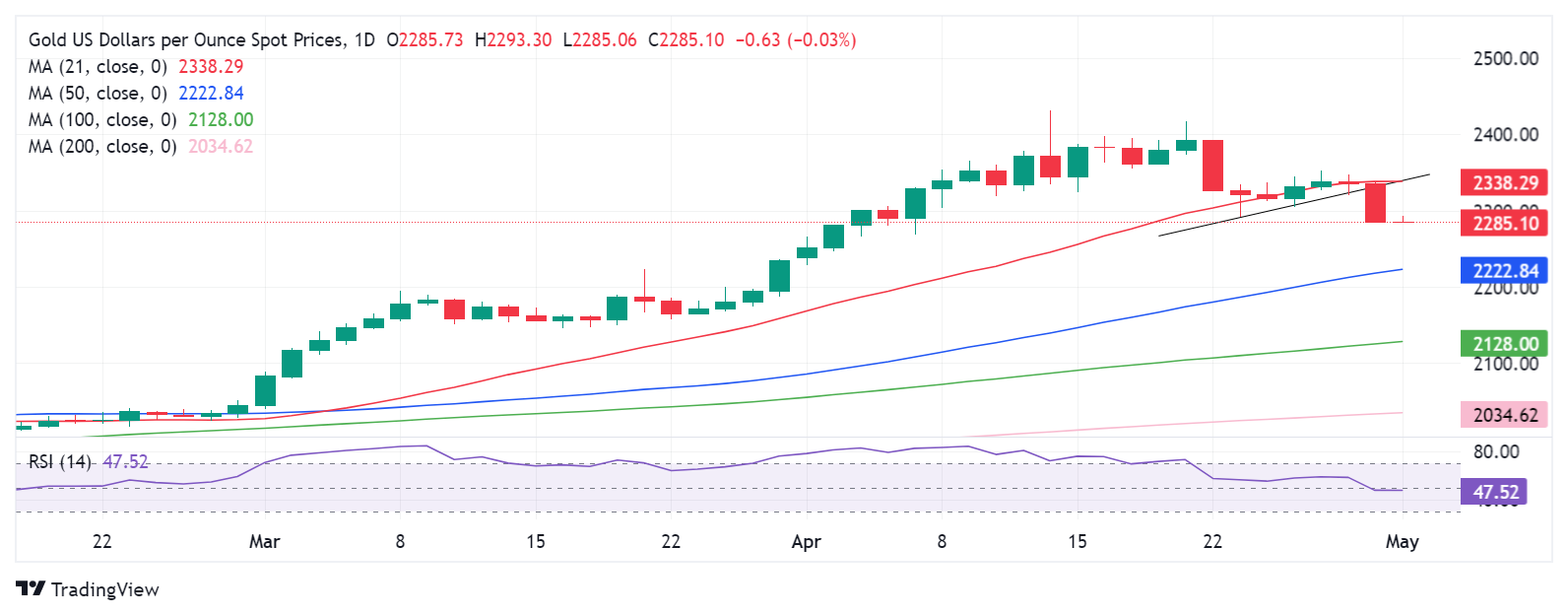
As observed on the daily chart, Gold price closed Tuesday below the key 21-day Simple Moving Average (SMA) at $2,338 and the rising trendline support, then at $2,330.
The 14-day Relative Strength Index (RSI) is now sitting beneath the 50 level, having pierced through the latter for the downside on Tuesday.
The downside break of the key daily support line and the bearish RSI indicator suggest that the path of least resistance for Gold price appears down.
The immediate support is seen at the psychological $2,250 level, below which the 50-day SMA at $2,223 will be challenged.
On the flip side, acceptance above the key confluence zone of $2,338 is critical to initiating any meaningful recovery in Gold price.
The next relevant topside barriers are seen at the $2,350 mark. followed by the $2,370 round level.
Gold FAQs
Gold has played a key role in human’s history as it has been widely used as a store of value and medium of exchange. Currently, apart from its shine and usage for jewelry, the precious metal is widely seen as a safe-haven asset, meaning that it is considered a good investment during turbulent times. Gold is also widely seen as a hedge against inflation and against depreciating currencies as it doesn’t rely on any specific issuer or government.
Central banks are the biggest Gold holders. In their aim to support their currencies in turbulent times, central banks tend to diversify their reserves and buy Gold to improve the perceived strength of the economy and the currency. High Gold reserves can be a source of trust for a country’s solvency. Central banks added 1,136 tonnes of Gold worth around $70 billion to their reserves in 2022, according to data from the World Gold Council. This is the highest yearly purchase since records began. Central banks from emerging economies such as China, India and Turkey are quickly increasing their Gold reserves.
Gold has an inverse correlation with the US Dollar and US Treasuries, which are both major reserve and safe-haven assets. When the Dollar depreciates, Gold tends to rise, enabling investors and central banks to diversify their assets in turbulent times. Gold is also inversely correlated with risk assets. A rally in the stock market tends to weaken Gold price, while sell-offs in riskier markets tend to favor the precious metal.
The price can move due to a wide range of factors. Geopolitical instability or fears of a deep recession can quickly make Gold price escalate due to its safe-haven status. As a yield-less asset, Gold tends to rise with lower interest rates, while higher cost of money usually weighs down on the yellow metal. Still, most moves depend on how the US Dollar (USD) behaves as the asset is priced in dollars (XAU/USD). A strong Dollar tends to keep the price of Gold controlled, whereas a weaker Dollar is likely to push Gold prices up.
Author

Dhwani Mehta
FXStreet
Residing in Mumbai (India), Dhwani is a Senior Analyst and Manager of the Asian session at FXStreet. She has over 10 years of experience in analyzing and covering the global financial markets, with specialization in Forex and commodities markets.