Gold Price Forecast: XAU/USD recaptures key 21-day SMA, as buyers refuse to give up
- Gold price looks to extend the bounce from three-week lows ahead of US PPI data.
- The US Dollar gives back US CPI-led uptick amid employment concerns, hawkish Fedspeak ignored.
- Gold price finds footing again above 21-day SMA at $2,627, more recovery likely?

Gold price is looking to build on the previous recovery from three-week lows of $2,604 early Friday. Broad risk aversion and a modest US Dollar (USD) downtick support Gold price heading into the US Producer Price Index (CPI) data release due later on Friday.
US jobs worries outweigh hot inflation, lifting Gold price
Gold price continues to cheer the unfazed odds of a 25 basis points (bps) interest rate cut by the US Federal Reserve (Fed) in November. Markets currently price in about an 86% chance of such a move next month, according to the CME Group’s FedWatch Tool.
The health of the US labor market remains a concern for investors after Initial Jobless Claims surged by 33,000 last week to a seasonally adjusted 258,000 for the week ended October. 5. Discouraging US jobs data overshadowed the hot Consumer Price Index (CPI) inflation data for September, keeping the November rate cut hopes alive and kicking.
US annual CPI inflation dropped from 2.5% in August to 2.4% in September, the lowest level since February 2021, although still came in above the estimated 2.3% print. The CPI increased by 0.2% over the month in September, matching August’s increase and surpassing 0.1% expectations.
Therefore, the US Dollar failed to sustain its recovery momentum and pullback from two-month highs against its major rivals, as short-term two-year US Treasury bond yields tumbled. This helped Gold price stage a comeback from multi-week troughs.
The USD retracement was partly sponsored by the USD/JPY slide, fuelled by hawkish comments from Bank of Japan (BoJ) Deputy Governor Ryozo Himino, who said on Thursday that “if the outlook for economic activity and prices presented in the July report is achieved, the BoJ will accordingly raise interest rates.”
Late Thursday, slightly hawkish commentary from Atlanta Fed President Raphael Bostic was unable to lift the sentiment around the Greenback, leaving the buck on the back foot ahead of Friday’s US PPI inflation data.
Bostic said in a Wall Street Journal (WSJ) interview that he would be "totally comfortable" skipping an interest-rate cut at an upcoming meeting of the US central bank. He added that the "choppiness" in recent data on inflation and employment may warrant leaving rates on hold in November.
The dovish sentiment around the Fed rate cut expectations could be tested on the US PPI report, significantly impacting the value of the US Dollar and Gold price. The US PPI is seen easing to 1.6% YoY in September while the annual core PPI inflation is set to rise to 2.7% in the same period, against a 2.4% growth reported previously.
Gold price could continue to draw support from increased optimism about China’s fiscal stimulus package due to be rolled out on Saturday. Meanwhile, speeches from several Fed policymakers will also keep Gold traders entertained.
Gold price technical analysis: Daily chart
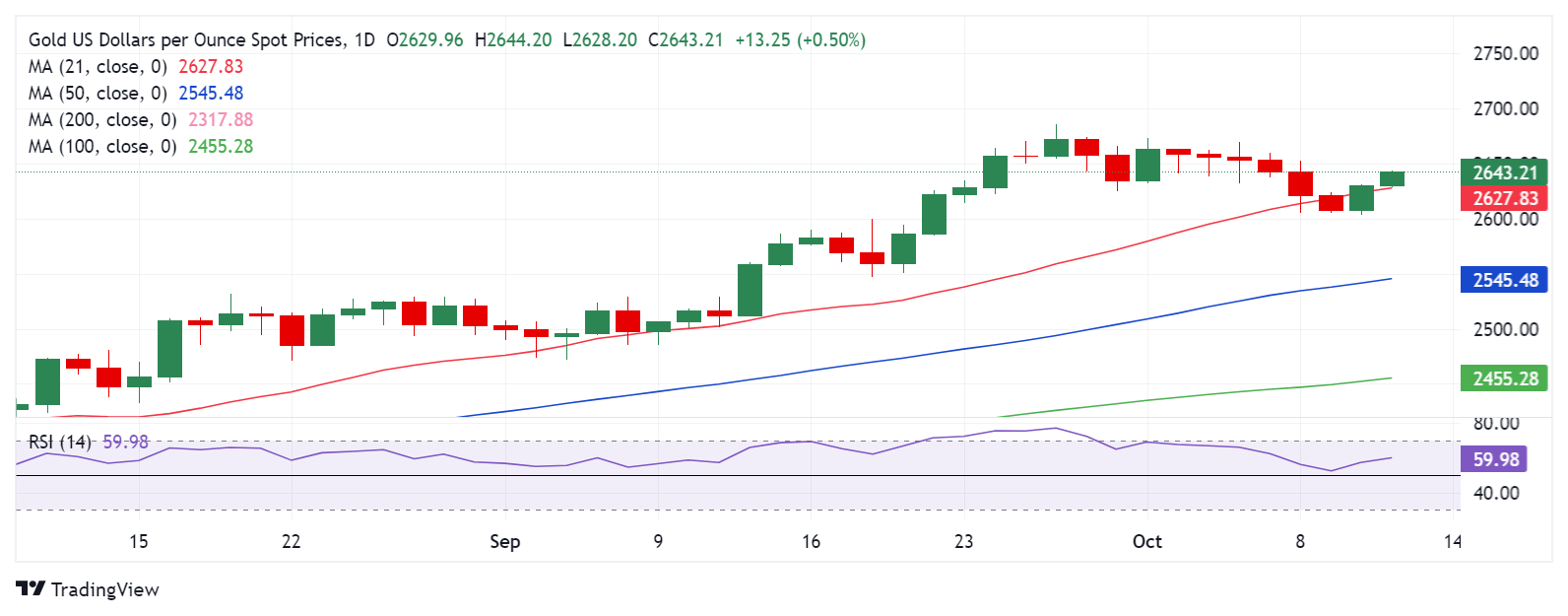
Buyers refused to give up on Thursday and jumped back into the game even after Gold price closed Wednesday below the key 21-day Simple Moving Average (SMA) support, then at $2,619.
Gold price recaptured the 21-day SMA support-turned-resistance, now at $2,628, on a daily closing basis on Thursday, reviving the uptrend.
The 14-day Relative Strength Index (RSI) looks north above the 50 level, suggesting that there is scope for more upside.
The next bullish targets for Gold price are seen at the $2,650 psychological barrier and the intermittent highs near $2,670.
On the downside, the immeddate support is seen at the three-week lows near the $2,600 threshold. A sustained break below the latter could extend the downside toward the September 20 low of $2,585.
Further declines could challenge the $2,550 demand area, where the 50-day SMA aligns.
Gold FAQs
Gold has played a key role in human’s history as it has been widely used as a store of value and medium of exchange. Currently, apart from its shine and usage for jewelry, the precious metal is widely seen as a safe-haven asset, meaning that it is considered a good investment during turbulent times. Gold is also widely seen as a hedge against inflation and against depreciating currencies as it doesn’t rely on any specific issuer or government.
Central banks are the biggest Gold holders. In their aim to support their currencies in turbulent times, central banks tend to diversify their reserves and buy Gold to improve the perceived strength of the economy and the currency. High Gold reserves can be a source of trust for a country’s solvency. Central banks added 1,136 tonnes of Gold worth around $70 billion to their reserves in 2022, according to data from the World Gold Council. This is the highest yearly purchase since records began. Central banks from emerging economies such as China, India and Turkey are quickly increasing their Gold reserves.
Gold has an inverse correlation with the US Dollar and US Treasuries, which are both major reserve and safe-haven assets. When the Dollar depreciates, Gold tends to rise, enabling investors and central banks to diversify their assets in turbulent times. Gold is also inversely correlated with risk assets. A rally in the stock market tends to weaken Gold price, while sell-offs in riskier markets tend to favor the precious metal.
The price can move due to a wide range of factors. Geopolitical instability or fears of a deep recession can quickly make Gold price escalate due to its safe-haven status. As a yield-less asset, Gold tends to rise with lower interest rates, while higher cost of money usually weighs down on the yellow metal. Still, most moves depend on how the US Dollar (USD) behaves as the asset is priced in dollars (XAU/USD). A strong Dollar tends to keep the price of Gold controlled, whereas a weaker Dollar is likely to push Gold prices up.
Author

Dhwani Mehta
FXStreet
Residing in Mumbai (India), Dhwani is a Senior Analyst and Manager of the Asian session at FXStreet. She has over 10 years of experience in analyzing and covering the global financial markets, with specialization in Forex and commodities markets.