Gold Price Forecast: XAU/USD needs acceptance above $2,750 en-route record highs
- Gold price sits at two-month highs at $2,750, eyes more upside.
- Trump’s tariff threats on China revive haven demand for the US Dollar and Gold price.
- Technically, Gold price aims for the symmetrical triangle target at $2,785 or record highs.

Gold price extends its three-day bullish momentum into Wednesday, hitting the highest level in two months at $2,750. A renewed risk-aversion wave appears to put a fresh bid under the Gold price as markets digest US President Donald Trump’s latest tariff threats.
Gold price benefits from trade war fears
Citing President Trump, Reuters reported earlier in the Asian session, “we are talking about a 10% tariff on China because they sell fentanyl.” Trump said the tariffs will be effective from February 1. He added that the “European Union will be in for tariffs.”
Risk sentiment turned soured as trade war fears intensified on these threats, with Chinese Vice Premier Ding Xuexiang warning that there are “no winners” in a trade war, speaking at the World Economic Forum (WEF) in Davos on Tuesday. The sell-off in Chinese stocks on looming US tariffs revived the flight to safety theme, lifting the safe havens – the US Dollar and the Gold price.
However, it remains to be seen if Gold price sustains the three-day winning streak as risk flows could return as most of these tariffs announced by Trump were priced in, while traders could cheer the US President’s announcement of artificial intelligence (AI) infrastructure investment. Late Tuesday, Trump announced that OpenAI, SoftBank and Oracle will form a joint venture called Stargate and invest up to $500 billion in AI infrastructure.
Meanwhile, “streaming giant Netflix on January 21 released its October-December quarter results, reporting that it added close to 19 million subscribers during the holiday period to surpass 300 million subs in total,” AFP reported. This news could also comfort investors amid mounting trade war fears.
Furthermore, the tepid recovery in the US Treasury bond yields could outweigh the dovish US Federal Reserve (Fed) interest rate cut expectations, capping the upside in the non-yielding Gold price. Markets are pricing in a total easing of 37 basis points (bps) from the Fed this year, with the first-rate cut not fully priced until July, per Refinitive.
That said, fresh tariffs talks and policies from Trump will likely play a pivotal role in impacting the broad market sentiment, eventually influencing the USD and the Gold price.
Gold price technical analysis: Daily chart
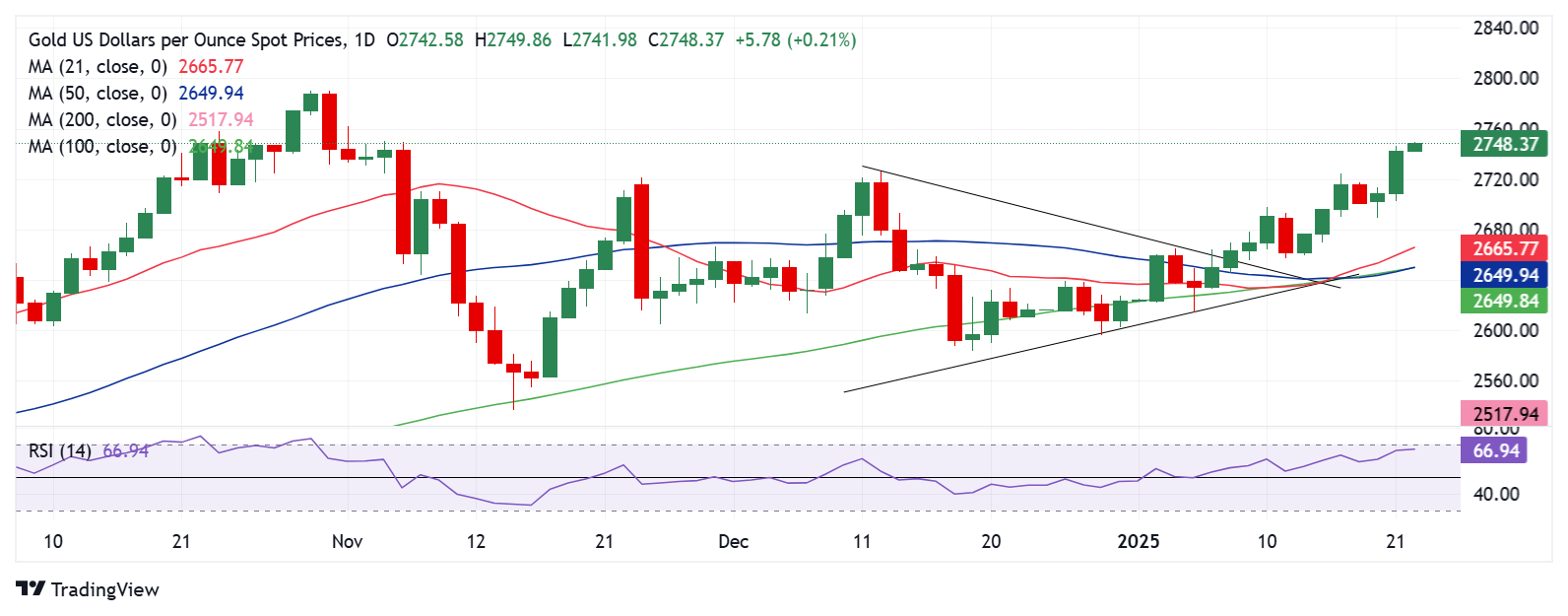
The daily chart shows that Gold price remains on track to test the record high of $2,790 or the symmetrical triangle target, measured at $2,785.
Gold price charted a symmetrical triangle breakout earlier this month while it holds comfortably above all the major daily simple moving averages (SMA), supporting the bullish case.
The 14-day Relative Strength Index (RSI) continues to grind higher above the midline, currently near 67, keeping buyers hopeful.
Gold price must scale the $2,750 psychological barrier on a daily closing basis to challenge the November 2024 high of $2,762.
The next target is aligned near the aforementioned resistance near $2,790.
On the flip side, Gold price could test the $2,700 round level, below which the 21-day SMA at $2,666 will be threatened.
The 50-day SMA and the 100-day SMA converge at $2,650 seems to be the last line of defense for Gold buyers.
Gold FAQs
Gold has played a key role in human’s history as it has been widely used as a store of value and medium of exchange. Currently, apart from its shine and usage for jewelry, the precious metal is widely seen as a safe-haven asset, meaning that it is considered a good investment during turbulent times. Gold is also widely seen as a hedge against inflation and against depreciating currencies as it doesn’t rely on any specific issuer or government.
Central banks are the biggest Gold holders. In their aim to support their currencies in turbulent times, central banks tend to diversify their reserves and buy Gold to improve the perceived strength of the economy and the currency. High Gold reserves can be a source of trust for a country’s solvency. Central banks added 1,136 tonnes of Gold worth around $70 billion to their reserves in 2022, according to data from the World Gold Council. This is the highest yearly purchase since records began. Central banks from emerging economies such as China, India and Turkey are quickly increasing their Gold reserves.
Gold has an inverse correlation with the US Dollar and US Treasuries, which are both major reserve and safe-haven assets. When the Dollar depreciates, Gold tends to rise, enabling investors and central banks to diversify their assets in turbulent times. Gold is also inversely correlated with risk assets. A rally in the stock market tends to weaken Gold price, while sell-offs in riskier markets tend to favor the precious metal.
The price can move due to a wide range of factors. Geopolitical instability or fears of a deep recession can quickly make Gold price escalate due to its safe-haven status. As a yield-less asset, Gold tends to rise with lower interest rates, while higher cost of money usually weighs down on the yellow metal. Still, most moves depend on how the US Dollar (USD) behaves as the asset is priced in dollars (XAU/USD). A strong Dollar tends to keep the price of Gold controlled, whereas a weaker Dollar is likely to push Gold prices up.
Author

Dhwani Mehta
FXStreet
Residing in Mumbai (India), Dhwani is a Senior Analyst and Manager of the Asian session at FXStreet. She has over 10 years of experience in analyzing and covering the global financial markets, with specialization in Forex and commodities markets.