Gold Price Forecast: XAU/USD needs acceptance above $2,740 to sustain the uptrend
- Gold price turns south after facing rejection once again above $2,740 on Thursday.
- The US Dollar licks wounds with Treasury bond yields amid a mixed market mood.
- Technically, Gold price remains a ‘buy-the-dips’ trade, as range play is set to extend.

Gold price is on the back foot early Friday, as sellers return on a failure to find a strong foothold above the $2,740 static resistance yet again. Attention now turns toward a fresh batch of US economic data and speeches from US Federal Reserve (Fed) policymakers for a fresh direction impetus in Gold price.
Gold price eyes fresh US data for a range breakout
Gold price extends its upside consolidative mode into the second consecutive day in Asian trading on Friday. However, it remains confined in a familiar range since the start of this week even after recxording a fresh lifetime high at $2,759 on Wednesday.
The Gold price action is divided between the increased expectations that the Fed will opt for a less aggressive easing policy in the coming months and uncertainty around the US presidential elections combined with rife Middle East geopolitical concerns.
Additionally, the US corporate earnings reports also play a pivot role in driving risk sentiment, and hence the safe-haven US Dollar (USD) and Gold price.
That said, the upcoming US Durable Goods Orders and Michigan Consumer Sentiment (revision) data could provide fresh hints on the state of the US economy, which could impact the Fed rate cut expectations and the US Dollar’s value in the near term.
Thus, Gold price could see a fresh direction move on the US data releases and a speech by Boston Fed president Susan Collins.
On Thursday, Gold price snapped its correction and rebounded 1% as the USD pulled back sharply with the US Treasury bond yields, as risk flows remained on Tesla’s earnings optimism while uncertainty in the run-up to the US election provided a fresh lift to Gold price.
Markets are pricing in a victory for the Republican nominee and the former US President Donald Trump in the presidential race, and his trade and fiscal policies are seen as inflationary, for which the Gold price could emerge as the go-to asset as a hedge against inflation.
Gold price technical analysis: Daily chart
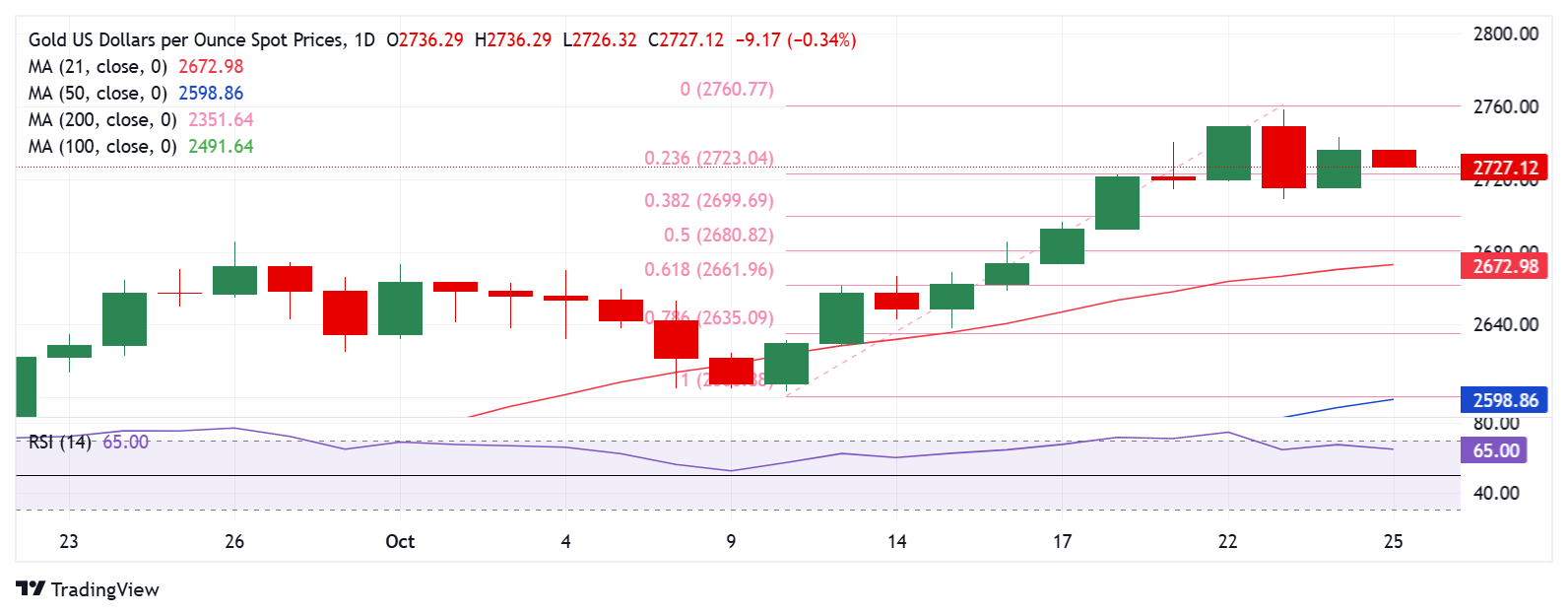
Gold price has turned south once again to test the previous resistance now support at $2,723, the 23.6% Fibonacci Retracement (Fibo) level of the latest record rally from the October 10 low of $2,604 to an all-time high of $2,759.
A failure to defend that level on a daily candlestick closing basis could accelerate the declines toward the 38.2% Fibo level of the same ascent at $2,700.
Further south, the 50% Fibo support at $2,681 will be put to the test, near where the 21-day Simple Moving Average (SMA) closes in.
On the flip side, acceptance above the $2,740 static resistance is critical to resuming a sustained uptrend.
Gold buyers would then take on the $2,750 psychological barrier. The record high of $2,759 will be next on buyers’ radars.
The 14-day Relative Strength Index (RSI) is pointing lower but holds comfortable above the 50 level, currently trading near 65, suggesting that any decline in Gold price could be seen as a good dip-buying opportunity.
Gold FAQs
Gold has played a key role in human’s history as it has been widely used as a store of value and medium of exchange. Currently, apart from its shine and usage for jewelry, the precious metal is widely seen as a safe-haven asset, meaning that it is considered a good investment during turbulent times. Gold is also widely seen as a hedge against inflation and against depreciating currencies as it doesn’t rely on any specific issuer or government.
Central banks are the biggest Gold holders. In their aim to support their currencies in turbulent times, central banks tend to diversify their reserves and buy Gold to improve the perceived strength of the economy and the currency. High Gold reserves can be a source of trust for a country’s solvency. Central banks added 1,136 tonnes of Gold worth around $70 billion to their reserves in 2022, according to data from the World Gold Council. This is the highest yearly purchase since records began. Central banks from emerging economies such as China, India and Turkey are quickly increasing their Gold reserves.
Gold has an inverse correlation with the US Dollar and US Treasuries, which are both major reserve and safe-haven assets. When the Dollar depreciates, Gold tends to rise, enabling investors and central banks to diversify their assets in turbulent times. Gold is also inversely correlated with risk assets. A rally in the stock market tends to weaken Gold price, while sell-offs in riskier markets tend to favor the precious metal.
The price can move due to a wide range of factors. Geopolitical instability or fears of a deep recession can quickly make Gold price escalate due to its safe-haven status. As a yield-less asset, Gold tends to rise with lower interest rates, while higher cost of money usually weighs down on the yellow metal. Still, most moves depend on how the US Dollar (USD) behaves as the asset is priced in dollars (XAU/USD). A strong Dollar tends to keep the price of Gold controlled, whereas a weaker Dollar is likely to push Gold prices up.
Author

Dhwani Mehta
FXStreet
Residing in Mumbai (India), Dhwani is a Senior Analyst and Manager of the Asian session at FXStreet. She has over 10 years of experience in analyzing and covering the global financial markets, with specialization in Forex and commodities markets.