Gold Price Forecast: XAU/USD needs acceptance above $2,530 for a fresh uptrend
- Gold price returns to the red early Tuesday after testing record highs at $2,532 on Monday.
- The US Dollar and Treasury bond yields pause their recovery stint amid a tepid risk tone.
- The daily technical setup leans in favor of Gold buyers, with fresh lifetime highs in sight.

Gold price has entered a phase of upside consolidation above $2,500, as buyers await fresh catalysts for a fresh leg higher. The focus now shifts to the mid-tier US housing and sentiment data, as the Middle East tensions seem to ease.
Gold price bides time, as fresh record highs eyed
Gold price retreats in Asian trading on Tuesday, having faced rejection once again near the $2,530 level. Fears over a broader Middle East conflict seem to have eased, which is weighing on the traditional safe-haven Gold price even though the US Dollar has stalled its overnight recovery alongside the US Treasury bond yields.
US Air Force General C.Q. Brown, chairman of the Joint Chiefs of Staff, said early Tuesday that fears of a near-term broader Middle East conflict have ebbed after Israel and Lebanon’s Hezbollah exchanged fire without further escalation.
These comments came after Israel launched a preemptive airstrike on Hezbollah in southern Lebanon on Sunday, as Hezbollah was said to launch a large-scale missile and rocket attack on northern and central Israel with the intended target being Mossad, the Israeli spy agency.
Meanwhile, traders snap their short-covering spree in the US Dollar, triggered by a strong headline US Durable Goods Orders print for July, which jumped by 9.9% against a rise of 4.0% expected. Encouraging US data tempered expectations that the US Federal Reserve (Fed) could lower interest rates by 50 basis points (bps) in September, thus helping the US Dollar stage a comeback from yearly troughs.
Markets are currently pricing in a 28% probability of a 50 bps rate reduction in September while the odds of a 25 bps cut jump to 72%, the CME Group’s FedWatch Tool showed on Tuesday.
The next direction in Gold price appears north, as it remains underpinned by the increased Fed rate-cut bets and looming Mid-East geopolitical risks. Further, hopes of improvement in physical Gold demand from India and China are likely to keep any downside limited in Gold price.
Sachin Jain, CEO of the World Gold Council's (WGC) Indian operations said that “the primary beneficiaries of the reduced duty cut will be retail consumers.” Demand during the upcoming festival season will be very strong, Jain told Reuters on the sidelines of the India Gold Conference.
“Gold demand in China is expected to improve in coming months as consumers adjust to higher prices, industry officials said, with economic uncertainty and concerns about currency weakness driving investment flows,” according to Reuters.
Looking ahead, Gold traders will take cues from the upcoming US CB Consumer Confidence and housing data while speeches from Fed policymakers will be also scrutinized for fresh policy hints.
Gold price technical analysis: Daily chart
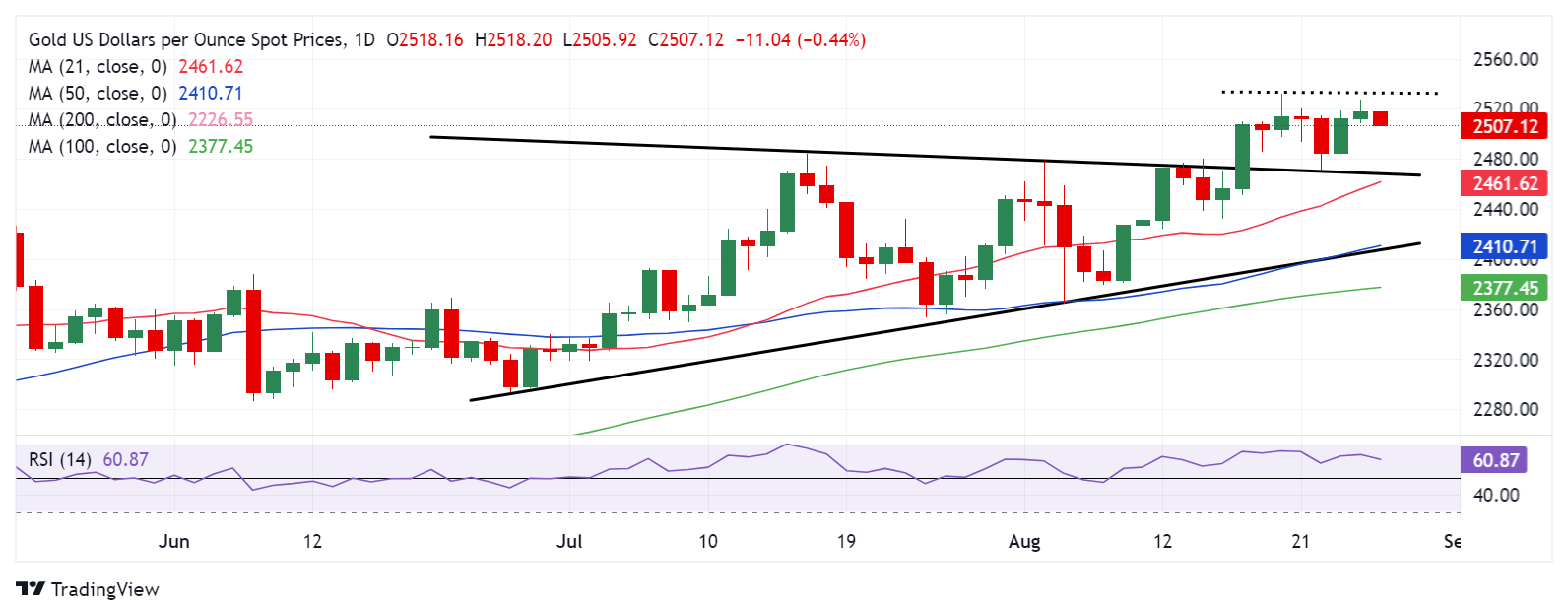
The short-term technical outlook for Gold price remains more or less the same, with the upside risks intact so long as buyers defend the triangle resistance-turned-support at $2,468.
The 21-day Simple Moving Average (SMA) closes in on that level, making it a strong support.
It’s worth mentioning that Gold price consolidates its upside break from a symmetrical triangle confirmed a couple of weeks ago.
Meanwhile, the 14-day Relative Strength Index (RSI) turns lower but holds comfortably above 50, currently near 61, justifying the bullish outlook.
Gold buyers need to recapture the record high of $2,532 to take on the next key barrier at the $2,550 level.
Acceptance above the latter could challenge the $2,600 round level en route to the triangle target, measured at $2,660.
On the flip side, the initial demand area is seen at the $2,500 threshold for Gold buyers, below which Friday’s low of $2,485 will be challenged.
A sustained breach of the latter could expose the downside toward the abovementioned triangle resistance-turned-support at $2,468.
Gold FAQs
Gold has played a key role in human’s history as it has been widely used as a store of value and medium of exchange. Currently, apart from its shine and usage for jewelry, the precious metal is widely seen as a safe-haven asset, meaning that it is considered a good investment during turbulent times. Gold is also widely seen as a hedge against inflation and against depreciating currencies as it doesn’t rely on any specific issuer or government.
Central banks are the biggest Gold holders. In their aim to support their currencies in turbulent times, central banks tend to diversify their reserves and buy Gold to improve the perceived strength of the economy and the currency. High Gold reserves can be a source of trust for a country’s solvency. Central banks added 1,136 tonnes of Gold worth around $70 billion to their reserves in 2022, according to data from the World Gold Council. This is the highest yearly purchase since records began. Central banks from emerging economies such as China, India and Turkey are quickly increasing their Gold reserves.
Gold has an inverse correlation with the US Dollar and US Treasuries, which are both major reserve and safe-haven assets. When the Dollar depreciates, Gold tends to rise, enabling investors and central banks to diversify their assets in turbulent times. Gold is also inversely correlated with risk assets. A rally in the stock market tends to weaken Gold price, while sell-offs in riskier markets tend to favor the precious metal.
The price can move due to a wide range of factors. Geopolitical instability or fears of a deep recession can quickly make Gold price escalate due to its safe-haven status. As a yield-less asset, Gold tends to rise with lower interest rates, while higher cost of money usually weighs down on the yellow metal. Still, most moves depend on how the US Dollar (USD) behaves as the asset is priced in dollars (XAU/USD). A strong Dollar tends to keep the price of Gold controlled, whereas a weaker Dollar is likely to push Gold prices up.
Author

Dhwani Mehta
FXStreet
Residing in Mumbai (India), Dhwani is a Senior Analyst and Manager of the Asian session at FXStreet. She has over 10 years of experience in analyzing and covering the global financial markets, with specialization in Forex and commodities markets.