Gold Price Forecast: XAU/USD looks to Powell speech for a clear directional impetus
- Gold price extends retreat from 10-day highs of $2,049 on the Fed day.
- Risk aversion props up the US Dollar even as Treasury bond yields tumble.
- Fed Chair Powell’s words hold the key for Gold price mixed technical indicators.

Gold price is extending its pullback from a ten-day high of $2,049 reached in the early American trading on Tuesday, as the US Dollar (USD) is attracting fresh demand amid broad risk-aversion on the all-important US Federal Reserve (Fed) interest rate decision day.
All eyes remain on Fed Chair Jerome Powell’s presser
Markets are sensing caution, as China’s economic concerns and escalating Middle East geopolitical tensions persist amid typical risk-averse trading heading into the Fed policy announcements. The tepid risk sentiment has revived the demand for the US Dollar as a safe-haven asset, fuelling a further retreat in Gold price.
The official manufacturing data from China showed contraction for the straight month in January, as the market angst continues over the lack of large stimulus moves by authorities to shore up the economy.
The downside in the Gold price, however, appears cushioned, thanks to the ongoing sell-off in the US Treasury bond yields, as investors remain wary ahead of Wednesday’s Treasury Department’s announcement of its bond-buying plan. Industry experts are expecting the US Treasury Department to increase the portion of longer-rated bonds as it did in recent debt-sale plans.
Also, repositioning in the bond market before the Fed interest rate decision and Chair Jerome Powell’s press conference could be attributed to the persistent weakness in the US Treasury bond yields.
The Fed is expected to leave the interest rates unchanged following the conclusion of its two-day policy meeting on Wednesday. The focus, however, will be on Powell's post-meeting press conference for any hints on the timing and pace of the interest rate cuts.
Data on Tuesday showed US JOLTS Job Openings unexpectedly increased in December, suggesting that the labor market still remains resilient, dissuading the Fed from delivering aggressive rate cuts.
Gold price technical analysis: Daily chart
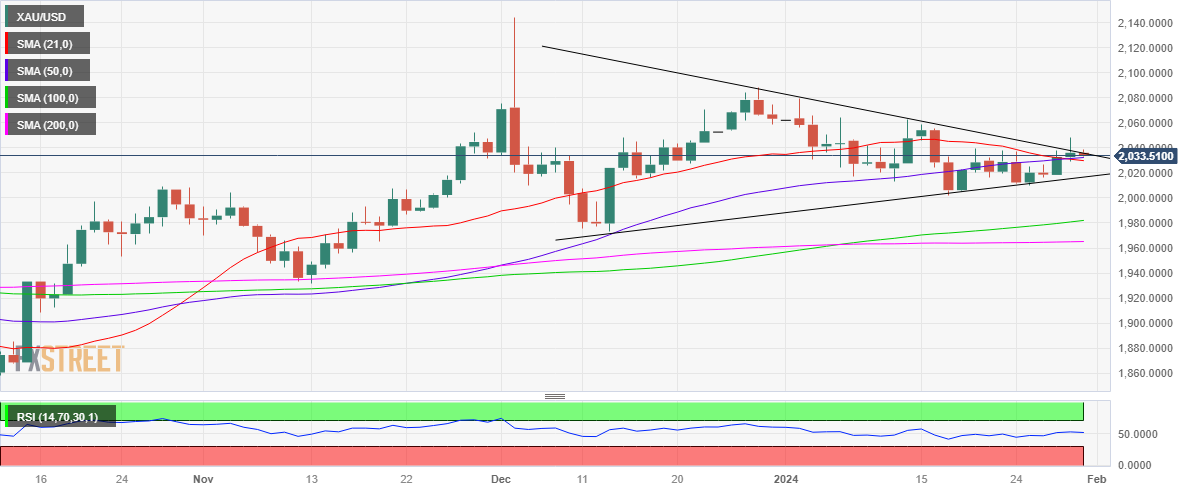
As observed on the daily chart, Gold price seems at a critical juncture, looking to confirm an upside break from a month-long symmetrical triangle formation.
The triangle breakout could be validated should the Gold price yield a daily closing above the falling trendline resistance at $2,036.
The 14-day Relative Strength Index (RSI) indicator recaptured the midline, justifying the latest upswing in the bright metal.
However, traders remain cautious as a Bear Cross was confirmed on Tuesday after the 21-day Simple Moving Average (SMA) crossed the 50-day SMA from above on a sustained basis.
Amid mixed technical indicators, it now remains to be seen if the Gold price could sustain its recent upbeat momentum.
The immediate strong resistance is seen around the $2,040 level, above which the psychological $2,050 level will be back in play. Further up, Gold optimists will target the December 12 high of 2,062.
On the downside, an immediate cushion is seen around the $2,030 region, where the 21- and 50-day SMAs hang around. If the latter gives way, Gold sellers will test the rising trendline support of $2,017 on their way to the key $2,000 threshold.
A balanced or hawkish tone perceived in Powell’s speech could revive the hawks and trigger a fresh downfall in the non-interest-bearing Gold price.
Gold FAQs
Why do people invest in Gold?
Gold has played a key role in human’s history as it has been widely used as a store of value and medium of exchange. Currently, apart from its shine and usage for jewelry, the precious metal is widely seen as a safe-haven asset, meaning that it is considered a good investment during turbulent times. Gold is also widely seen as a hedge against inflation and against depreciating currencies as it doesn’t rely on any specific issuer or government.
Who buys the most Gold?
Central banks are the biggest Gold holders. In their aim to support their currencies in turbulent times, central banks tend to diversify their reserves and buy Gold to improve the perceived strength of the economy and the currency. High Gold reserves can be a source of trust for a country’s solvency. Central banks added 1,136 tonnes of Gold worth around $70 billion to their reserves in 2022, according to data from the World Gold Council. This is the highest yearly purchase since records began. Central banks from emerging economies such as China, India and Turkey are quickly increasing their Gold reserves.
How is Gold correlated with other assets?
Gold has an inverse correlation with the US Dollar and US Treasuries, which are both major reserve and safe-haven assets. When the Dollar depreciates, Gold tends to rise, enabling investors and central banks to diversify their assets in turbulent times. Gold is also inversely correlated with risk assets. A rally in the stock market tends to weaken Gold price, while sell-offs in riskier markets tend to favor the precious metal.
What does the price of Gold depend on?
The price can move due to a wide range of factors. Geopolitical instability or fears of a deep recession can quickly make Gold price escalate due to its safe-haven status. As a yield-less asset, Gold tends to rise with lower interest rates, while higher cost of money usually weighs down on the yellow metal. Still, most moves depend on how the US Dollar (USD) behaves as the asset is priced in dollars (XAU/USD). A strong Dollar tends to keep the price of Gold controlled, whereas a weaker Dollar is likely to push Gold prices up.
Author

Dhwani Mehta
FXStreet
Residing in Mumbai (India), Dhwani is a Senior Analyst and Manager of the Asian session at FXStreet. She has over 10 years of experience in analyzing and covering the global financial markets, with specialization in Forex and commodities markets.