Gold Price Forecast: XAU/USD looks north amid light trading, focus shifts to US NFP
- Gold price sits at eight-day highs at $2,365 amid a US holiday-thinned trading.
- Downbeat US data keep the US Dollar and the Treasury yields undermined.
- Gold price charted a range breakout after settling Wednesday above the 50-day SMA.
- The daily RSI holds firm well above the 50 level, backing the Gold price upside.


Gold price is looking to extend the previous upsurge early Thursday, sitting at the highest level in over a week near $2,360. Sustained US Dollar (USD) weakness alongside sluggish US Treasury bond yields underpin Gold price amid the July 4 US holiday-thinned market conditions.
Gold price cheers dovish Fed expectations
Following US Federal Reserve (Fed) Chairman Jerome Powell’s remarks at the European Central Bank (ECB) Forum On Central Banking in Sintra on Tuesday, the USD sellers refuse to give up as Fed doves returned to the table with strong conviction after US economic data on Wednesday failed to impress, despite not-so-dovish Minutes of the June policy meeting.
Powell cheered the recent progress in disinflation on Tuesday, however, adding that he wants to see more before being confident enough to start cutting interest rates. Meanwhile, the ADP data on Wednesday showed that the US private sector employment rose 150,000 in June, following the 157,000 increase (revised from 152,000) recorded in May while coming in below the market forecast of 160,000.
The number of Americans filing first-time unemployment claims rose 4,000 last week to 238,000, according to Labor Department data released Wednesday.The figure was slightly higher than estimates of 235,000. Finally, US ISM Services PMI fell into contraction territory in June, arriving at 48.8 vs. May’s 53.8 and the expected 52.5 print.
Later in the American trading on Wednesday, the Fed published the June meeting Minutes, which showed that officials “emphasized that they did not expect that it would be appropriate to lower the target range for the federal funds rate until additional information had emerged to give them greater confidence that inflation was moving sustainably toward the Committee’s 2 percent objective.”
Discouraging US data ramped up September Fed rate cut bets, with markets now pricing a 73% chance, against a 67% probability seen before the data release. This smashed the US Treasury bond yields across the curve, heavily weighing on the US Dollar. Gold price tends to benefit in times of low interest-rates era.
Gold price continues to capitalize on the dovish Fed expectations heading into the US Independence Day holiday, with moves likely to be exaggerated likely to be exaggerated by low liquidity and repositioning ahead of the all-important US Nonfarm Payrolls data due on Friday.
In the meantime, investors would prefer to seek safety in the Gold price, as the UK general elections get underway on Thursday, heightening market anxiety even though the Labour Party is set for a sweeping victory for the first time in 14 years.
Gold price technical analysis: Daily chart
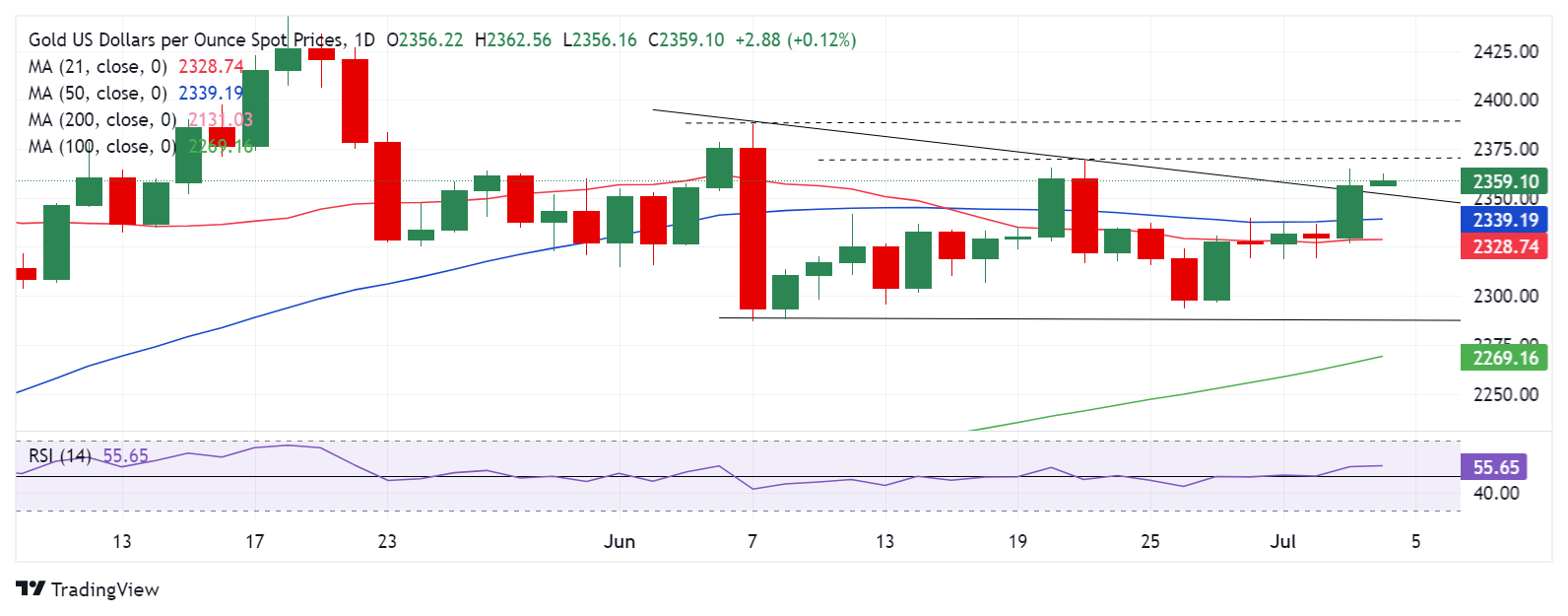
As observed on the daily chart, Gold price broke this week’s consolidation to the upside after closing Wednesday above the key 50-day Simple Moving Average (SMA), then at $2,338.
The bullish breakout gained momentum, as Gold price also took out the falling trendline resistance at $2,353 on a daily closing basis.
The 14-day Relative Strength Index (RSI) pierced through the 50 level for upside, reinforcing the bullish interests.
Gold buyers now need a sustained break above the two-week high of $2,369 to extend the uptrend toward the June high of $2,389. Further up, the $2,400 threshold will be tested.
Conversely, the immediate support is seen at the falling trendline resistance-turned-support, now at $2,351, below which the 50-day SMA at $2,339 will be come into play.
Gold sellers could flex their muscles toward the 21-day SMA at $2,329 should the selling momentum intensify.
Gold FAQs
Gold has played a key role in human’s history as it has been widely used as a store of value and medium of exchange. Currently, apart from its shine and usage for jewelry, the precious metal is widely seen as a safe-haven asset, meaning that it is considered a good investment during turbulent times. Gold is also widely seen as a hedge against inflation and against depreciating currencies as it doesn’t rely on any specific issuer or government.
Central banks are the biggest Gold holders. In their aim to support their currencies in turbulent times, central banks tend to diversify their reserves and buy Gold to improve the perceived strength of the economy and the currency. High Gold reserves can be a source of trust for a country’s solvency. Central banks added 1,136 tonnes of Gold worth around $70 billion to their reserves in 2022, according to data from the World Gold Council. This is the highest yearly purchase since records began. Central banks from emerging economies such as China, India and Turkey are quickly increasing their Gold reserves.
Gold has an inverse correlation with the US Dollar and US Treasuries, which are both major reserve and safe-haven assets. When the Dollar depreciates, Gold tends to rise, enabling investors and central banks to diversify their assets in turbulent times. Gold is also inversely correlated with risk assets. A rally in the stock market tends to weaken Gold price, while sell-offs in riskier markets tend to favor the precious metal.
The price can move due to a wide range of factors. Geopolitical instability or fears of a deep recession can quickly make Gold price escalate due to its safe-haven status. As a yield-less asset, Gold tends to rise with lower interest rates, while higher cost of money usually weighs down on the yellow metal. Still, most moves depend on how the US Dollar (USD) behaves as the asset is priced in dollars (XAU/USD). A strong Dollar tends to keep the price of Gold controlled, whereas a weaker Dollar is likely to push Gold prices up.
Premium
You have reached your limit of 3 free articles for this month.
Start your subscription and get access to all our original articles.
Author
Dhwani Mehta
FXStreet
Residing in Mumbai (India), Dhwani is a Senior Analyst and Manager of the Asian session at FXStreet. She has over 10 years of experience in analyzing and covering the global financial markets, with specialization in Forex and commodities markets.