Gold Price Forecast: XAU/USD focuses on US PCE Inflation and daily close below $2,360
- Gold price holds the bounce off the $2,350 level as Friday’s trading kicks off.
- US Dollar rebound falters with US Treasury bond yields, supporting the Gold price upswing.
- China’s economic woes remain a cause for concern while September Fed rate cut odds stay intact.
- Gold buyers defend 50-day SMA at $2,360 head into the monthly US PCE data release.

Gold price has managed to defend the key support near $2,360, consolidating weekly losses in Friday’s Asian session. Traders now shift their focus toward the monthly release of the US Personal Consumption Expenditures (PCE) Price Index after Thursday’s second-quarter Gross Domestic Product (GDP).
Will US inflation data trigger a fresh leg lower in Gold price?
US GDP expanded at an annualized rate of 2.8% in Q2 2024, doubling from the 1.4% growth reported in the previous quarter. The US Dollar (USD) jumped higher in an immediate reaction to the US GDP report but quickly returned to a familiar range, as markets digested the quarterly core PCE inflation and Jobless Claims data.
“The core PCE deflator (the Federal Reserve’s preferred inflation measure) rose 2.9% at an annualized rate in Q2, down from 3.7% in the previous quarter, indicating a moderation in inflationary pressure,” analysts at RBC Economics noted. Meanwhile, Initial Jobless Claims dropped 10,000 to a seasonally adjusted 235,000 for the week ended July 20, the Labor Department said on Thursday.
Markets continued to fully price in a US Federal Reserve (Fed) interest-rate cut in September, despite the acceleration in the US economic growth, as disinflation remains in progress. Gold price initially reacted negatively to the US GDP release, accelerating its downside to over two-month lows of $2,353 but staged a modest comeback on softer US core PCE inflation reading, settling Thursday above the key support at $2,360.
In the first half of Thursday’s trading, Gold price tumbled over 1%, having faced rejection at $2,400, undermined by profit-taking amid the market’s repositioning ahead of high-impact US economic data. China’s economic slowdown concerns also played a part in the Gold price sell-off, as investors raised demand concerns from the world’s top yellow metal consumer.
Gold buyers also found some respite from the persistent weakness in the USD/JPY pair, as the Japanese Yen carry trading unwinding gathered pace ahead of next week’s Bank of Japan’s (BoJ) policy meeting. Odds of a BoJ rate hike next week are on the rise, with additional credence coming in from Tokyo inflation data released early Friday.
Later on Friday, the annual core US PCE Price Index is expected to show an increase of 2.5% in June, a tad softer than the 2.6% booked in May. The headline annual figure is also expected to rise by 2.5% in the same period. An in-line with market expectations or a softer-than-expected US core PCE inflation print is likely to serve as a saving grace to Gold buyers.
The reaction to the data is mostly discount after Thursday’s quarterly core PCE data but the end-of-the-week flows and positions adjustments, ahead of the Fed policy announcements and Nonfarm Payrolls data next week, could spike up volatility around Gold price.
Gold price technical analysis: Daily chart
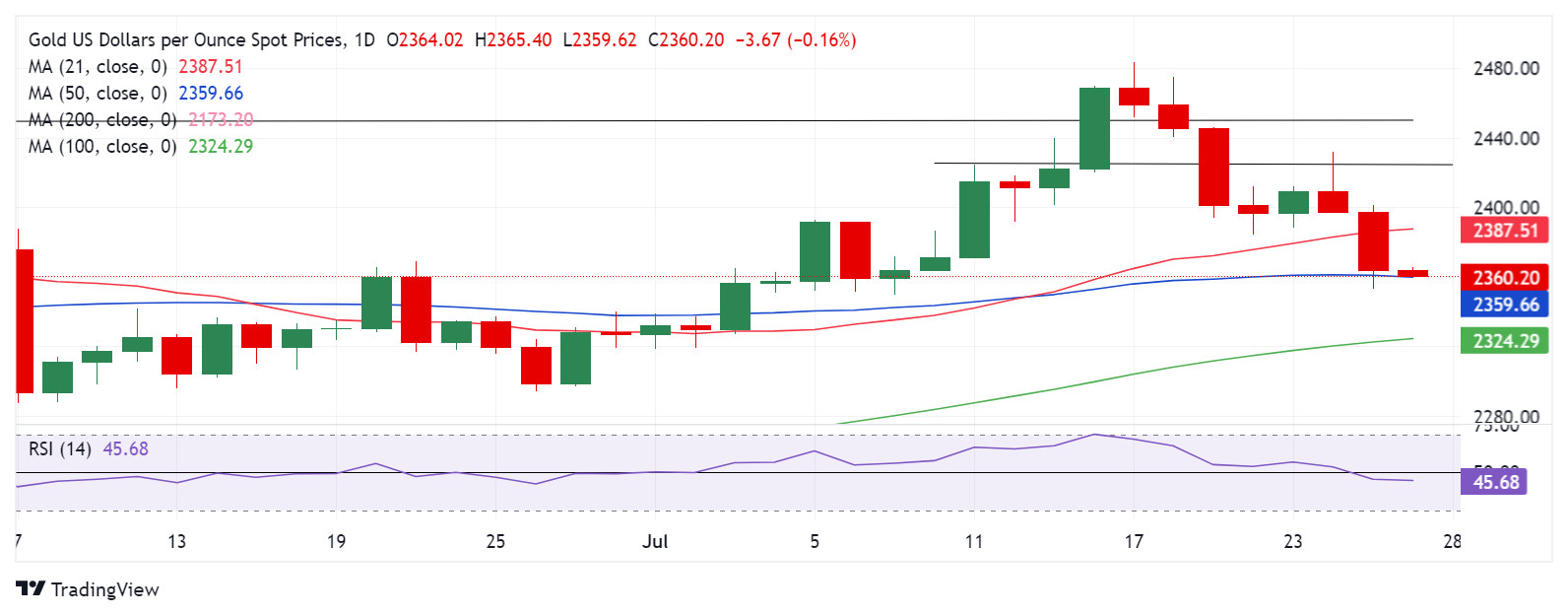
Gold sellers retain control early Friday, with the 14-day Relative Strength Index (RSI) holding its position below the 50 level, currently near 46.
They are once again attacking the key 50-day Simple Moving Average (SMA) at $2,360. Gold price needs a daily close below that level to initiate a fresh downtrend toward the 100-day SMA support at $2,324.
Buyers, however, could find support again at the $2,350 psychological level
On the flip side, the immediate resistance is seen at the previous support of the 21-day SMA at $2,387, above which the $2,400 mark could be retested.
The next recovery targets are seen at the $2,412 area and the $2,425 static resistance.
Economic Indicator
Personal Consumption Expenditures - Price Index (YoY)
The Personal Consumption Expenditures (PCE), released by the US Bureau of Economic Analysis on a monthly basis, measures the changes in the prices of goods and services purchased by consumers in the United States (US). The YoY reading compares prices in the reference month to a year earlier. Price changes may cause consumers to switch from buying one good to another and the PCE Deflator can account for such substitutions. This makes it the preferred measure of inflation for the Federal Reserve. Generally, a high reading is bullish for the US Dollar (USD), while a low reading is bearish.
Read more.Next release: Fri Jul 26, 2024 12:30
Frequency: Monthly
Consensus: 2.5%
Previous: 2.6%
Source: US Bureau of Economic Analysis
Author

Dhwani Mehta
FXStreet
Residing in Mumbai (India), Dhwani is a Senior Analyst and Manager of the Asian session at FXStreet. She has over 10 years of experience in analyzing and covering the global financial markets, with specialization in Forex and commodities markets.