Gold Price Forecast: XAU/USD eyes acceptance above $2,050 on dismal US Nonfarm Payrolls data
- Gold price is extending its range-play near $2,030 early Friday.
- US Dollar is licking its wounds, as US Treasury bond yields cling to recovery gains.
- Gold price looks north on a weak US Nonfarm Payrolls report, as the daily chart leans bullish.

Gold price is extending its range-play into the fourth straight trading day early Friday, as investors prefer to stay on the sidelines before the release of the all-important Nonfarm Payrolls data later in the day.
US Nonfarm Payrolls could offer a fresh boost to Gold price
Gold price is treading water, lacking any impetus, as traders refrain from placing any fresh directional bets on the United States Dollar (USD) in the lead-up to the critical US jobs data. The US Dollar is licking its wounds after falling hard in tandem with the USD/JPY pair. The Japanese Yen rallied over 500 pips against the US Dollar on Thursday, smashing USD/JPY to a new four-month low of 141.63 on hopes of a Bank of Japan’s (BoJ) policy pivot earlier than expected.
Despite the US Dollar sell-off, Gold price failed to benefit, as the US Treasury bond yields rebounded firmly from multi-month lows, diminishing the appeal of the non-interest-bearing Gold price. Markets resort to repositioning in the US government bonds and the US Dollar, as they seek to lock in profits heading toward next week’s Federal Reserve (Fed) interest rate decision.
In the meantime, the highly anticipated US labor market data will be closely scrutinized for fresh hints on the Fed’s interest rate outlook, with markets pricing roughly 60% odds of a rate cut in March. The NFP data is expected to show that the US economy added 180K jobs in November, as against the previous job growth of 150K while wage inflation, as measured by Average Hourly Earnings, is seen rising 4.0% YoY in November.
The latest US ADP and JOLTS Job Openings data pointed to loosening labor market conditions. If a weak US NFP print confirms that, the Fed rate cuts are likely to shoot up, smashing the US Dollar alongside the US Treasury bond yields. In such a case, Gold price is likely to reclaim the $2,050 barrier on a sustained basis. Contrarily, should the data outpace expectations, markets could use that as an excuse for profit-taking ahead of the Fed verdict. The Gold price correction could then resume toward the $2,000 mark.
Gold price technical analysis: Daily chart
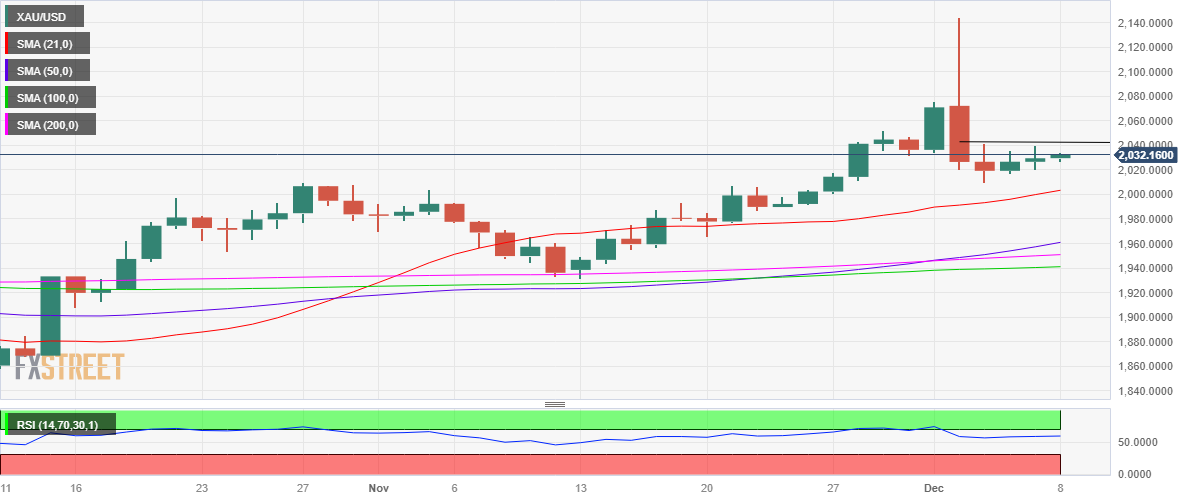
As observed on the daily chart, Gold price has been making higher lows following Monday’s volatile trading, suggesting that there is more scope for a fresh upside.
The 14-day Relative Strength Index (RSI) indicator edges higher above the midline, backing the bullish potential in Gold price.
Gold buyers need to find acceptance above the $2,050 region to unleash additional advances toward the $2,100 threshold.
Fresh buying opportunities will pop up above the latter, targeting the all-time highs of $2,144.
On the other hand, the immediate support is seen at Tuesday’s low of $2,009, below which the $2,000 threshold will be a critical test for bullish traders. At that level, the 21-day Simple Moving Average (SMA) aligns.
The next downside cushion is then seen at the $1,980 round figure.
Gold FAQs
Why do people invest in Gold?
Gold has played a key role in human’s history as it has been widely used as a store of value and medium of exchange. Currently, apart from its shine and usage for jewelry, the precious metal is widely seen as a safe-haven asset, meaning that it is considered a good investment during turbulent times. Gold is also widely seen as a hedge against inflation and against depreciating currencies as it doesn’t rely on any specific issuer or government.
Who buys the most Gold?
Central banks are the biggest Gold holders. In their aim to support their currencies in turbulent times, central banks tend to diversify their reserves and buy Gold to improve the perceived strength of the economy and the currency. High Gold reserves can be a source of trust for a country’s solvency. Central banks added 1,136 tonnes of Gold worth around $70 billion to their reserves in 2022, according to data from the World Gold Council. This is the highest yearly purchase since records began. Central banks from emerging economies such as China, India and Turkey are quickly increasing their Gold reserves.
How is Gold correlated with other assets?
Gold has an inverse correlation with the US Dollar and US Treasuries, which are both major reserve and safe-haven assets. When the Dollar depreciates, Gold tends to rise, enabling investors and central banks to diversify their assets in turbulent times. Gold is also inversely correlated with risk assets. A rally in the stock market tends to weaken Gold price, while sell-offs in riskier markets tend to favor the precious metal.
What does the price of Gold depend on?
The price can move due to a wide range of factors. Geopolitical instability or fears of a deep recession can quickly make Gold price escalate due to its safe-haven status. As a yield-less asset, Gold tends to rise with lower interest rates, while higher cost of money usually weighs down on the yellow metal. Still, most moves depend on how the US Dollar (USD) behaves as the asset is priced in dollars (XAU/USD). A strong Dollar tends to keep the price of Gold controlled, whereas a weaker Dollar is likely to push Gold prices up.
Author

Dhwani Mehta
FXStreet
Residing in Mumbai (India), Dhwani is a Senior Analyst and Manager of the Asian session at FXStreet. She has over 10 years of experience in analyzing and covering the global financial markets, with specialization in Forex and commodities markets.