Gold Price Forecast: XAU/USD extends range play as focus shifts to US Nonfarm Payrolls
- Gold price remains confined in a tight range between two key technical barriers.
- The US dollar and treasury yields attempt recovery after the Fed Chair Powell slump.
- Gold price lacks a clear directional bias amid a neutral daily RSI, eyeing US Nonfarm Payrolls.

Gold's price continues with its narrow range struggle at around $2,650 early Thursday, stalling Federal Reserve (Fed) Chairman Jerome Powell’s speech-led uptick. The focus now remains on the US Jobless Claims data due later in the day in the lead-up to the all-important Nonfarm Payrolls (NFP) data.
Gold price fails to defend Powell-led bid
Gold buyers seem to have turned cautious yet again, as the US Dollar (USD) and US Treasury bond yields recover from the overnight slump fuelled by Powell’s optimistic comments on the US economy at the New York Times' DealBook Summit.
Powell said in his speech that "Growth is definitely stronger than we thought, and inflation is coming a little higher," Powell said at the event. "The good news is that we can afford to be a little more cautious as we try to find neutral," he added, referring to the neutral interest rate.
His comments powered the Wall Street indices to fresh highs on increased ‘soft-landing’ hopes, weighing on the safe-haven US Dollar while boosting Gold price. Fed Chair Jerome Powell’s words, however, failed to alter the market’s pricing of 25 basis points (bps) interest rate cut later this month, which weighed heavily on the US Treasury bond yields across the curve, aiding the rebound in Gold price.
Markets continue pricing in a 73% probability of a Dec Fed rate reduction, the CME Group’s FedWatch Tool shows, more or less the same as a day ago.
During the first half of Wednesday’s trading, Gold price struggled amid a modest US Dollar upswing, courtesy of a risk-averse market mood on China’s economic concerns, looming US-Sino trade tensions and geopolitical risks.
Looking ahead, the broader market sentiment will play a pivotal role in the Gold price action but traders could refrain from placing fresh directional bets on the bright metal, anticipating the high-impact US labor market report on Friday. Data released by the ADP showed Wednesday that US private sector employment grew by 146,000 jobs last month, lower than the 150,000 figure that analysts expected.
Markets will also pay close attention to any developments on the global trade front and Middle East geopolitics, which could significantly impact risk sentiment and the USD-sensitive Gold price. Earlier on, an adviser to US President-elect Donald Trump said that Trump “wants to implement an Israel-Gaza cease-fire deal Gaza without delay and before January 20.”
Gold price technical analysis: Daily chart
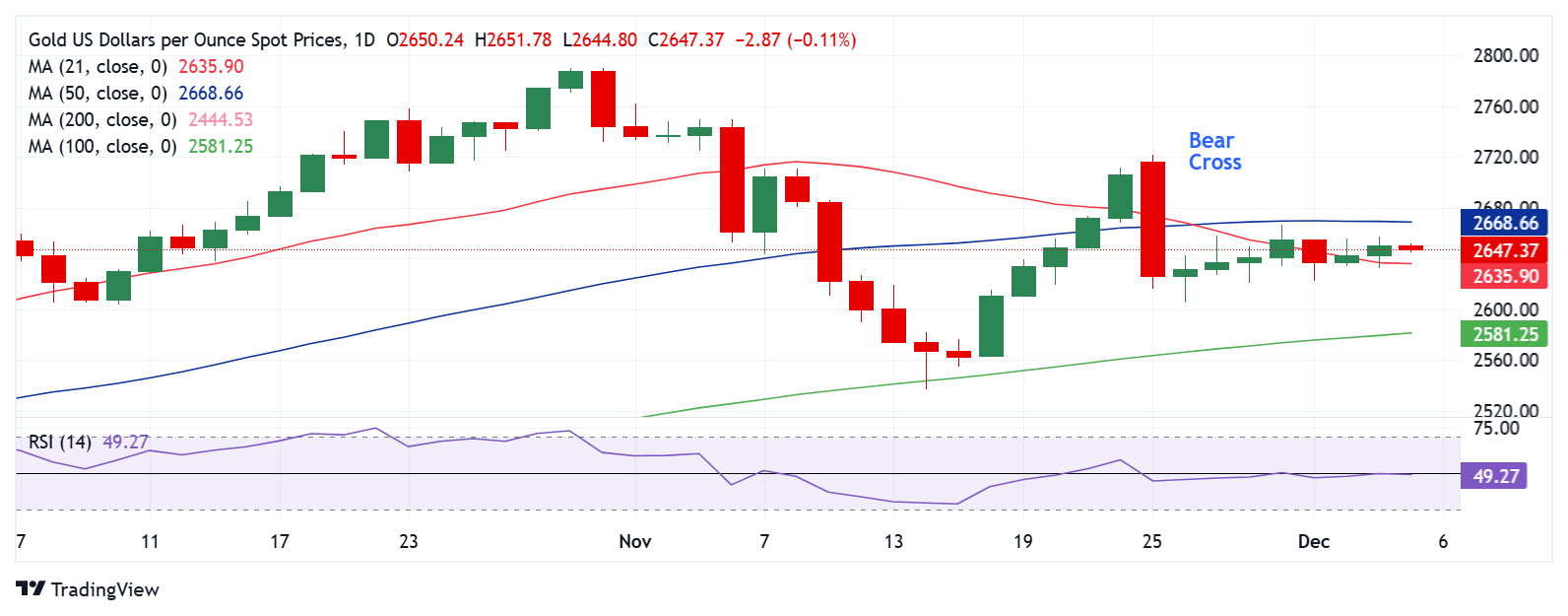
The daily chart shows that Gold's price remains stuck between the critical short-term 21-day Simple Moving Average (SMA) at $2,636 and the 50-day SMA at $2,669.
The 14-day Relative Strength Index (RSI) sits just beneath the 50 level, suggesting a lack of clear directional bias.
The previous week’s Bear Cross still remains a threat to Gold buyers.
Recapturing the 50-day SMA resistance at $2,669 on a daily closing basis is critical for buyers to affirm the recovery.
The next relevant resistance aligns at $2,700, above which the November 25 high of $2,721 will be tested.
Conversely, Gold sellers must find a foothold below the 21-day SMA at $2,636 to crack the $2,621 static support.
The previous week’s low of $2,605 will be the line in the sand for Gold buyers.
Gold FAQs
Gold has played a key role in human’s history as it has been widely used as a store of value and medium of exchange. Currently, apart from its shine and usage for jewelry, the precious metal is widely seen as a safe-haven asset, meaning that it is considered a good investment during turbulent times. Gold is also widely seen as a hedge against inflation and against depreciating currencies as it doesn’t rely on any specific issuer or government.
Central banks are the biggest Gold holders. In their aim to support their currencies in turbulent times, central banks tend to diversify their reserves and buy Gold to improve the perceived strength of the economy and the currency. High Gold reserves can be a source of trust for a country’s solvency. Central banks added 1,136 tonnes of Gold worth around $70 billion to their reserves in 2022, according to data from the World Gold Council. This is the highest yearly purchase since records began. Central banks from emerging economies such as China, India and Turkey are quickly increasing their Gold reserves.
Gold has an inverse correlation with the US Dollar and US Treasuries, which are both major reserve and safe-haven assets. When the Dollar depreciates, Gold tends to rise, enabling investors and central banks to diversify their assets in turbulent times. Gold is also inversely correlated with risk assets. A rally in the stock market tends to weaken Gold price, while sell-offs in riskier markets tend to favor the precious metal.
The price can move due to a wide range of factors. Geopolitical instability or fears of a deep recession can quickly make Gold price escalate due to its safe-haven status. As a yield-less asset, Gold tends to rise with lower interest rates, while higher cost of money usually weighs down on the yellow metal. Still, most moves depend on how the US Dollar (USD) behaves as the asset is priced in dollars (XAU/USD). A strong Dollar tends to keep the price of Gold controlled, whereas a weaker Dollar is likely to push Gold prices up.
Author

Dhwani Mehta
FXStreet
Residing in Mumbai (India), Dhwani is a Senior Analyst and Manager of the Asian session at FXStreet. She has over 10 years of experience in analyzing and covering the global financial markets, with specialization in Forex and commodities markets.