Gold Price Forecast: XAU/USD could run into sellers at $2,655 on the road to recovery
- Gold price builds on the previous recovery above $2,600 early Tuesday.
- Geopolitical risks and US Dollar pullback alongside Treasury bond yields power Gold price.
- Gold price eyes 50-day SMA resistance at $2,655 as the daily RSI remains bearish.

Gold price extends the recovery into Asian trading on Tuesday, reversing half the previous week’s decline. The focus remains on the upcoming speeches from US Federal Reserve (Fed) policymakers and geopolitical tensions between Russia and Ukraine.
Gold price gains on easing US Treasury bond yields
Gold price stays firm for the second consecutive day so far, drawing support from the recent retracement in the US Treasury bond yields across the curve, fuelling the corrective downside in the US Dollar (USD) against its major currency rivals.
The US bond yields have embarked upon a correction mode as investors remain wary of the impact of the potential fiscal and trade policies to be introduced by US President-elect Donald Trump on the economic and inflation outlook.
Additionally, Gold price capitalizes on the renewed geopolitical escalation between Russia and Ukraine after US President Joe Biden authorized Ukraine to use American Army Tactical Missile Systems (ATACMS) to strike inside Russia on Sunday. The decision to allow the use of long-range US weapons inside Russia came after Moscow deployed North Korean ground troops to supplement its own forces.
Moreover, expectations of more stimulus measures coming in from China also bode well for the bright metal. China is the world’s top Gold consumer. Securities Journal, Chinese state media, quoted analysts saying further cuts to the Reserve Requirement Ratio (RRR) coming this year.
Note that China is the world’s top Gold consumer, and any support measures by the local authorities to boost economic performance seem positive for the precious metal. However, it remains to be seen if Gold price manages to hold on to its recovery momentum as traders turn cautious, awaiting more cues on the Fed’s interest rate outlook from the central bank talks due Tuesday and later this week.
Also, traders could refrain from placing fresh bets on the yellow metal ahead of the American AI giant Nvidia Inc.’s earnings report, which could significantly impact the broader market sentiment and the value of the USD, eventually influencing the USD-sensitive Gold price.
Gold price technical analysis: Daily chart
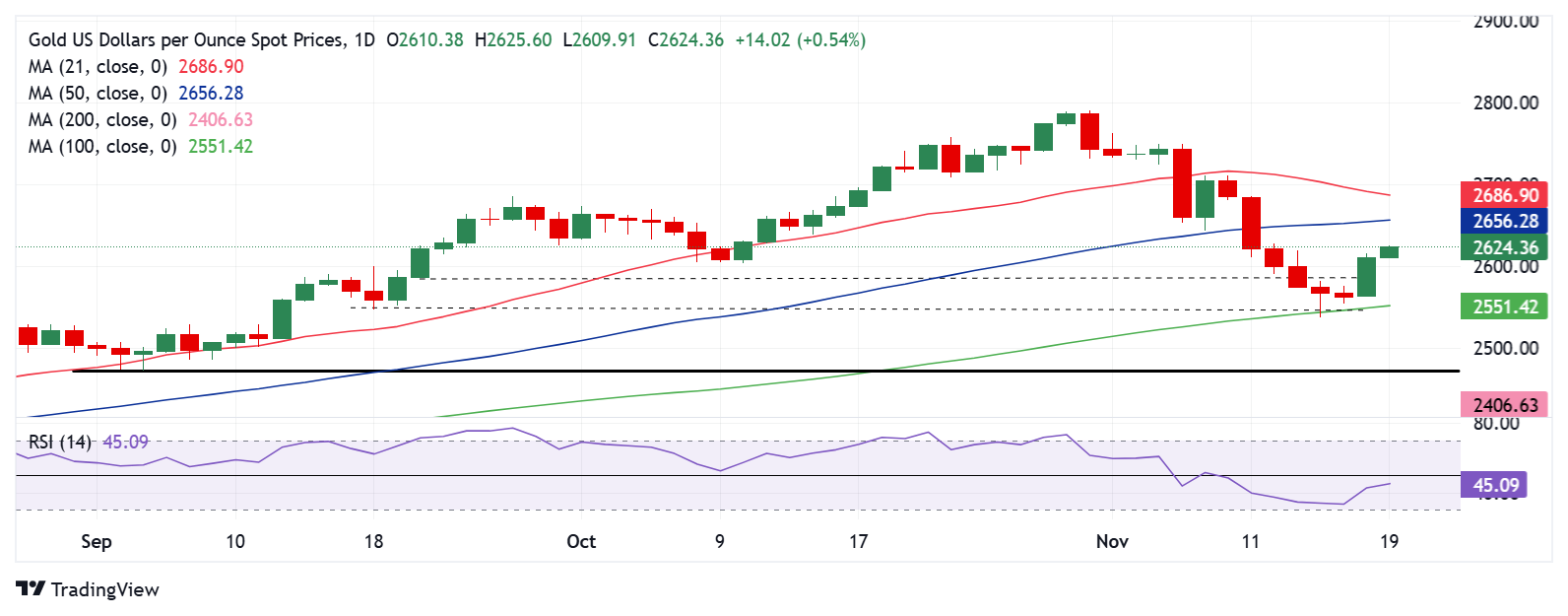
Technically, Gold price appears to be a ‘sell on bounce’ trade as long as the 14-day Relative Strength Index (RSI) remains below the 50 level. The indicator is currently trading near 45.
The immediate resistance is seen at the $2,630 round number, above which a strong topside barrier aligns at the 50-day Simple Moving Average (SMA) at $2,655.
Acceptance above the latter is critical to sustaining the recovery mode from two-month troughs of $2,537.
The next stiff resistance is located at $2,687, the 21-day SMA.
Failing to find a foothold above the 50-day SMA on a daily closing basis could revive the bearish sentiment, reinforcing sellers toward the $2,600 threshold.
Additional declines could threaten the confluence support at $2,551, where the 100-day SMA coincides with the September 18 low.
A sustained break below the last will trigger a fresh downtrend toward the $2,500 threshold, with the next bearish target seen at the September 4 low of $2,472.
Gold FAQs
Gold has played a key role in human’s history as it has been widely used as a store of value and medium of exchange. Currently, apart from its shine and usage for jewelry, the precious metal is widely seen as a safe-haven asset, meaning that it is considered a good investment during turbulent times. Gold is also widely seen as a hedge against inflation and against depreciating currencies as it doesn’t rely on any specific issuer or government.
Central banks are the biggest Gold holders. In their aim to support their currencies in turbulent times, central banks tend to diversify their reserves and buy Gold to improve the perceived strength of the economy and the currency. High Gold reserves can be a source of trust for a country’s solvency. Central banks added 1,136 tonnes of Gold worth around $70 billion to their reserves in 2022, according to data from the World Gold Council. This is the highest yearly purchase since records began. Central banks from emerging economies such as China, India and Turkey are quickly increasing their Gold reserves.
Gold has an inverse correlation with the US Dollar and US Treasuries, which are both major reserve and safe-haven assets. When the Dollar depreciates, Gold tends to rise, enabling investors and central banks to diversify their assets in turbulent times. Gold is also inversely correlated with risk assets. A rally in the stock market tends to weaken Gold price, while sell-offs in riskier markets tend to favor the precious metal.
The price can move due to a wide range of factors. Geopolitical instability or fears of a deep recession can quickly make Gold price escalate due to its safe-haven status. As a yield-less asset, Gold tends to rise with lower interest rates, while higher cost of money usually weighs down on the yellow metal. Still, most moves depend on how the US Dollar (USD) behaves as the asset is priced in dollars (XAU/USD). A strong Dollar tends to keep the price of Gold controlled, whereas a weaker Dollar is likely to push Gold prices up.
Author

Dhwani Mehta
FXStreet
Residing in Mumbai (India), Dhwani is a Senior Analyst and Manager of the Asian session at FXStreet. She has over 10 years of experience in analyzing and covering the global financial markets, with specialization in Forex and commodities markets.

















