Gold Price Forecast: XAU/USD could recapture $2,000 on weak US NFP data
- Gold price treads water below $2,000, awaits US Nonfarm Payrolls for a fresh impetus.
- US Dollar stalls sell-off with US Treasury bond yields as risk tone turns cautious.
- Gold price is poised for a fresh advance amid a bullish daily technical setup.

Gold price is gathering pace for a fresh run toward the $2,000 threshold early Friday, as the United States Dollar (USD) and US Treasury bond yields consolidate their weekly losses ahead of the all-important US Nonfarm Payrolls (NFP) data release.
All eyes on the United States Nonfarm Payrolls data
Gold price is finding support from a subdued performance in the US Dollar and the US Treasury bond yields, as they struggle to stabilize, following the steep losses incurred in the aftermath of a non-committal US Federal Reserve (Fed) policy outlook.
The sell-off in the US Dollar extended on Thursday, as the benchmark 10-year US Treasury bond yields breached the 4.70% key level on increased expectations that the Federal Reserve is done with hiking rates. Further, a hawkish pause from the Bank of England (BoE) boosted the GBP/USD pair, weighing down on the US Dollar. The BoE kept the policy rate steady at 5.25%, as widely expected but three policymakers voted in favor of a hike, suggesting that the door remains open for future rate hikes.
Downbeat US weekly Jobless Claims data exacerbated the pain in the US Dollar, motivating Gold buyers to briefly regain the $1,990 level. Initial Jobless Claims in the US increased by 5,000 in the week ending October 27 to the highest level in seven weeks. However, the less hawkish Fed-led global risk rally extended and the US stocks surged nearly 2.0% on Thursday, reducing the safe-haven demand for Gold price, as well as, the US Dollar.
Gold price managed to stay afloat and ended the day in the green near $1,985, as markets priced an 80% chance that the Fed will leave rates unchanged in December, according to the CME FedWatch tool.
Looking ahead, all eyes remain on the US labor market report, with the key focus on the headline NFP figure, which is foreseen at 180K in October, as against a 336K increase in September. Average Hourly Earnings are seen rising 4.0% in the reported period, compared with a 4.2% increase in September. A weak headline NFP print and soft wage inflation are likely to confirm market expectations that the Fed’s tightening cycle is likely over, triggering a fresh US Dollar selling wave. In such as case, Gold price could see a fresh upside to retake the $2,000 barrier.
Conversely, a big beat on the US jobs data is needed to reinforce December Fed rate hike bets, which could help the US Dollar recover some of its weekly losses. Gold price is likely to resume its correction toward $1,950 on a strong US NFP report.
Gold price technical analysis: Daily chart
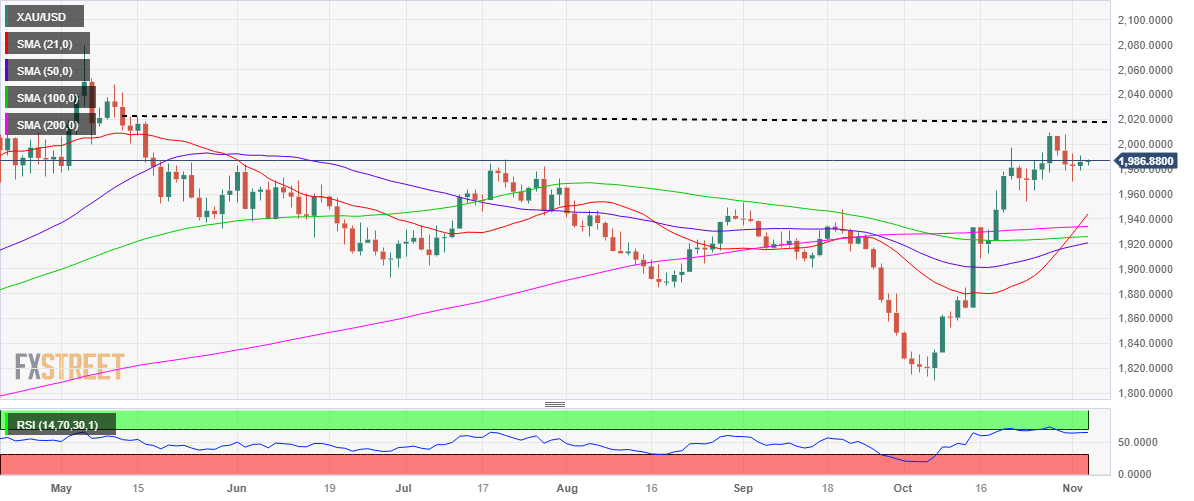
Gold price found fresh demand on Thursday, although remained capped below the $2,000 level. Looking ahead, risks remain tilted to the upside for Gold price, as several Bull Crosses remain in play and the 14-day Relative Strength Index (RSI) indicator sits just beneath the overbought territory.
The 21-day Simple Moving Average (SMA) broke above all the key major SMAs, confirming multiple Bull Cross earlier this week.
If the Gold price rebound gains traction, immediate resistance is seen at Wednesday’s high of $1,993, above which the $2,000 threshold will be retested.
Acceptance above the multi-month high of $2,009 is critical to reviving the uptrend toward the mid-May high near $2,020.
On the downside, strong support awaits at Wednesday’s low of $1,970. A failure to resist above the latter will target the static support at $1,963, paving the way toward the $1,950 psychological level.
(This story was corrected on November 3 at 09:38 GMT to say that Gold buyers briefly regained the $1,990 level, not $1,900.)
Author

Dhwani Mehta
FXStreet
Residing in Mumbai (India), Dhwani is a Senior Analyst and Manager of the Asian session at FXStreet. She has over 10 years of experience in analyzing and covering the global financial markets, with specialization in Forex and commodities markets.