Gold Price Forecast: XAU/USD captures $2,700 for first time ever, what’s next?
- Gold price sits at record highs above $2,700, awaits Fedspeak for fresh impetus.
- The US Dollar consolidates weekly gains after riding on a likely Trump victory optimism.
- The daily RSI prods overbought territory but Gold buyers are not ready to give up yet.

Gold price is sitting at the highest level on record above $2,70o early Friday, with the latest uptick led by China’s stimulus optimism and a broad-based US Dollar (USD) pullback. The focus now shifts to the Middle East geopolitical updates and Fedspeak for further trading impetus.
Gold price eyes Mideast tensions, Fedspeak
The USD retreats from over two-month highs against its six major rivals in Asian trades on Friday, as buyers take a breather after the recent rally back by the market’s optimism that Republican nominee Donald Trump is set to win the 2024 US presidential elections. Trump’s fiscal and trade policies are seen as inflationary and positive for the Greenback.
Besides, markets witness a positive shift in risk sentiment, as the mixed Chinese growth and activity data combined with the People’s Bank of China’s statement have rekindled stimulus hopes. The renewed market optimism also diminishes the Greenback’s appeal as a safe-haven currency.
Therefore, Gold price receives a double booster shot, first from a broad USD retracement and then from expectations of further interest-rate cuts from China. Chinese central bank Governor Pan Gongsheng said that “depending on market liquidity, reserve requirement ratio (RRR) could be further reduced by 0.25 to 0.5 percentage points before the end of the year.”
He noted that “the interest rate of 7-day reverse repo operation in the open market will be lowered by 0.2 percentage points,” adding, “It is expected that the loan market prime rate (LPR) could also fall by 0.2-0.25 percentage points.”
A period of low-interest-rate regime tends to benefit the non-interest-rate bearing Gold price.
That said, the European Central Bank (ECB) lowered key policy rates for the third time this year on Thursday but did not provide any forward guidance on the rates outlook. However, four sources close to the matter told Reuters a fourth cut in December is likely unless economic or inflation data turns around in the coming weeks.
Meanwhile, US Retail Sales rose 0.4% in September after an unrevised 0.1% gain in August, the Commerce Department's Census Bureau said on Thursday. Strong US data indicated robust economic prospects but that failed to alter the odds of a 25 basis points (bps) rate cut by the US Federal Reserve (Fed) in November. Markets are currently pricing in a 93% probability of such a move by the Fed next month.
Additionally, Gold price found fresh haven demand amidst escalating geopolitical tensions between Iran and Israel. Iran-backed militant group, Hezbollah, said it will escalate war with Israel after Israel’s Foreign Minister confirmed the killing of Hamas leader Yahya Sinwar on Thursday.
Looking ahead, all eyes remain on the speeches from several Fed policymakers and the rife tensions in the Middle East for further upside in Gold price. The end-of-the-week flows could also play its part in driving the volatility around Gold price.
Gold price technical analysis: Daily chart
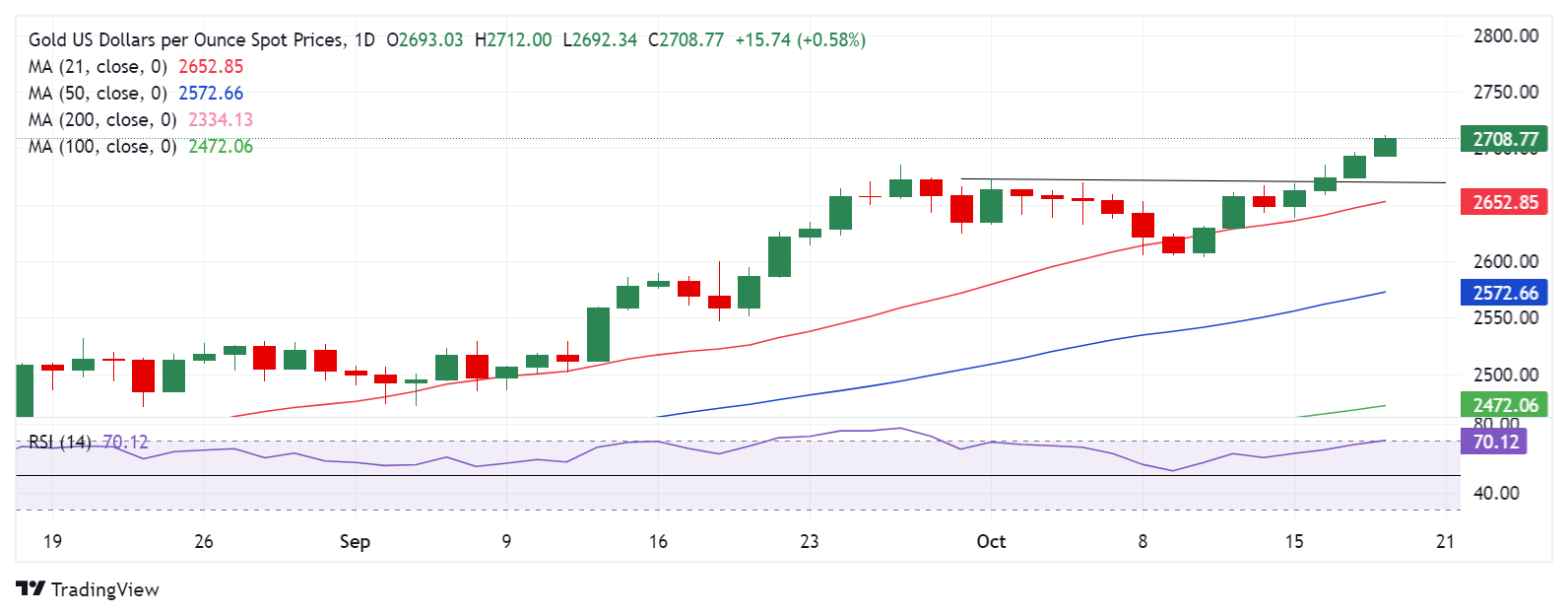
Gold price tested $2,700 on Thursday and conquered the latter early Friday, extending the upside break of the key resistance at $2,670.
The 14-day Relative Strength Index (RSI), battles the overbougtht region near 70, at the moment, suggesting that there remains some more room to the upside before a correction could set in.
If Gold buyers manage to defend the $2,700 round level, a test of the $2,750 psychological barrier will be inevitable.
On the downside, the immediate support is seen at the intraday low of $2,692, below which a drop toward the previous resistance now turned support at $2,670 cannot be ruled out.
Acceptance below that level will expose sellers to the key 21-day Simple Moving Average (SMA) support at $2,653.
Gold FAQs
Gold has played a key role in human’s history as it has been widely used as a store of value and medium of exchange. Currently, apart from its shine and usage for jewelry, the precious metal is widely seen as a safe-haven asset, meaning that it is considered a good investment during turbulent times. Gold is also widely seen as a hedge against inflation and against depreciating currencies as it doesn’t rely on any specific issuer or government.
Central banks are the biggest Gold holders. In their aim to support their currencies in turbulent times, central banks tend to diversify their reserves and buy Gold to improve the perceived strength of the economy and the currency. High Gold reserves can be a source of trust for a country’s solvency. Central banks added 1,136 tonnes of Gold worth around $70 billion to their reserves in 2022, according to data from the World Gold Council. This is the highest yearly purchase since records began. Central banks from emerging economies such as China, India and Turkey are quickly increasing their Gold reserves.
Gold has an inverse correlation with the US Dollar and US Treasuries, which are both major reserve and safe-haven assets. When the Dollar depreciates, Gold tends to rise, enabling investors and central banks to diversify their assets in turbulent times. Gold is also inversely correlated with risk assets. A rally in the stock market tends to weaken Gold price, while sell-offs in riskier markets tend to favor the precious metal.
The price can move due to a wide range of factors. Geopolitical instability or fears of a deep recession can quickly make Gold price escalate due to its safe-haven status. As a yield-less asset, Gold tends to rise with lower interest rates, while higher cost of money usually weighs down on the yellow metal. Still, most moves depend on how the US Dollar (USD) behaves as the asset is priced in dollars (XAU/USD). A strong Dollar tends to keep the price of Gold controlled, whereas a weaker Dollar is likely to push Gold prices up.
Author

Dhwani Mehta
FXStreet
Residing in Mumbai (India), Dhwani is a Senior Analyst and Manager of the Asian session at FXStreet. She has over 10 years of experience in analyzing and covering the global financial markets, with specialization in Forex and commodities markets.