Gold Price Forecast: XAU/USD buyers yearn for a daily close above $2,670
- Gold price challenges key $2,670 resistance as the recovery extends into early Wednesday.
- The US Dollar struggles with Treasury bond yields amid broad risk-aversion due to China's woes.
- Gold price’s daily technical setup suggests a retest of record highs on a sustained recovery.

Gold price is building on the previous recovery early Wednesday, challenging the static resistance level at $2,670. Gold buyers stay optimistic amid a bullish technical setup on the daily time frame and broad risk aversion.
Gold price shines as China-led risk aversion intensifies
Skepticism surrounding the Chinese fiscal stimulus grows, as investors remain expectant of details on the plans announced by China’s Finance Minister last Saturday. This coupled with a sharp slowdown in China’s exports amplifies the economic concerns, intensifying risk-off flows across the financial markets in Asia so far this Wednesday.
Risk aversion extended into Asia, following a steep sell-off in the European and Wall Street stocks after disappointing earnings from Europe's biggest tech firm ASML dragged chip stocks around the world.
Additionally, investors remain wary, as the US Federal Reserve (Fed) is expected to adopt a modest interest-rate cut path.
Recent Fed commentary continues to suggest that a 25 basis points (bps) rate cut is likely to be the outcome in November. Atlanta Fed President Raphael Bostic said late Tuesday that “my dot was 25 basis points more in 2024 beyond the September 50 basis point cut.”
San Francisco Fed President Mary Daly noted on Tuesday that “if inflation wanes along the lines central bankers expect, I think one or two [rate cuts] this year would be a reasonable thing” for the central bank to implement.”
However, less dovish Fed commentary fails to threaten the Gold price recovery, as investors run for cover in the traditional safe haven on growing uncertainty from China. Further, the US Dollar (USD) struggles to sustain its ongoing uptrend amid recent declines in the US Treasury bond yields, helping Gold price attempt another run toward the record high of $2,686.
All eyes now turn to Thursday when China will hold a press conference to discuss promoting the "steady and healthy" development of the property sector. Also, the US Retail Sales report will go hog the limelight on Thursday, in the absence of high-impact economic data releases from the US in the first half of this week.
In the meantime, China worries will likely dominate risk trends, which could continue to impact the value of the US Dollar, eventually influencing the USD-sensitive Gold price. The bright metal could also take cues from the ongoing geopolitical escalation between Israel and Iran. Israeli Prime Minister Benjamin Netanyahu told French President Emmanuel Macron that he would not agree to a ceasefire deal that failed to stop Hezbollah from rearming and regrouping.
Gold price technical analysis: Daily chart
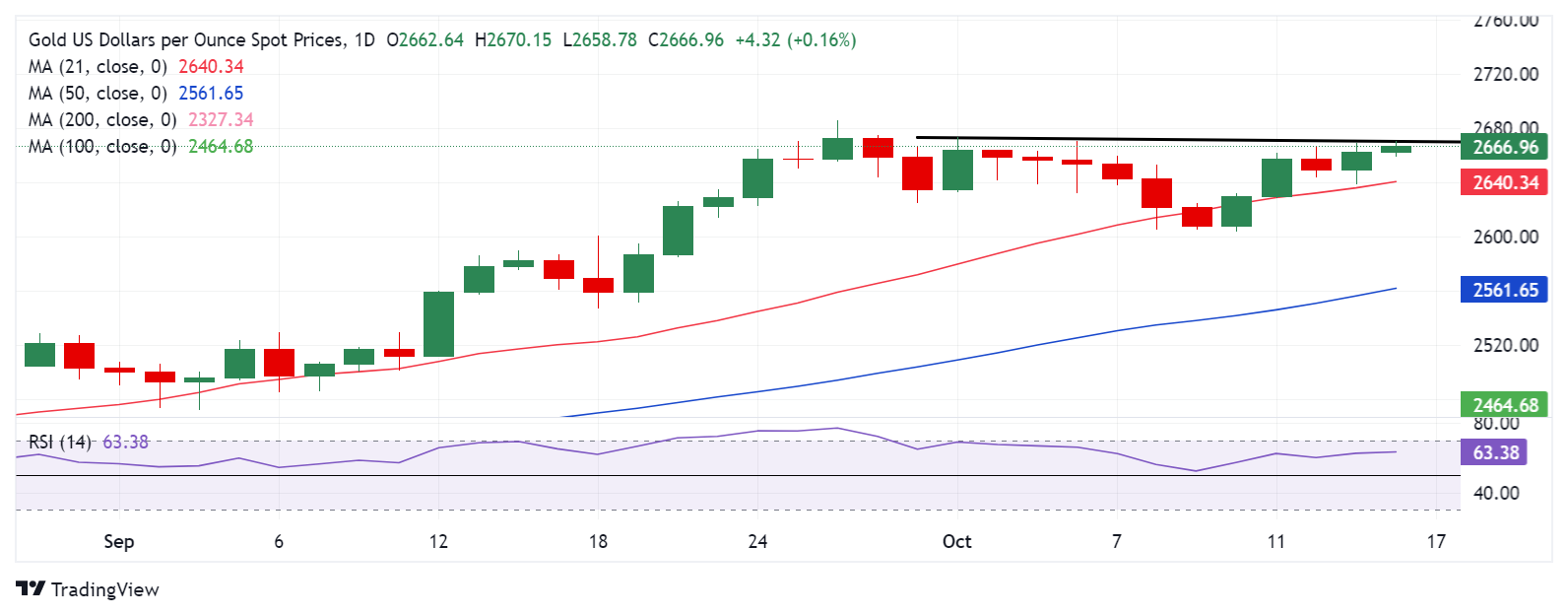
Gold price extends the upswing above the key 21-day Simple Moving Average (SMA) support, now at $2,640, as buyers regain control.
The 14-day Relative Strength Index (RSI), points north above the midline, suggesting that more gains remain in the offing.
Gold price needs acceptance above the key $2,670 resistance on a daily candlestick closing basis to take on the record high at $2,686.
Further up, the $2,700 round level will be tested.
On the flip side, the immediate support is seen at the 21-day SMA at $2,640, below which the three-week lows near the $2,600 threshold will be tested.
A sustained break below the latter could extend the downside toward the September 20 low of $2,585.
Gold FAQs
Gold has played a key role in human’s history as it has been widely used as a store of value and medium of exchange. Currently, apart from its shine and usage for jewelry, the precious metal is widely seen as a safe-haven asset, meaning that it is considered a good investment during turbulent times. Gold is also widely seen as a hedge against inflation and against depreciating currencies as it doesn’t rely on any specific issuer or government.
Central banks are the biggest Gold holders. In their aim to support their currencies in turbulent times, central banks tend to diversify their reserves and buy Gold to improve the perceived strength of the economy and the currency. High Gold reserves can be a source of trust for a country’s solvency. Central banks added 1,136 tonnes of Gold worth around $70 billion to their reserves in 2022, according to data from the World Gold Council. This is the highest yearly purchase since records began. Central banks from emerging economies such as China, India and Turkey are quickly increasing their Gold reserves.
Gold has an inverse correlation with the US Dollar and US Treasuries, which are both major reserve and safe-haven assets. When the Dollar depreciates, Gold tends to rise, enabling investors and central banks to diversify their assets in turbulent times. Gold is also inversely correlated with risk assets. A rally in the stock market tends to weaken Gold price, while sell-offs in riskier markets tend to favor the precious metal.
The price can move due to a wide range of factors. Geopolitical instability or fears of a deep recession can quickly make Gold price escalate due to its safe-haven status. As a yield-less asset, Gold tends to rise with lower interest rates, while higher cost of money usually weighs down on the yellow metal. Still, most moves depend on how the US Dollar (USD) behaves as the asset is priced in dollars (XAU/USD). A strong Dollar tends to keep the price of Gold controlled, whereas a weaker Dollar is likely to push Gold prices up.
Author

Dhwani Mehta
FXStreet
Residing in Mumbai (India), Dhwani is a Senior Analyst and Manager of the Asian session at FXStreet. She has over 10 years of experience in analyzing and covering the global financial markets, with specialization in Forex and commodities markets.