Gold Price Forecast: XAU/USD buyers retain control, with eyes on Fed Minutes
- Gold price sits at multi-day highs near $2,030 ahead of the Fed Minutes.
- US Dollar stays weak with the US Treasury bond yields, despite a tepid risk tone.
- Gold buyers flex muscles after recapturing 21-day SMA near $2,025. RSI flips bullish.

Gold price is looking to extend its winning streak into a fifth straight day on Wednesday, sitting close to the highest level in five days reached at $2,031 on Tuesday. A sustained US Dollar (USD) weakness combined with subdued US Treasury bond yields render positive for Gold price, as buyers await the US Federal Reserve (Fed) January meeting Minutes for the next push higher.
Gold price braces for Fed Minutes and Fedspeak
The latest leg down in the US Dollar could be attributed to renewed fears of a United States (US) government shutdown. House Republicans have shifted from optimistically cautious to expecting a government shutdown unless a budget or spending stopgap is passed by March 1, according to a report carried by Axios. The government will go into a full shutdown by March 8.
The prolonged fiscal issue in the US is keeping the US Treasury bond yields on the defensive, exerting additional downside pressure on the US Dollar, even as risk sentiment remains tepid. Asian markets opened lower on Wednesday, tracking a negative Wall Street close. However, Chinese stocks have rebounded firmly on hopes of more stimulus coming through from Beijing to prop up the property market and the overall economy.
Gold price is taking advantage of the ongoing US Dollar weakness, looking forward to the release of the Fed’s January meeting Minutes, which could provide fresh hints on the timing of the first-rate cut this year.
in the absence of any high-impact US economic data releases on Tuesday. Also, of note remains the earnings result from the American tech-giant Nvidia on Wednesday, as it could have a significant impact on the market sentiment. Markets are currently pricing a 77% chance of a cut in June, according to the CME Group’s Fed Watch Tool. Markets now expect 92 basis points (bps) of cuts from the Fed this year, closer to the Fed's projection of 75 bps of easing and sharply below the 150 bps of cuts priced in by traders at the start of the year, per Reuters.
Also, of note will be earnings result from the American tech-giant Nvidia on Wednesday, which could have a significant impact on the market sentiment, in turn, influencing the value of the US Dollar and the Gold price. American chipmaker Nvidia stumbled on Tuesday, leading the decline in the US stocks, in anticipation of its earnings report.
Besides, Atlantic Fed President Raphael Bostic and Fed Governor Michelle Bowman will make their respective scheduled appearances later on Wednesday, offering some food for thought for Gold traders.
Gold price technical analysis: Daily chart
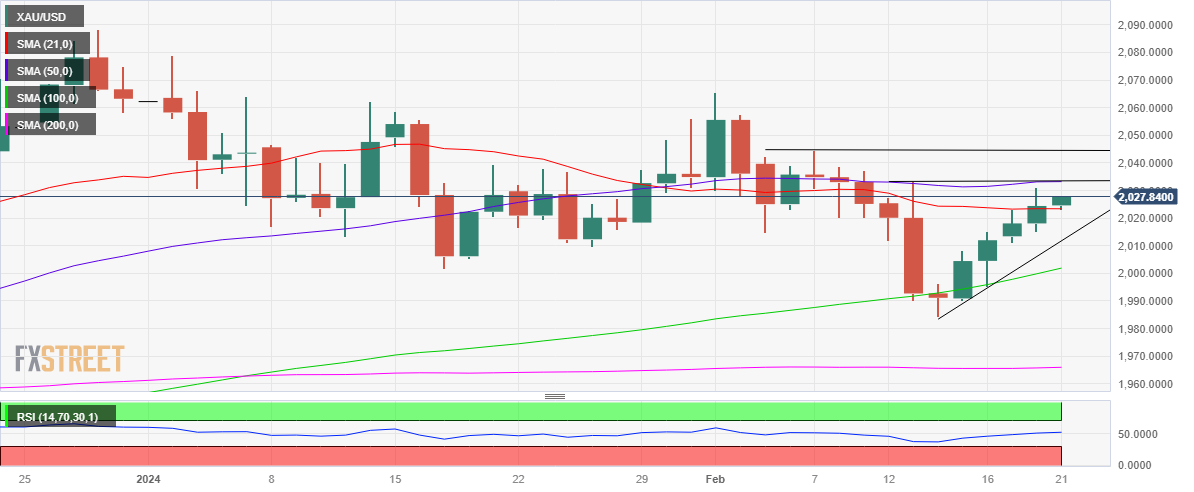
Gold price finally yielded a daily closing above the 21-day Simple Moving Average (SMA), now at $2,023, on Tuesday.
The 14-day Relative Strength Index (RSI) extended its recovery above the midline, suggesting that the tide may have turned in favor of Gold buyers.
Therefore, the immediate resistance is now seen at the $2,033 level, where the 50-day SMA and the February 13 high coincide.
A sustained break above that level will generate fresh buying opportunities in Gold price, targeting the February 7 high of $2,044 and the $2,050 psychological barrier.
On the contrary, if Gold sellers fight back control, the 21-day SMA at $2,023 will need to hold the fort. A failure to defend the latter could fuel a fresh downswing toward the previous day low of $2,015, followed by the rising trendline support that aligns at $2,011.
The upwsrd-pointing 100-day SMA at $2,002 will act as a tough nut to crack for Gold sellers.
Gold FAQs
Why do people invest in Gold?
Gold has played a key role in human’s history as it has been widely used as a store of value and medium of exchange. Currently, apart from its shine and usage for jewelry, the precious metal is widely seen as a safe-haven asset, meaning that it is considered a good investment during turbulent times. Gold is also widely seen as a hedge against inflation and against depreciating currencies as it doesn’t rely on any specific issuer or government.
Who buys the most Gold?
Central banks are the biggest Gold holders. In their aim to support their currencies in turbulent times, central banks tend to diversify their reserves and buy Gold to improve the perceived strength of the economy and the currency. High Gold reserves can be a source of trust for a country’s solvency. Central banks added 1,136 tonnes of Gold worth around $70 billion to their reserves in 2022, according to data from the World Gold Council. This is the highest yearly purchase since records began. Central banks from emerging economies such as China, India and Turkey are quickly increasing their Gold reserves.
How is Gold correlated with other assets?
Gold has an inverse correlation with the US Dollar and US Treasuries, which are both major reserve and safe-haven assets. When the Dollar depreciates, Gold tends to rise, enabling investors and central banks to diversify their assets in turbulent times. Gold is also inversely correlated with risk assets. A rally in the stock market tends to weaken Gold price, while sell-offs in riskier markets tend to favor the precious metal.
What does the price of Gold depend on?
The price can move due to a wide range of factors. Geopolitical instability or fears of a deep recession can quickly make Gold price escalate due to its safe-haven status. As a yield-less asset, Gold tends to rise with lower interest rates, while higher cost of money usually weighs down on the yellow metal. Still, most moves depend on how the US Dollar (USD) behaves as the asset is priced in dollars (XAU/USD). A strong Dollar tends to keep the price of Gold controlled, whereas a weaker Dollar is likely to push Gold prices up.
Author

Dhwani Mehta
FXStreet
Residing in Mumbai (India), Dhwani is a Senior Analyst and Manager of the Asian session at FXStreet. She has over 10 years of experience in analyzing and covering the global financial markets, with specialization in Forex and commodities markets.