Gold Price Forecast: XAU/USD appears stuck between key technical levels, what’s next?
- Gold sellers continue to lurk above $2,700 early Friday ahead of UoM Consumer Sentiment data.
- The US Dollar pauses decline with Treasury bond yields, as traders digest the Trump win and Fed rate cut.
- Gold price remains stuck between two key Fibo levels and daily averages amid a neutral daily RSI.

Gold price has returned to the red early Thursday after reversing more than half of the Trump win-led 3% slide on Wednesday. Gold sellers fight back control, as the US Dollar (USD) finds its feet amid a pause in the US Treasury bond yields sell-off while awaiting the Michigan preliminary Consumer Sentiment data.
Gold price appears divided between the Trump win and Fed rate cut
Gold is consolidating at around $2,700 in Asian trading on Friday, as investors catch a breather and take account of the volatile trading witnessed over the last two days.
Republican candidate Donald Trump’s second term as the US president, following an outstanding win in the election, spelt doom for the bright metal on Wednesday before being rescued by the US Federal Reserve (Fed) Chairman Jerome Powell after the two-day monetary policy meeting concluded on Thursday.
Markets digested the Trump presidency, believing that his policies on immigration, tax cuts and tariffs would put upward pressure on inflation, prompted a fresh run higher in the USD, US Treasury bond yields and global stocks at the expense of the yieldless Gold price on Wednesday.
On Thursday, Gold price jumped back on the bids, as traders took profits off their USD longs ahead of the Fed interest rate decision. The Gold price rebound extended into American trading after the Greenback witnessed a fresh leg down following the Fed policy announcements.
The USD attempted a bounce in a knee-jerk reaction to the Fed’s rate decision, which was quickly reversed on Chairman Powell’s press conference. Powell noted that the Fed remains on a gradual easing path and that the election won’t have any near-term effect on the policy decision. He added that he will not quit even if asked by Trump.
Powell’s commitment to the Fed’s easing cycle was enough to trigger a fresh sell-off in the US Dollar across the board, providing extra legs to the Gold price recovery.
The US central bank reduced the fed funds rate by 25 basis points (bps) to a range of 4.50% to 4.75%, as expected.
However, the Trump trades optimism remains well in place, as the Fed verdict is now out of the way, reviving the US Dollar’s bullish undertone while acting as a headwind for the Gold price.
The top-tier US consumer sentiment and inflation expectations data will also play its part in influencing the value of the USD and the Gold price in the session ahead, as traders may resort to positioning readjustments following a crucial week for markets while bracing for the US Consumer Price Index (CPI) data due next week.
The end-of-the-week flows could also infuse some volatility around the Gold price.
Gold price technical analysis: Daily chart
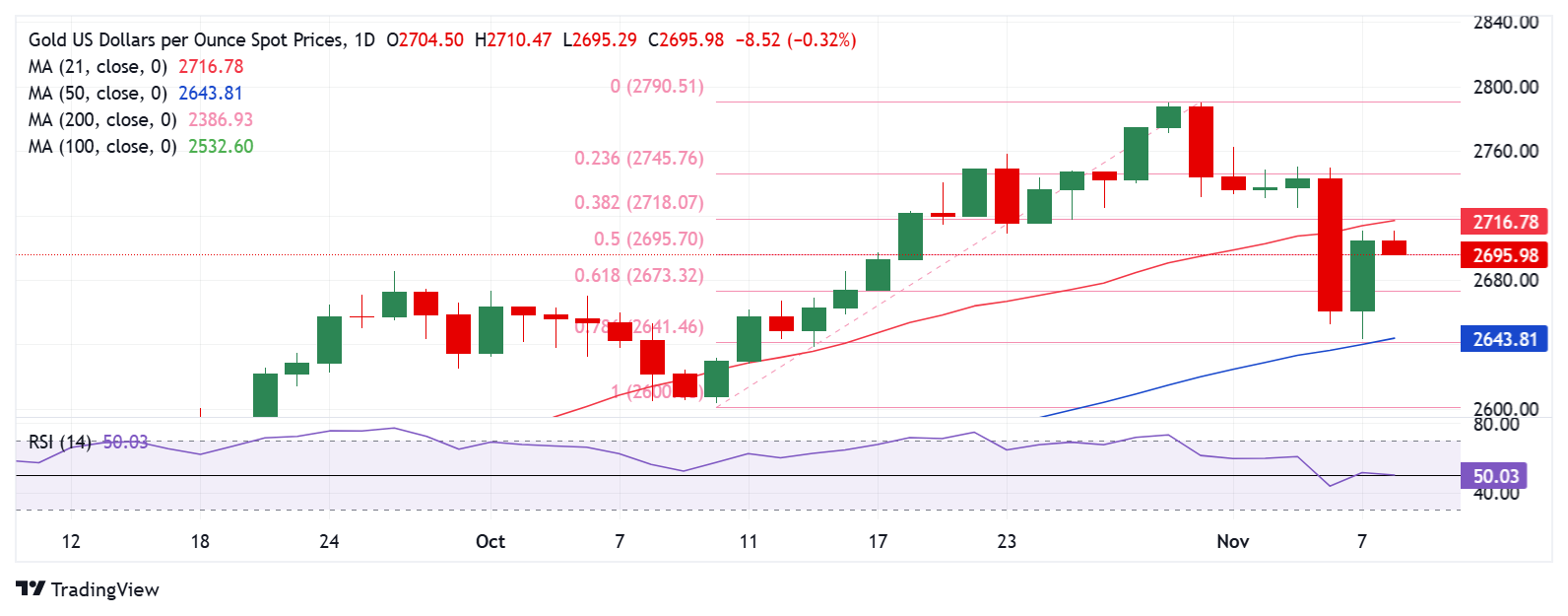
As observed on the daily chart, Gold price bounced off the important support at $2,641, which is the confluence of the 50-day Simple Moving Average (SMA) and the 78.6% Fibo level of the latest record rally from the October 10 low of $2,604 to the new all-time high of $2,790.
Defending that level triggered a fresh upswing, where buyers challenged the 21-day SMA, then at $2,712.
At the moment, Gold price remains stuck between the confluence resistance of the 21-day SMA and the 38.2% Fibo level at $2,718 while holding well above the aforesaid strong cushion at $2,641.
The 14-day Relative Strength Index (RSI) is flatlining at the 50 level, suggesting a lack of a clear directional bias for Gold price.
If the renewed weakness extends below the 50% Fibo support at $2,695, a fresh leg lower toward the 61.8% Fibo level of $2,673 will be in the offing.
Further down, the $2,641 confluence support will come into play once again.
On the flip side, Gold buyers need acceptance above the healthy resistance at $2,718 to initiate a fresh uptrend toward the previous static resistance near $2,745, where the 23.6% Fibo aligns.
The next relevant bullish target is seen at around the $2,760 round level en route to the record high of $2,790.
Gold FAQs
Gold has played a key role in human’s history as it has been widely used as a store of value and medium of exchange. Currently, apart from its shine and usage for jewelry, the precious metal is widely seen as a safe-haven asset, meaning that it is considered a good investment during turbulent times. Gold is also widely seen as a hedge against inflation and against depreciating currencies as it doesn’t rely on any specific issuer or government.
Central banks are the biggest Gold holders. In their aim to support their currencies in turbulent times, central banks tend to diversify their reserves and buy Gold to improve the perceived strength of the economy and the currency. High Gold reserves can be a source of trust for a country’s solvency. Central banks added 1,136 tonnes of Gold worth around $70 billion to their reserves in 2022, according to data from the World Gold Council. This is the highest yearly purchase since records began. Central banks from emerging economies such as China, India and Turkey are quickly increasing their Gold reserves.
Gold has an inverse correlation with the US Dollar and US Treasuries, which are both major reserve and safe-haven assets. When the Dollar depreciates, Gold tends to rise, enabling investors and central banks to diversify their assets in turbulent times. Gold is also inversely correlated with risk assets. A rally in the stock market tends to weaken Gold price, while sell-offs in riskier markets tend to favor the precious metal.
The price can move due to a wide range of factors. Geopolitical instability or fears of a deep recession can quickly make Gold price escalate due to its safe-haven status. As a yield-less asset, Gold tends to rise with lower interest rates, while higher cost of money usually weighs down on the yellow metal. Still, most moves depend on how the US Dollar (USD) behaves as the asset is priced in dollars (XAU/USD). A strong Dollar tends to keep the price of Gold controlled, whereas a weaker Dollar is likely to push Gold prices up.
Author

Dhwani Mehta
FXStreet
Residing in Mumbai (India), Dhwani is a Senior Analyst and Manager of the Asian session at FXStreet. She has over 10 years of experience in analyzing and covering the global financial markets, with specialization in Forex and commodities markets.