Gold Price Forecast: XAU/USD appears a ‘buy-the-dips’ trade on simmering Israel-Iran tensions
- Gold price attempts another run to reclaim $2,400 amid looming geopolitical risks.
- US Dollar pulls back with Treasury yields despite hawkish Fedspeak, as risk appetite returns.
- Gold price confirmed a symmetrical triangle breakdown on 4H but defends 50-SMA support.

Gold price is replicating the tepid recovery mode seen in Wednesday’s Asian trading early Thursday, having faced rejection just shy of $2,400 for the second day in a row.
Will geopolitical tensions support Gold price?
The US Dollar (USD) licks its wounds in tandem with the US Treasury bond yields after witnessing a sharp corrective decline from multi-month highs in the second half of Wednesday’s trading, as an early risk rally on Wall Street indices dampened the safe-haven appeal of the Greenback.
Additionally, markets resorted to profit-taking on their USD longs, following the rally inspired by US Federal Reserve (Fed) Chair Jerome Powell’s hawkish comments on Tuesday.
Risk appetite, however, waned into the US markets close, with investors staying wary ahead of the US earnings results from big companies. Market participants also considered the latest slide in the mega-cap technology stock, Nvidia.
Meanwhile, brewing geopolitical tensions between Israel and Iran boosted safe-haven flows into the US government bonds, weighing heavily on the US Treasury bond yields.
Despite the US Dollar correction, the pullback in the US Treasury bond yields and looming geopolitical tensions, Gold price failed to sustain its rebound and once again fell toward the $2,350 region. The Gold price retreat could be attributed to the market’s pricing of a delayed and slower policy pivot by the Fed, as affirmed by Fed Chair Jerome Powell on Tuesday.
In Thursday’s trading so far, Gold price is attempting another run to recapture the $2,400 barrier, as fresh leg lower in the US Dollar alongside the US Treasury bond yields remain supportive of the non-yielding metal.
Further, investors digest the mixed Fed commentary and the latest geopolitical developments surrounding the Israel-Iran conflict. Cleveland Fed President Loretta Mestersaid early Thursday that she “anticipates a shift to eased policy,” and hinted at a “possible rate cut if labor market worsens.” Meanwhile, Fed Governor Michelle Bowman said that monetary policy is currently restrictive and time will tell if it is "sufficiently" restrictive, sounding a bit hawkish.
On the geopolitical front, Israeli Prime Minister Benjamin Netanyahu said on Wednesday that Israel will make its own decisions about how to defend itself. His comments came after Western countries pleaded for restraint following the weekend’s attacks from Iran.
Israel's Air Force said Wednesday its fighter jets had struck the "terrorist infrastructure" of Iran-backed Hezbollah in eastern Lebanon, stoking concerns about a further escalation in clashes across Israel's northern border.
Therefore, Gold price could continue to find safe-haven demand on every pullback, amid rife geopolitical concerns, unless the upcoming speeches from Fed policymakers further expectations of a Fed rate cut, currently priced in for the September meeting. The US weekly Jobless Claims and housing data will also offer some incentives to Gold traders in the day ahead.
Gold price technical analysis: Four-hour chart
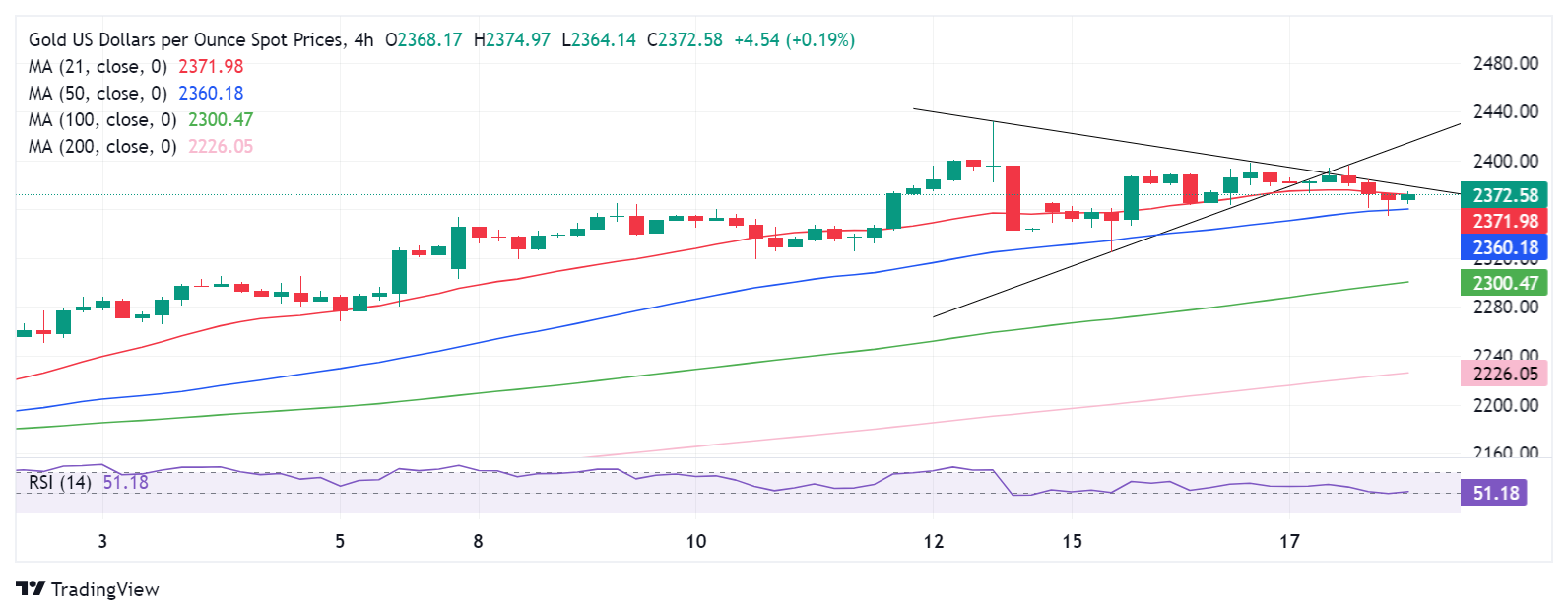
Gold price confirmed a symmetrical triangle breakdown on the four-hour chart on Wednesday, reviving the selling interest around the Gold price.
Following the renewed downswing, Gold price breached the 21-Simple Moving Average (SMA), now at $2,372. However, buyers are not trying hard to find a foothold above the latter, as the Relative Strength Index (RSI) has swung back into the positive territory, near 51.50.
If the recovery mode sustains, Gold price could retest this week’s key resistance near $2,400. Acceptance above that level is critical to resume the Gold price uptrend for a retest of the record high at $2,432.
Further up, the $2,450 psychological level will be the level to beat for Gold buyers.
On the downside, Gold sellers need a four-hourly candlestick closing below the 50-SMA at $2,360 to extend the correction toward the April 15 low of $2,324.
Additional declines could challenge the $2,300 round figure.
Gold FAQs
Gold has played a key role in human’s history as it has been widely used as a store of value and medium of exchange. Currently, apart from its shine and usage for jewelry, the precious metal is widely seen as a safe-haven asset, meaning that it is considered a good investment during turbulent times. Gold is also widely seen as a hedge against inflation and against depreciating currencies as it doesn’t rely on any specific issuer or government.
Central banks are the biggest Gold holders. In their aim to support their currencies in turbulent times, central banks tend to diversify their reserves and buy Gold to improve the perceived strength of the economy and the currency. High Gold reserves can be a source of trust for a country’s solvency. Central banks added 1,136 tonnes of Gold worth around $70 billion to their reserves in 2022, according to data from the World Gold Council. This is the highest yearly purchase since records began. Central banks from emerging economies such as China, India and Turkey are quickly increasing their Gold reserves.
Gold has an inverse correlation with the US Dollar and US Treasuries, which are both major reserve and safe-haven assets. When the Dollar depreciates, Gold tends to rise, enabling investors and central banks to diversify their assets in turbulent times. Gold is also inversely correlated with risk assets. A rally in the stock market tends to weaken Gold price, while sell-offs in riskier markets tend to favor the precious metal.
The price can move due to a wide range of factors. Geopolitical instability or fears of a deep recession can quickly make Gold price escalate due to its safe-haven status. As a yield-less asset, Gold tends to rise with lower interest rates, while higher cost of money usually weighs down on the yellow metal. Still, most moves depend on how the US Dollar (USD) behaves as the asset is priced in dollars (XAU/USD). A strong Dollar tends to keep the price of Gold controlled, whereas a weaker Dollar is likely to push Gold prices up.
Author

Dhwani Mehta
FXStreet
Residing in Mumbai (India), Dhwani is a Senior Analyst and Manager of the Asian session at FXStreet. She has over 10 years of experience in analyzing and covering the global financial markets, with specialization in Forex and commodities markets.