Gold Price Forecast: Will XAU/USD reclaim $2,400 ahead of Powell speech?
- Gold price consolidates the rebound below $2,400 amid risk-aversion.
- Dollar gains on strong US Retail Sales data despite easing Middle East tensions.
- Bullish potential for Gold price still intact on favorable four-hour technical setup.

Gold price is gathering strength to extend the previous upswing above $2,400 in Asian trading on Tuesday. Gold price stays supported by a minor pullback in the US Treasury bond yields from multi-month highs even as the US Dollar sees a fresh leg higher amid broad risk-aversion.
Gold price awaits Fed Chair Powell’s speech
Asian markets are in a sea of red, as traders weigh the likelihood of delay in the US Federal Reserve (Fed) interest rate cuts following strong US Retail Sales data reported on Tuesday. Retail Sales rose 0.7% last month and data for February was revised higher to show sales rebounding 0.9% instead of 0.6% as previously reported. The market forecast was for a 0.3% increase.
Chances that the Fed will hold rates in July and September rose above 50% after the data release, lifting the US Dollar alongside the US Treasury bond yields while smashing Wall Street stocks. Risk-aversion extended into Asia to sponsor the latest leg higher in the Greenback against its major peers. The US Dollar Index is challenging five-month highs near 106.40, at the time of writing.
Mixed China’s Gross Domestic Product (GDP) and activity data also added to the downbeat risk tone, underpinning the US Dollar’s haven demand. China's economy grew 5.3% in the first quarter of 2024, surpassing estimates of a 5.0% growth. Despite this, March Retail Sales and Industrial Output fell short of expectations. China's property market struggles persist, with 1Q New Home Sales falling nearly 31% over the year.
Further, hawkish comments from San Francisco Fed President Mary Daly bolstered the Greenback. Daly said on rate cuts, “the worst thing to do is act urgently when urgency isn't necessary.”
However, Gold price appears resilient to a firmer US Dollar, helped by a retreat in the US Treasury bond yields from multi-month highs. Easing geopolitical tensions between Israel and Iran also fails to deter Gold buyers, as they bide time before the next push higher.
“Iran is willing to exercise restraint and has no intention of further escalating the situation,” Iranian Foreign Minister Hossein Amir-Abdollahian told the Chinese counterpart in a phone call early Tuesday.
Investors, however, remain on a cautious footing, as a renewed flare-up in Israel and Iran conflict cannot be ruled out. Next of note for Gold traders remain Fed Chair Jerome Powell’s speech and speeches from a few other Fed policymakers, as the US economic docket is relatively light this Tuesday.
Geopolitical developments in the Middle East will be closely followed for fresh trading incentives in Gold price.
Gold price technical analysis: Four-hour chart
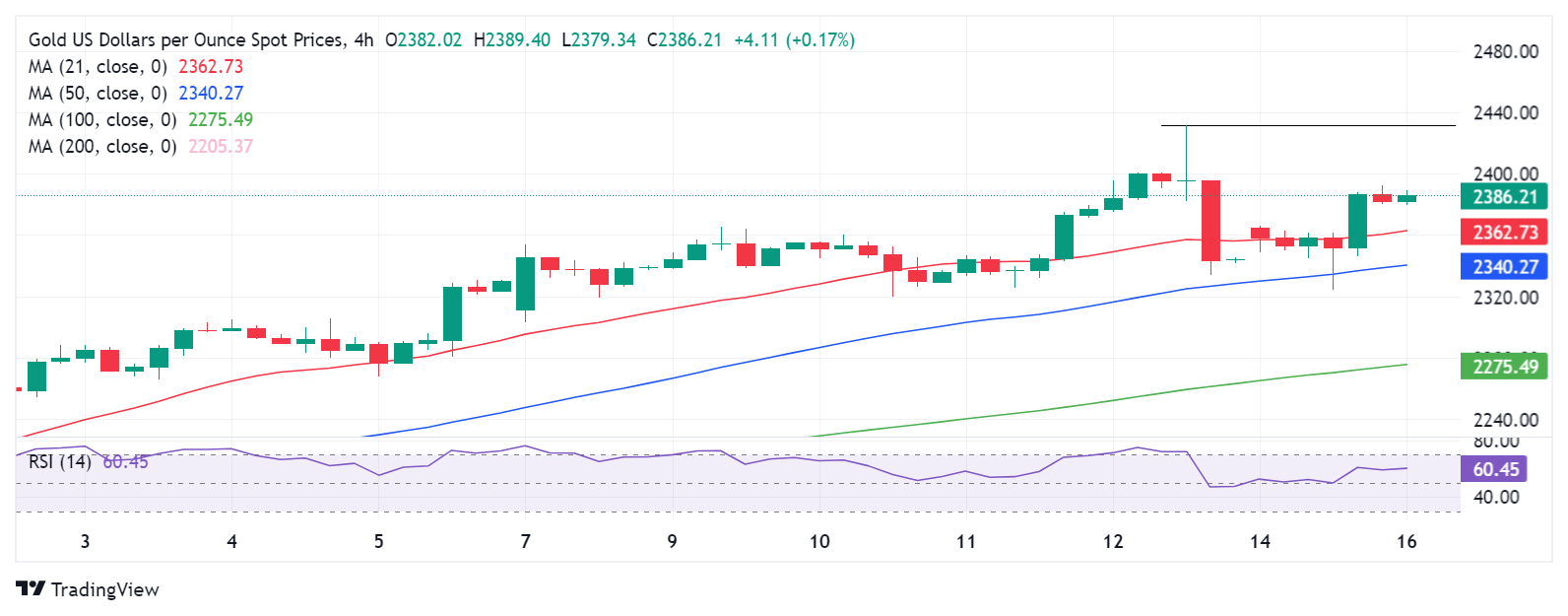
As observed on the four-hour chart, Gold price is holding comfortably above the 21-Simple Moving Average (SMA) at $2,363, having reclaimed that barrier in Monday’s North American trading.
The Relative Strength Index (RSI) is pointing north while above the 50 level, currently near 61.0, justifying the latest move higher.
If buying momentum gains traction, immediate resistance is seen at the $2,400 round figure, above which the record high of $2,432 will be retested.
On the downside, if the Gold price breaches the 21-SMA support at $2,363 once again, the 100-SMA at $2,340 will rescue Gold buyers.
Further down, the previous week’s low of $2,319 could be put to the test.
Gold FAQs
Gold has played a key role in human’s history as it has been widely used as a store of value and medium of exchange. Currently, apart from its shine and usage for jewelry, the precious metal is widely seen as a safe-haven asset, meaning that it is considered a good investment during turbulent times. Gold is also widely seen as a hedge against inflation and against depreciating currencies as it doesn’t rely on any specific issuer or government.
Central banks are the biggest Gold holders. In their aim to support their currencies in turbulent times, central banks tend to diversify their reserves and buy Gold to improve the perceived strength of the economy and the currency. High Gold reserves can be a source of trust for a country’s solvency. Central banks added 1,136 tonnes of Gold worth around $70 billion to their reserves in 2022, according to data from the World Gold Council. This is the highest yearly purchase since records began. Central banks from emerging economies such as China, India and Turkey are quickly increasing their Gold reserves.
Gold has an inverse correlation with the US Dollar and US Treasuries, which are both major reserve and safe-haven assets. When the Dollar depreciates, Gold tends to rise, enabling investors and central banks to diversify their assets in turbulent times. Gold is also inversely correlated with risk assets. A rally in the stock market tends to weaken Gold price, while sell-offs in riskier markets tend to favor the precious metal.
The price can move due to a wide range of factors. Geopolitical instability or fears of a deep recession can quickly make Gold price escalate due to its safe-haven status. As a yield-less asset, Gold tends to rise with lower interest rates, while higher cost of money usually weighs down on the yellow metal. Still, most moves depend on how the US Dollar (USD) behaves as the asset is priced in dollars (XAU/USD). A strong Dollar tends to keep the price of Gold controlled, whereas a weaker Dollar is likely to push Gold prices up.
Author

Dhwani Mehta
FXStreet
Residing in Mumbai (India), Dhwani is a Senior Analyst and Manager of the Asian session at FXStreet. She has over 10 years of experience in analyzing and covering the global financial markets, with specialization in Forex and commodities markets.

















