Gold Price Forecast: Will XAU/USD defend the key $2,635 support?
- Gold price hovers around $2,650 early Tuesday, consolidating the previous decline.
- Despite lingering Chinese economic risks, the US Dollar pulls back with Treasury bond yields.
- Gold price could find fresh demand as long as a 21-day SMA holds at $2,635. The daily RSI stays bullish.

Gold price is trading modestly flat near $2,650 early Tuesday, licking its wounds after retreating from a six-day high of $2,667 set on Monday.
Gold price buyers test their luck
The tepid recovery attempt in Gold price is sponsored by a mild correction in the US Dollar (USD) against its major rivals from over two-month highs. Meanwhile, retreating US Treasury bond yields on renewed haven flows into the government bonds exert downward pressure on the USD, allowing Gold price buyers to briefly come up for air.
Amid a quiet Asian affair, China’s economic worries persist and dent risk sentiment. The latest data showed that Chinese exports grew at the slowest pace in five months in September. Further, a lack of specifics on China’s fiscal stimulus announced last Saturday remains a drag on investors’ confidence.
However, it remains to be seen if Gold price builds on the rebound, as markets continue to bet on a smaller - 25 basis points (bps) interest rate cut by the US Federal Reserve (Fed) in November, with a probability of such a move seen at about 86%, according to the CME Group’s FedWatch Tool.
The Greenback extended its previous week’s advance and hit its highest in over two months across its competitors after Fed Governor Christopher Waller said Monday urged "more caution" on rate cuts ahead, citing recent economic data. "Whatever happens in the near term, my baseline still calls for reducing the policy rate gradually over the next year," Waller added.
Joining the chorus, Minneapolis Fed President Neel Kashkari said on Monday that the monetary policy is still in a restrictive stance, adding further "modest" rate cuts could be appropriate, per Reuters.
Also, Gold price could face headwinds from easing geopolitical tensions between Israel and Iran after the Washington Post (WaPo) cited two officials familiar with the matter, as saying that Israeli Prime Minister Benjamin Netanyahu told the US that Israel would strike Iranian military, not nuclear or oil, targets. The report suggests that there will be a more limited counterstrike aimed at preventing a full-scale war.
Attention now turns toward speeches from more Fed policymakers for fresh trading impetus in the US Dollar and the Gold price, as full markets return later in the American session on Tuesday. Gold traders could also resort to position adjustments ahead of Thursday’s US Retail Sales data release.
Gold price technical analysis: Daily chart
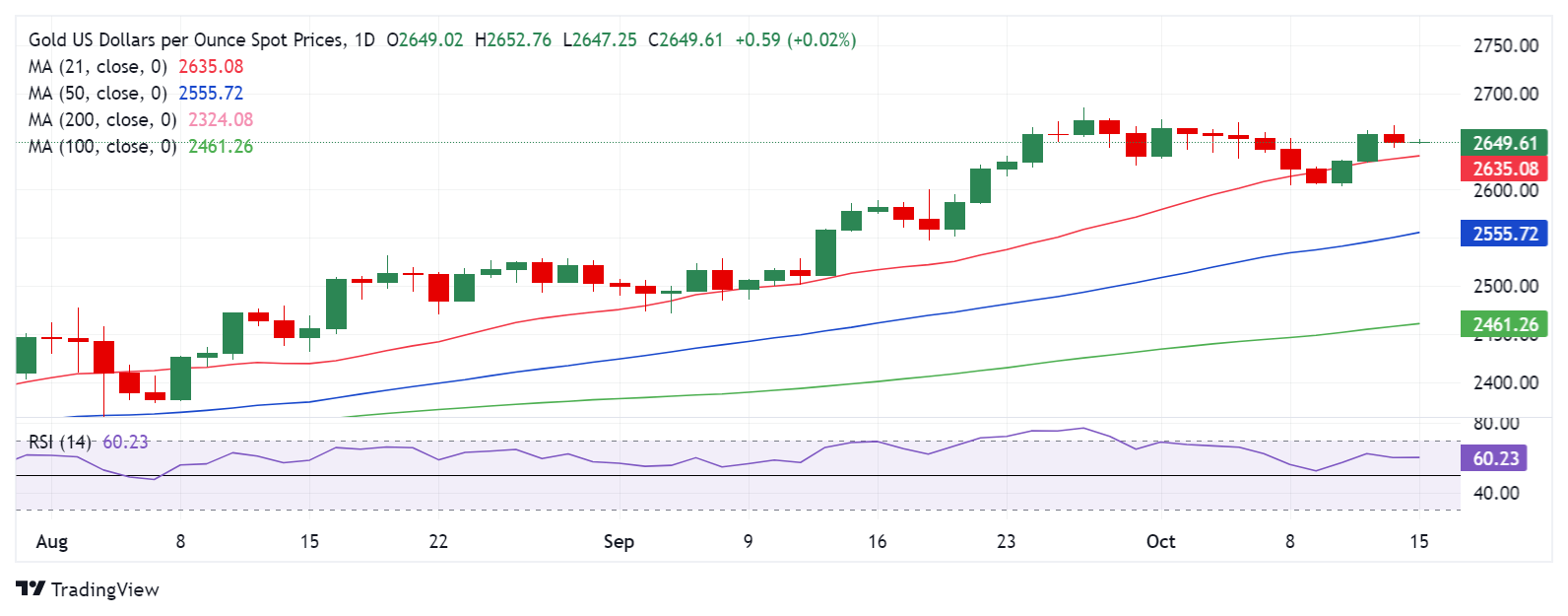
Gold price stays supported above the key 21-day Simple Moving Average (SMA) support, now at $2,635, so far this week.
The 14-day Relative Strength Index (RSI), however, holds firm above the midline, suggesting that any dip in Gold price could be a good buying opportunity in the near term.
If the Gold price recovers, the next bullish target is seen at the previous high of $2,667, followed by the intermittent high at $2,670.
Further up, the record high at $2,686 will come into play.
Conversely, the immediate support is seen at the 21-day SMA at $2,632, below which the three-week lows near the $2,600 threshold will be tested.
A sustained break below the latter could extend the downside toward the September 20 low of $2,585.
Gold FAQs
Gold has played a key role in human’s history as it has been widely used as a store of value and medium of exchange. Currently, apart from its shine and usage for jewelry, the precious metal is widely seen as a safe-haven asset, meaning that it is considered a good investment during turbulent times. Gold is also widely seen as a hedge against inflation and against depreciating currencies as it doesn’t rely on any specific issuer or government.
Central banks are the biggest Gold holders. In their aim to support their currencies in turbulent times, central banks tend to diversify their reserves and buy Gold to improve the perceived strength of the economy and the currency. High Gold reserves can be a source of trust for a country’s solvency. Central banks added 1,136 tonnes of Gold worth around $70 billion to their reserves in 2022, according to data from the World Gold Council. This is the highest yearly purchase since records began. Central banks from emerging economies such as China, India and Turkey are quickly increasing their Gold reserves.
Gold has an inverse correlation with the US Dollar and US Treasuries, which are both major reserve and safe-haven assets. When the Dollar depreciates, Gold tends to rise, enabling investors and central banks to diversify their assets in turbulent times. Gold is also inversely correlated with risk assets. A rally in the stock market tends to weaken Gold price, while sell-offs in riskier markets tend to favor the precious metal.
The price can move due to a wide range of factors. Geopolitical instability or fears of a deep recession can quickly make Gold price escalate due to its safe-haven status. As a yield-less asset, Gold tends to rise with lower interest rates, while higher cost of money usually weighs down on the yellow metal. Still, most moves depend on how the US Dollar (USD) behaves as the asset is priced in dollars (XAU/USD). A strong Dollar tends to keep the price of Gold controlled, whereas a weaker Dollar is likely to push Gold prices up.
Author

Dhwani Mehta
FXStreet
Residing in Mumbai (India), Dhwani is a Senior Analyst and Manager of the Asian session at FXStreet. She has over 10 years of experience in analyzing and covering the global financial markets, with specialization in Forex and commodities markets.