Gold Price Forecast: Will Powell’s testimony trigger a sharp correction in XAU/USD?
- Gold price corrects from near fresh 2024 highs of $2,142 reached on Tuesday.
- Dollar recovers with Treasury yields, as all eyes remain on Powell’s testimony, US jobs data.
- Gold price risks a correction on less dovish Powell, overbought RSI conditions.

Gold price is once again attempting a corrective stint, replicating the price action for the third straight session in Wednesday’s Asian trading.
The US Dollar has paused its downtrend alongside the US Treasury bond yields, fuelling a brief pullback in Gold price from the near 2024 high of $2,142 set in the North American session on Tuesday.
Gold price awaits Powell and US jobs data
Gold buyers take a breather after the recent relentless surge, backed by heightened expectations of aggressive interest rate cuts expectations from the US Federal Reserve (Fed), in the face of a series of soft US economic data, which fuels concerns regarding a ‘soft-landing’.
The US ISM said on Tuesday that its Services PMI slipped to 52.6 last month from 53.4 in January. A gauge of prices paid for inputs by businesses fell to 58.6 from an 11-month high of 64.0 in January. Last week, the ISM Manufacturing PMI index dropped from 49.1 in January to 47.8 in February, missing the market expectation of 49.5 by a wide margin.
Markets are currently pricing in about a 63% chance that the Fed could begin easing rates in June, slightly lower than a 67% probability seen at the start of the week, according to the CME FedWatch Tool.
The next push higher in the Gold price now remains at the mercy of Fed Chair Jerome Powell’s testimony, as his words would be closely scrutinized for fresh hints on the timing and the scope of Fed rate cuts this year.
Ahead of his testimony on the semi-annual Monetary Policy Report (MPR) before the US Congress, the ADP Employment Change data and the JOLTS Job Openings survey will be keenly awaited for fresh trading action in the US Dollar, as well as, the Gold price.
Gold price technical analysis: Daily chart
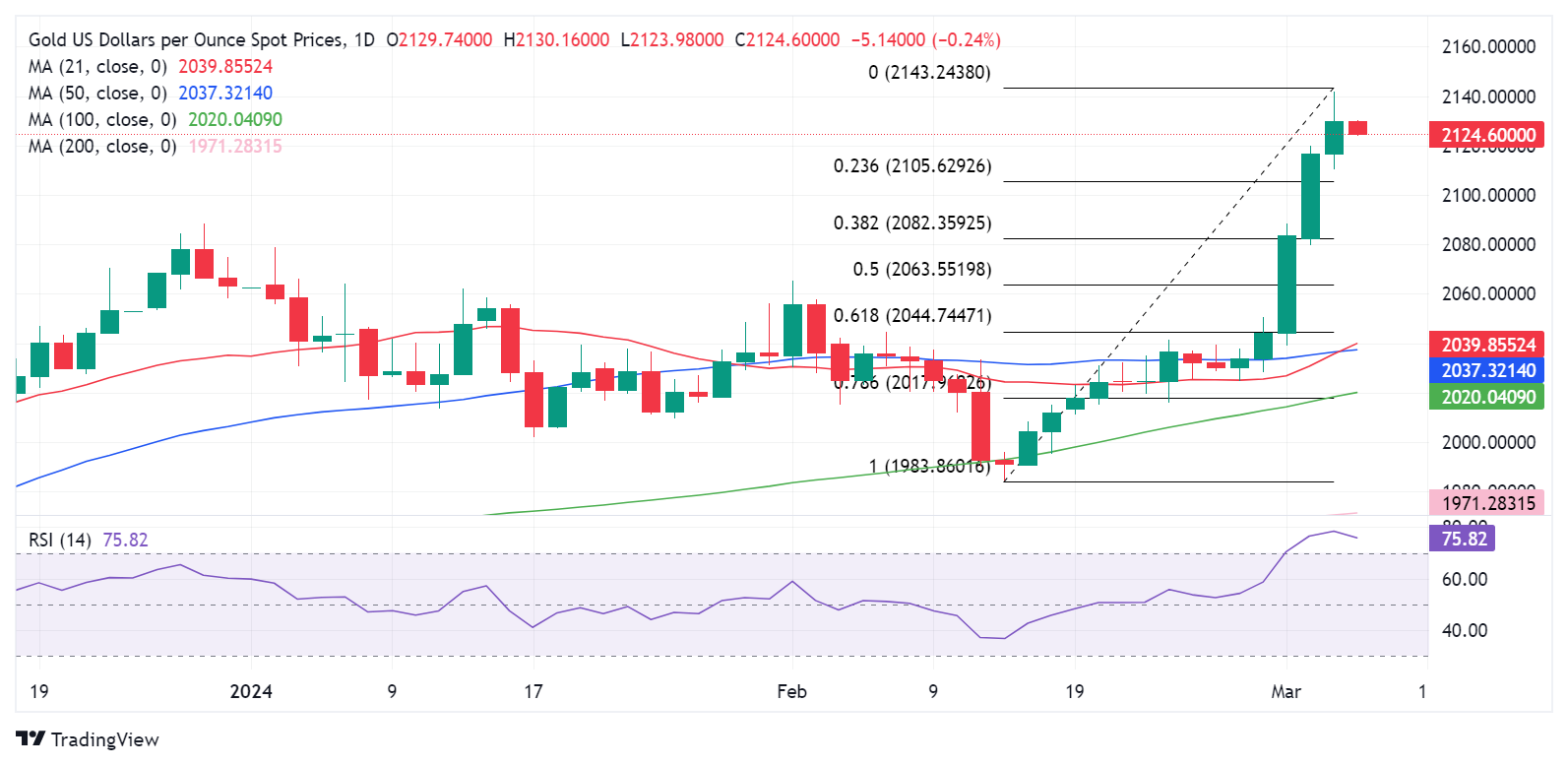
As observed on the daily chart, Gold price is consolidating the recent run of gains, with the 14-day Relative Strength Index (RSI) warranting caution for buyers.
The leading indicator is highly overbought, suggesting that a sharp corrective downside could be in the offing.
If that happens, the $2,107 support area will be critical to hold. That level is the 23.6% Fibonacci Retracement (Fibo) level of the recent rally from the February 14 low of $1,984 to the 2024 high of $2,142.
Acceptance below the latter is likely to trigger a fresh drop toward the 38.2% Fibo support at $2,082.
However, the downside could be cushioned, as the 21-day Simple Moving Average (SMA) and the 50-day SMA Bull Cross confirmation remains in play.
Gold buyers need to recapture the record high of $2,144 on a sustained basis to unleash further upside toward the $2,200 threshold.
Gold FAQs
Gold has played a key role in human’s history as it has been widely used as a store of value and medium of exchange. Currently, apart from its shine and usage for jewelry, the precious metal is widely seen as a safe-haven asset, meaning that it is considered a good investment during turbulent times. Gold is also widely seen as a hedge against inflation and against depreciating currencies as it doesn’t rely on any specific issuer or government.
Central banks are the biggest Gold holders. In their aim to support their currencies in turbulent times, central banks tend to diversify their reserves and buy Gold to improve the perceived strength of the economy and the currency. High Gold reserves can be a source of trust for a country’s solvency. Central banks added 1,136 tonnes of Gold worth around $70 billion to their reserves in 2022, according to data from the World Gold Council. This is the highest yearly purchase since records began. Central banks from emerging economies such as China, India and Turkey are quickly increasing their Gold reserves.
Gold has an inverse correlation with the US Dollar and US Treasuries, which are both major reserve and safe-haven assets. When the Dollar depreciates, Gold tends to rise, enabling investors and central banks to diversify their assets in turbulent times. Gold is also inversely correlated with risk assets. A rally in the stock market tends to weaken Gold price, while sell-offs in riskier markets tend to favor the precious metal.
The price can move due to a wide range of factors. Geopolitical instability or fears of a deep recession can quickly make Gold price escalate due to its safe-haven status. As a yield-less asset, Gold tends to rise with lower interest rates, while higher cost of money usually weighs down on the yellow metal. Still, most moves depend on how the US Dollar (USD) behaves as the asset is priced in dollars (XAU/USD). A strong Dollar tends to keep the price of Gold controlled, whereas a weaker Dollar is likely to push Gold prices up.
Author

Dhwani Mehta
FXStreet
Residing in Mumbai (India), Dhwani is a Senior Analyst and Manager of the Asian session at FXStreet. She has over 10 years of experience in analyzing and covering the global financial markets, with specialization in Forex and commodities markets.