Gold Price Forecast: Middle East tensions power XAU/USD to fresh record highs, but for how long?
- Gold price renews all-time highs near $2,290 early Wednesday amid Middle East tensions.
- Tempered bets for June Fed rate cut weigh on the US Dollar and Treasury bond yields despite risk-aversion.
- Gold price rises even as overbought RSI warrants caution for buyers ahead of US ADP data and Powell’s speech.

Gold price is holding near a new record high of $2,288 reached in the early Asian session on Wednesday, as softer US Dollar (USD) and the US Treasury bond yields lend support to the bright metal along with escalating Middle East geopolitical tensions.
Will US ADP jobs data and Powell trigger Gold price correction?
Gold price continues to draw support from escalating geopolitical tensions in the Middle East and between Ukraine and Russia, and therefore, buyers stay unperturbed by the tempered bets for a June US Federal Reserve (Fed) interest rate cut bets.
On Tuesday, a Ukrainian drone struck one of Russia's biggest refineries, which shot up Oil prices, in turn, boosting the inflation-hedge Gold price. Additionally, investors flocked to safety in the traditional safe-haven Gold, following reports of Israel's air strikes on an Iranian embassy compound compound in Damascus, Syria. In response, Iranian President Ebrahim Raisi said it was an "inhumane assault in brazen violation of international law”, warning that it will not go unanswered.
Markets are also risk-averse in reaction to the devastating earthquake of 7.7 magnitude that struck Taiwan and caused 26 buildings to collapse, with Tsunami alerts being issued. Also, the overnight sell-off in Wall Street stocks on the back of fading June Fed rate expectations and strong US jobs data sap investors’ confidence..
Even as risk sentiment remains tepid, the US Dollar fails to capitalize due to weaker US Treasury bond yields, as a flight to safety lifts the demand for the US Treasury bonds.
Strong US ISM Manufacturing PMI and JOLTS Job Openings data have sponsored the recent upsurge in the US Treasury bond yields, anticipating that the Fed could delay its dovish policy pivot on the back of the US economic resilience.
“The ISM said on Monday that its manufacturing PMI increased to 50.3 last month, the highest and first reading above 50 since September 2022, from 47.8 in February. The rebound ended 16 straight months of contraction in manufacturing,” per Reuters. US job openings rose by 8,000 to 8.756 million on the last day of February, the Labor Department's Bureau of Labor Statistics said on Tuesday.
Despite strong data, markets are now pricing a 64% probability of a June Fed rate cut, up from a 58% chance seen a day ago. This could be attributed to the recent commentaries from Fed officials.
Cleveland Fed President Loretta Mester said on Tuesday that she still expects interest rate cuts this year but ruled out the next policy meeting in May. San Francisco Fed President Mary Daly noted that three reductions this year is a “very reasonable baseline” though she said nothing is promised. The Fedspeak likely triggered a sharp pullback in the US Treasury bond yields late Tuesday, prompting the US Dollar to end the day in the red.
Attention now turns toward the high-impact US ADP Employment Change data and Fed Chairman Jerome Powell’s speech for fresh hints on the Fed rate cut outlook. Also of note remains the Eurozone inflation report, ISM Services PMI and a bunch of speeches from several other Fed policymakers. Gold price is set for a volatile session, in light of an action-packed US calendar on Wednesday.
Gold price technical analysis: Daily chart
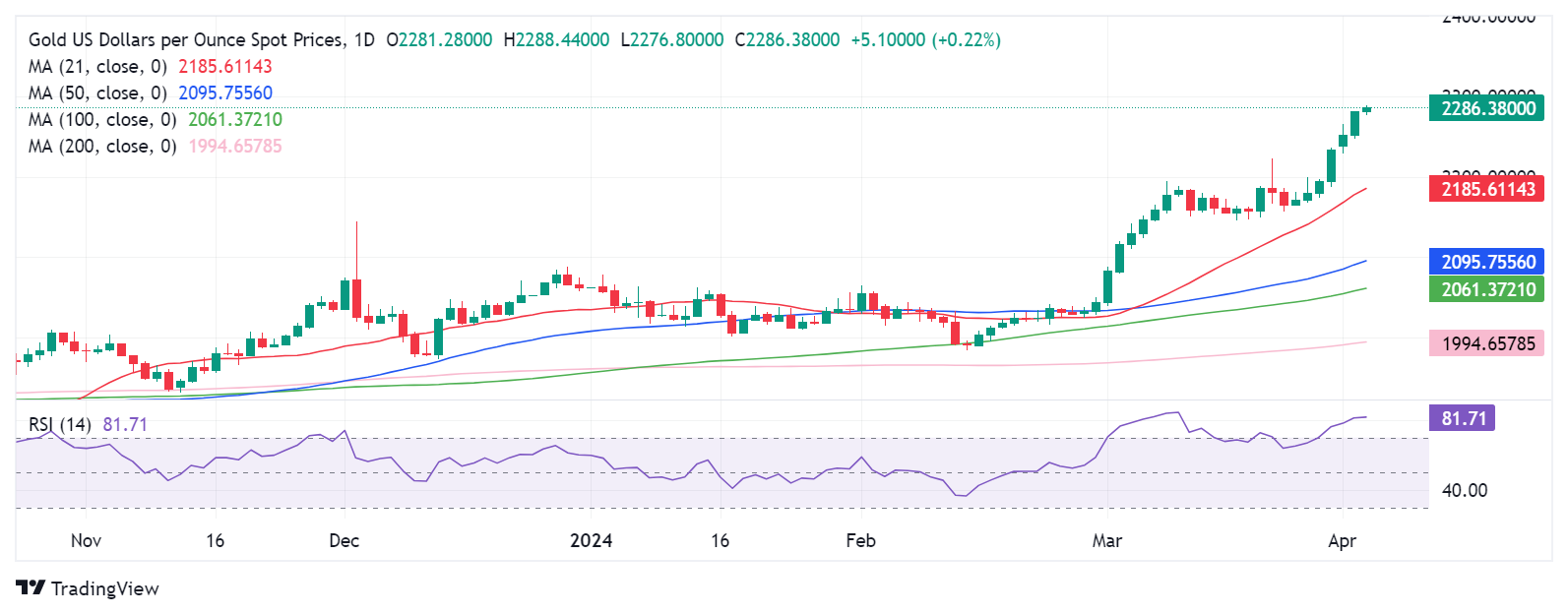
The buying interest around Gold price remains unabated but a sense of caution seems to be creeping in, as the 14-day Relative Strength Index (RSI) remains highly overbought, trading near 82.00.
Any retracement could find initial support at $2,266, the previous all-time high, below which the psychological $2,250 level will come into play.
A breach of the latter could fuel a sharp drop toward the $2,200 threshold.
Should Gold buyers extend their control, the $2,300 round level remains within touching distance. The next relevant upside target is envisioned at $2,350.
Gold FAQs
Gold has played a key role in human’s history as it has been widely used as a store of value and medium of exchange. Currently, apart from its shine and usage for jewelry, the precious metal is widely seen as a safe-haven asset, meaning that it is considered a good investment during turbulent times. Gold is also widely seen as a hedge against inflation and against depreciating currencies as it doesn’t rely on any specific issuer or government.
Central banks are the biggest Gold holders. In their aim to support their currencies in turbulent times, central banks tend to diversify their reserves and buy Gold to improve the perceived strength of the economy and the currency. High Gold reserves can be a source of trust for a country’s solvency. Central banks added 1,136 tonnes of Gold worth around $70 billion to their reserves in 2022, according to data from the World Gold Council. This is the highest yearly purchase since records began. Central banks from emerging economies such as China, India and Turkey are quickly increasing their Gold reserves.
Gold has an inverse correlation with the US Dollar and US Treasuries, which are both major reserve and safe-haven assets. When the Dollar depreciates, Gold tends to rise, enabling investors and central banks to diversify their assets in turbulent times. Gold is also inversely correlated with risk assets. A rally in the stock market tends to weaken Gold price, while sell-offs in riskier markets tend to favor the precious metal.
The price can move due to a wide range of factors. Geopolitical instability or fears of a deep recession can quickly make Gold price escalate due to its safe-haven status. As a yield-less asset, Gold tends to rise with lower interest rates, while higher cost of money usually weighs down on the yellow metal. Still, most moves depend on how the US Dollar (USD) behaves as the asset is priced in dollars (XAU/USD). A strong Dollar tends to keep the price of Gold controlled, whereas a weaker Dollar is likely to push Gold prices up.
Author

Dhwani Mehta
FXStreet
Residing in Mumbai (India), Dhwani is a Senior Analyst and Manager of the Asian session at FXStreet. She has over 10 years of experience in analyzing and covering the global financial markets, with specialization in Forex and commodities markets.