GBP/USD Weekly Forecast: Pound Sterling yields a range breakdown ahead of US Nonfarm Payrolls
- GBP/USD broke its consolidation to the downside amid relentless US Dollar demand.
- US jobs data to stand out in a holiday-shortened week for the Pound Sterling.
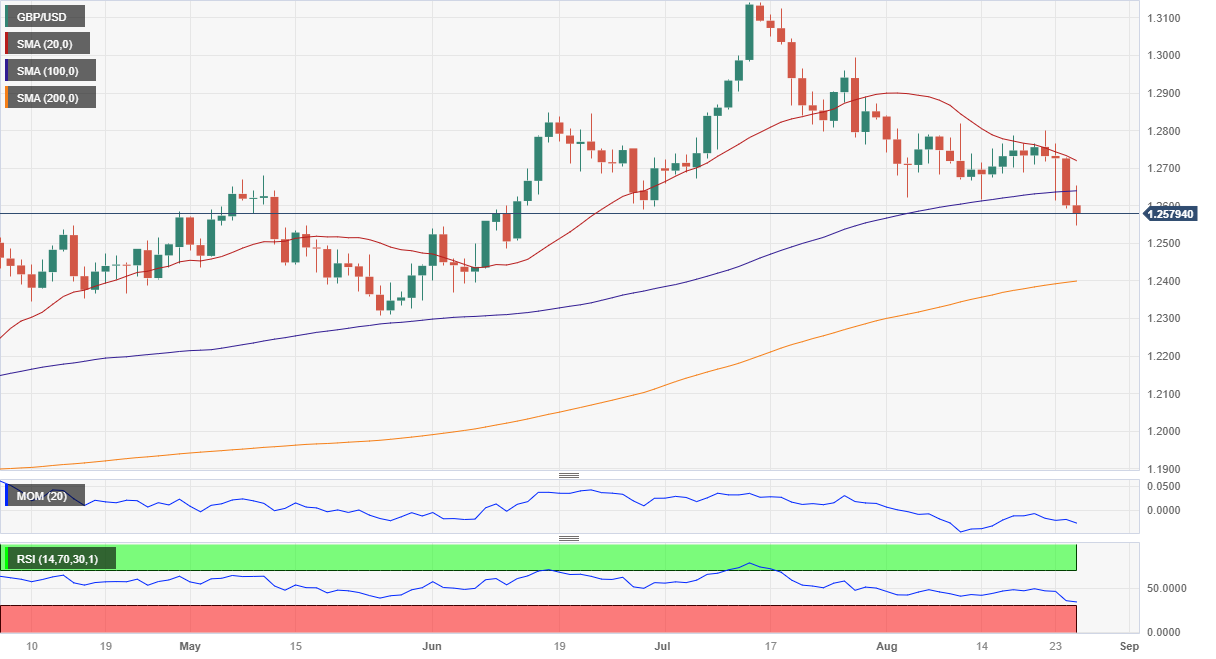
- GBP/USD remains poised to test the 200-day Simple Moving Average at 1.2400.

The Pound Sterling finally ended its 200 pips range trade against the United States Dollar (USD), sending GBP/USD back under the 1.2600 level this week. Attention turns toward the all-important United States (US) Nonfarm Payrolls data release in the holiday-shortened week ahead for GBP/USD traders.
GBP/USD: What happened last week?
The GBP/USD pair reversed a temporary rebound and resumed its downtrend in the past week, as the love for the US Dollar was unmatchable in the critical US Federal Reserve’s (Fed) Jackson Hole Symposium week.
Resurfacing worries over the health of the global economy amid elevated inflation levels and higher interest rates continued to underpin the sentiment around the US Dollar. After Chinese embattled property giant, Evergrande, filed for US bankruptcy protection on Friday, reports hit the wires on Monday that another real estate company Country Garden Holdings is set to be removed from Hong Kong’s Hang Seng Index. Meanwhile, the People’s Bank of China (PBOC) poured cold water on the stimulus optimism after it cut its one-year benchmark lending rate by 10 basis points (bps) and left its five-year rate unchanged, against market expectations for 15 bp cuts to both.
The latest US banking concerns were accentuated after S&P Global on Monday cut credit ratings and revised its outlook for multiple US banks, citing large deposit outflows and prevailing higher interest rates. Amidst these worrying factors, markets found some support from the upbeat earnings report from the US artificial intelligence (AI) chip maker Nvidia.
However, risk-off flows soon returned, as investors weighed stagflation risks after the Eurozone, the UK and the US business PMI reports showed a downturn in the services sector while the manufacturing sector remained in contraction. S&P Global said its preliminary US Composite PMI index, which tracks manufacturing and service sectors, dropped to 50.4 in August from 52 in July, registering the biggest drop since November 2022.
Following the downbeat S&P Global UK Services PMI data, bets for more tightening from the Bank of England (BoE) dropped. UK interest rate swaps showed more than a 50% chance of rates reaching 6.0%. Risk-aversion combined with dovish BoE expectations weighed heavily on the Pound Sterling against the US Dollar.
The pain in the GBP/USD pair was exacerbated after the US Dollar extended its rally to renew two-month highs above 104.00 across its main competitors, in the face of encouraging US Initial Jobless Claims data and in anticipation of Fed Chair Jerome Powell’s Jackson Hole speech on Friday. Markets expected Powell to reiterate his rhetoric of a ‘higher for longer’ narrative, sparking a fresh rally in the US Treasury bond yields, which lifted the US Dollar broadly.
The US Treasury bond yields rallied to 16-year highs due to multiple factors, including an increase in the US Treasury issuance, Fitch's credit downgrade, concerns China will dump Treasuries to support the Yuan and the hawkish Fed expectations.
GBP/USD jumped to 1.2653 as an immediate reaction to Fed Chairman Jerome Powell’s words. However, the pair quickly changed course and sank roughly 70 pips, on Powell's hawkish surprise. He said that they are prepared to raise rates further if appropriate in his opening remarks at the annual Jackson Hole Economic Symposium, while adding the Fed is attentive to signs the economy is not cooling as expected. Furthermore, he added that inflation remains too high, and bringing it down is a long lasting process. Finally, he said that "there is substantial further ground to cover to get back to price stability."
It’s all about the US employment data
With the Jackson Hole Symposium out of the week, GBP/USD traders look forward to another high-impact event from the United States, the labor market data.
Liquidity is expected to be thin at the start of the week on Monday, as the United Kingdom markets will be closed in observance of the Summer Bank Holiday. The absence of any relevant US economic data releases will also leave the pair exposed to minimal volatility.
Tuesday will feature the US Conference Board Consumer Confidence and JOLTS Job Openings data while the UK docket lacks top-tier economic data publication.
The JOLTS Job Openings data will be the first of the key US employment data releases in the week ahead and could likely trigger a big market reaction in case of any major deviations from the forecasts.
It will be an intense US economic calendar again on Wednesday, as the ADP Employment Change data will be reported ahead of the second estimate of the second-quarter Gross Domestic Product (GDP) report and the Pending Home Sales data.
Early Thursday, China’s National Bureau of Statistics (NBS) will report the official Manufacturing and Non-Manufacturing PMI reports, which could have a significant impact on risk sentiment. The data could underscore the economic concerns in the world’s second-largest economy. Later that day, the US Personal Consumption Expenditures (PCE) - Price Index will be released alongside the Personal Spending and Income data. The weekly US Jobless Claims data will also entertain Pound Sterling traders.
China’s Caixin Manufacturing PMI for August will be published on Friday, followed by the final reading of the UK S&P Global Manufacturing PMI. The main event risk on Friday, however, remains the US employment data, including the headline Nonfarm Payrolls and the Average Hourly Earnings. The US labor market data will shape up the Fed interest rate expectations and set the tone for markets in the coming weeks.
Additionally, speeches from the Fed and BoE policymakers will also have a strong bearing on the central banks’ policy outlooks, impacting the GBP/USD pair.
GBP/USD: Technical outlook
Having faced stiff resistance at the critical 50-day Simple Moving Average (SMA) at around 1.2785 on multiple occasions over the past two weeks, GBP/USD sellers fought back control and hammered the pair through a couple of key support levels at 1.2725 and 1.2640, the downward-sloping 21-day SMA and flattish 100-day SMA, respectively.
Meanwhile, the 14-day Relative Strength Index (RSI) indicator continues to keep its range just beneath the midline, pointing to more downside in the near term.
If the selling momentum intensifies in the upcoming week, Pound Sterling sellers could attack the 200-day SMA at 1.2400. Further down, the May low of 1.2308 could be exposed.
Alternatively, if the pair gains acceptance above the 50-day SMA resistance at 1.2785, it will likely confirm a bullish reversal and open doors toward the July 27 high of 1.2995. Pound Sterling buyers, however, need a daily closing above the 1.2850 static resistance, at first.
GBP/USD sentiment poll
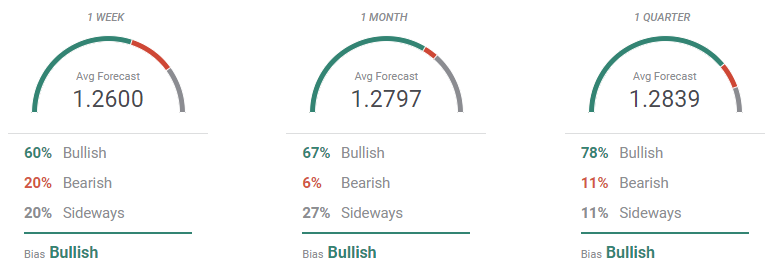
According to the FXStreet Forecast Poll, GBP/USD still has room to recover. The pair is seen bullish in all the time frames under study. The pair is seen at 1.2600 on average in the weekly view and up to an average of 1.2830 in the quarterly perspective. In all cases, bulls stand above 60% of the polled experts.
In the Overview chart, the shorter moving average is bearish, with an even spread of potential targets. In the monthly view, most targets accumulate between 1.2500 and 1.2800, but the range increases to 1.2700/1.3100 in the quarterly one. Chances of a slide below 1.2500 seems unlikely at the time being, but the picture may change next week.
Author

Dhwani Mehta
FXStreet
Residing in Mumbai (India), Dhwani is a Senior Analyst and Manager of the Asian session at FXStreet. She has over 10 years of experience in analyzing and covering the global financial markets, with specialization in Forex and commodities markets.