GBP/USD Weekly Forecast: Pound Sterling stays hopeful, eyeing PMIs, Powell and PCE
- The Pound Sterling extended positive traction against the US Dollar, conquering 1.3300.
- GBP/USD braces for another busy week, dominated by US economic events.
- Pound Sterling yielded a technical breakout amid a bullish RSI, with more upside likely.

The Pound Sterling (GBP) extended its hold against the US Dollar (USD) after the previous week’s resurgence, as the GBP/USD pair tapped the highest level since March 2022 above 1.3300.
Pound Sterling stood tall in the central banks’ week
The bullish potential remained intact for the GBP/USD pair, as the Pound Sterling capitalized on the monetary policy divergence between the Bank of England (BoE) and the US Federal Reserve (Fed), underscored in the central banks’ bonanza week.
The Fed opted for a 50 basis points (bps) interest rate cut on Wednesday, bringing the fed funds rate to the range of 4.75%-5.0%. The Summary of Economic Projections, the so-called Dot Plot chart, suggested a total of 100 bps of rate cuts for this year and the next.
In contrast, the BoE decided to leave the policy rate on hold at 5.0% on Thursday, as Governor Andrew Bailey warned that policymakers “need to be careful not to cut too fast or by too much”.
The central banks’ imbalances added extra legs to the uptrend in the pair, driving it to a new 30-month top at 1.3315 on Thursday. Buyers remained in control heading into the weekend, despite deteriorating risk sentiment amid renewed concerns over China’s economic slowdown.
In the early part of the week, GBP/USD largely held onto its recovery mode at around 1.3200, as traders preferred to stay on the sidelines, refraining from placing any directional bets on the major heading into the central banks’ decisions.
Tuesday’s US Retail Sales data came in strong and briefly lifted the sentiment around the USD on ‘soft-landing’ optimism but that quickly changed on the Fed verdict. Retail Sales increased 0.1% last month after an upwardly revised 1.1% surge in July, the US Commerce Department's Census Bureau said.
Meanwhile, data published by the Office of National Statistics (ONS) on Friday showed that Retail Sales in the UK increased by 1.0% over the month in August after rebounding 0.5% in July. Data beat the expected 0.4% growth in the reported month.
PMIs, Powell and PCE in focus
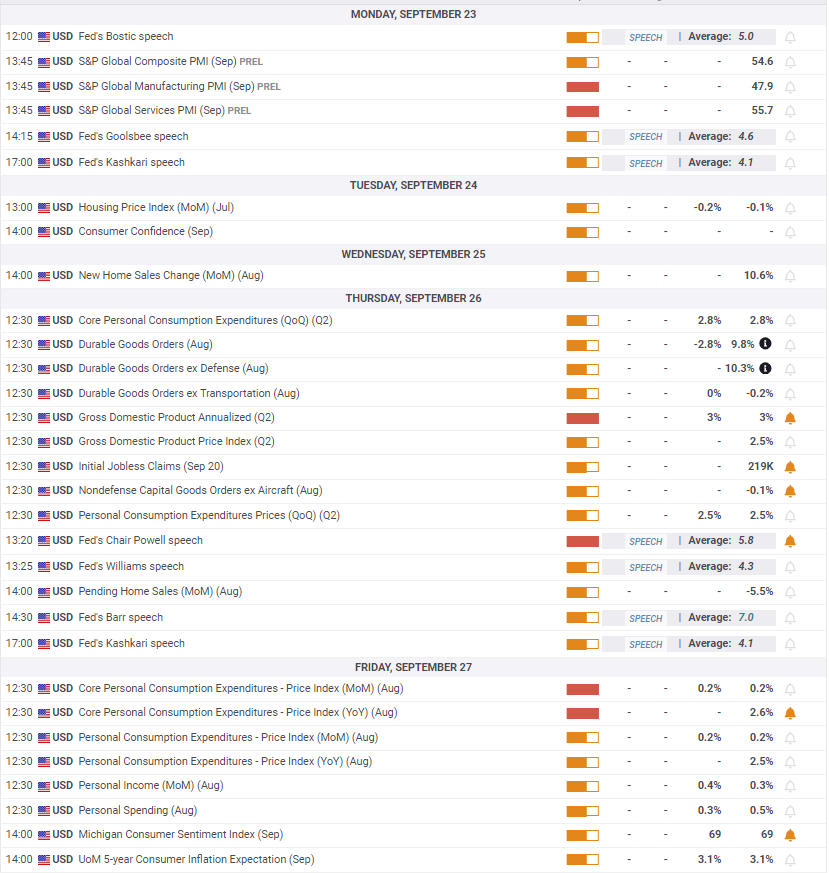
With the Fed and BoE policy decisions out of the way, the focus now shifts to the global business PMI data and the US Personal Consumption Expenditures (PCE) inflation data due in the week ahead.
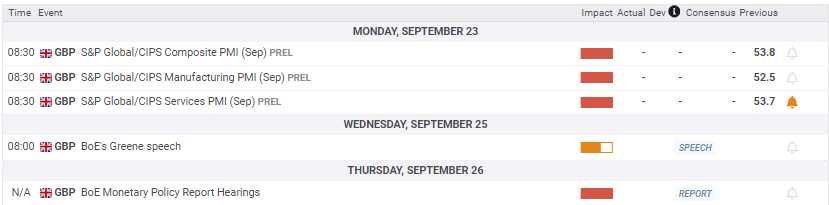
It’s a busy start to the week, with the S&P Global preliminary Manufacturing and Services PMI data dropping in from the UK and the US on Monday. Tuesday and Wednesday are relatively quiet, as only the US Conference Board Consumer Confidence data and US New Home Sales will be released, respectively.
On Thursday, the US calendar will feature the final revision to the second quarter Gross Domestic Product (GDP) alongside the Durable Goods and Jobless Claims data. The main focus that day, however, will be on Fed Chair Jerome Powell’s opening remarks at the US Treasury Market Conference, in New York.
Traders will closely scrutinize his speech heading into the US core PCE Price Index data due on Friday.
Apart from the macro data releases, speeches from several Fed policymakers and the Middle East geopolitical developments could also emerge as the market-moving drivers.
GBP/USD: Technical Outlook
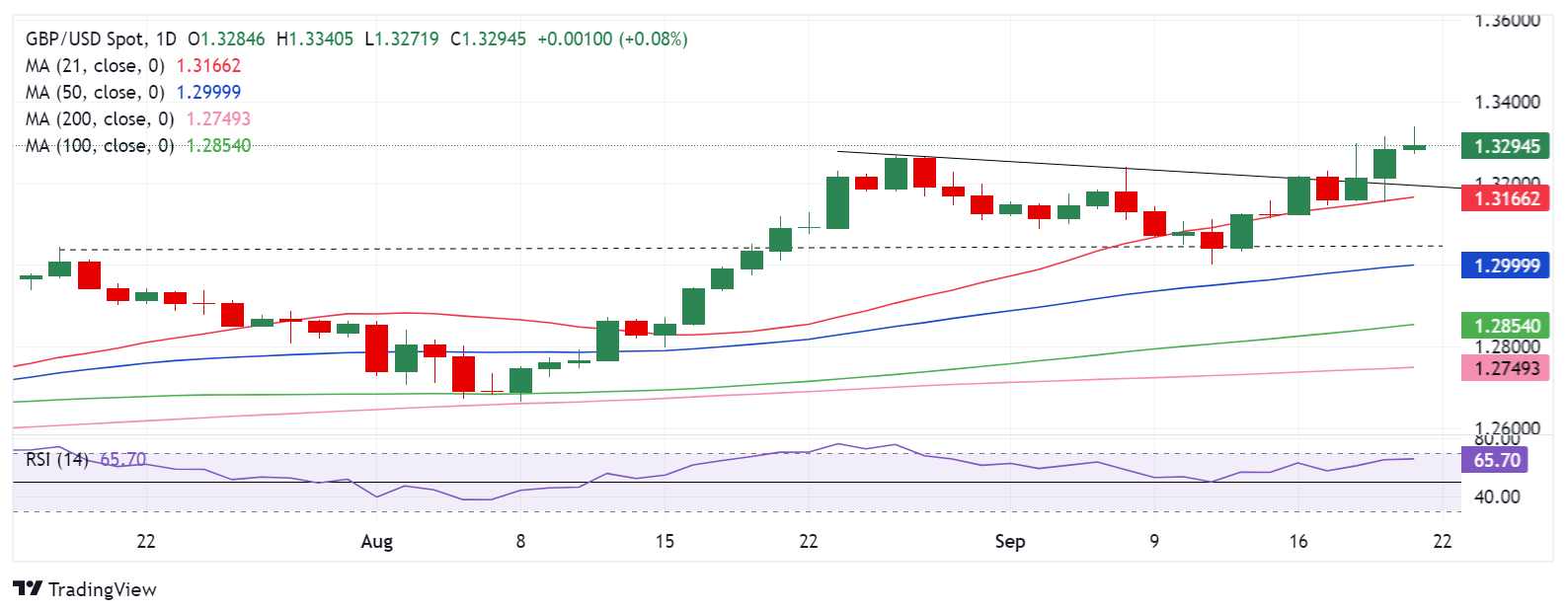
As observed on the daily chart, the GBP/USD pair settled Wednesday above the falling trendline resistance, then at 1.3199, yielding a technical breakout.
Since then, buyers have retained control, with the 14-day Relative Strength Index (RSI) holding comfortably above the 50 level, currently near 65.50, justifying the bullish outlook.
Further upside, however, needs acceptance above the 1.3300 level on a daily closing basis. If that materializes, the next topside barrier is seen at 1.3350 before fresh buying opportunities emerge, calling for a test of the 1.3400 threshold.
Alternatively, any pullback could meet initial demand at the falling trendline resistance now turned support at 1.3195, below which the 21-day Simple Moving Average (SMA) at 1.3166 will be challenged.
Should sellers manage to find a strong foothold below that level, a fresh downtrend is likely to initiate toward the July 17 high of 1.3045.
The 100-day SMA at 1.3000 will be the line in the sand for Pound Sterling buyers.
Pound Sterling FAQs
The Pound Sterling (GBP) is the oldest currency in the world (886 AD) and the official currency of the United Kingdom. It is the fourth most traded unit for foreign exchange (FX) in the world, accounting for 12% of all transactions, averaging $630 billion a day, according to 2022 data. Its key trading pairs are GBP/USD, aka ‘Cable’, which accounts for 11% of FX, GBP/JPY, or the ‘Dragon’ as it is known by traders (3%), and EUR/GBP (2%). The Pound Sterling is issued by the Bank of England (BoE).
The single most important factor influencing the value of the Pound Sterling is monetary policy decided by the Bank of England. The BoE bases its decisions on whether it has achieved its primary goal of “price stability” – a steady inflation rate of around 2%. Its primary tool for achieving this is the adjustment of interest rates. When inflation is too high, the BoE will try to rein it in by raising interest rates, making it more expensive for people and businesses to access credit. This is generally positive for GBP, as higher interest rates make the UK a more attractive place for global investors to park their money. When inflation falls too low it is a sign economic growth is slowing. In this scenario, the BoE will consider lowering interest rates to cheapen credit so businesses will borrow more to invest in growth-generating projects.
Data releases gauge the health of the economy and can impact the value of the Pound Sterling. Indicators such as GDP, Manufacturing and Services PMIs, and employment can all influence the direction of the GBP. A strong economy is good for Sterling. Not only does it attract more foreign investment but it may encourage the BoE to put up interest rates, which will directly strengthen GBP. Otherwise, if economic data is weak, the Pound Sterling is likely to fall.
Another significant data release for the Pound Sterling is the Trade Balance. This indicator measures the difference between what a country earns from its exports and what it spends on imports over a given period. If a country produces highly sought-after exports, its currency will benefit purely from the extra demand created from foreign buyers seeking to purchase these goods. Therefore, a positive net Trade Balance strengthens a currency and vice versa for a negative balance.
Author

Dhwani Mehta
FXStreet
Residing in Mumbai (India), Dhwani is a Senior Analyst and Manager of the Asian session at FXStreet. She has over 10 years of experience in analyzing and covering the global financial markets, with specialization in Forex and commodities markets.














