GBP/USD Weekly Forecast: Pound Sterling faces shortened week looking at US key data
- The Pound Sterling consolidated its correction from seven-month highs against the US Dollar.
- GBP/USD looks vulnerable heading into another holiday-shortened week.
- The Pound Sterling could keep an eye on 1.2400, with a bearish channel in play and RSI below 50.00.

The Pound Sterling (GBP) remained defensive against the US Dollar (USD) for the third consecutive week, as the GBP/USD entered a downside consolidation phase below 1.2700.
Pound Sterling suffers from renewed USD demand
The US Dollar extended its late last week’s recovery momentum against its major counterparts, although a holiday-shortened week and an end to the first quarter of 2024 left GBP/USD restricted in a 100-pips range during the week.
The rekindling of geopolitical tensions between Russia and Ukraine combined with fairly hawkish commentaries from US Federal Reserve (Fed) policymakers continued to support the US Dollar.
Of the Fedspeak, Fed Governor Christopher Waller’s comments stood out, as Waller said early Thursday that "there is no rush to cut the policy rate,” adding that the “Fed may need to maintain current rate target for longer than expected.” Chicago Fed President Austan Goolsbee said on Monday that they are "in a bit of a murky period,” as "the main puzzle with inflation is housing."
Markets are now pricing about a 64% probability that the Fed will begin cutting rates in June, according to CMEGroup’s FedWatch Tool, down from a 70% chance seen at the start of the week.
On the other hand, the Pound Sterling failed to capitalize on hawkish remarks from the Bank of England (BoE) officials. BoE policymaker Catherine Mann noted on Tuesday that “markets are pricing in too many cuts to rates.” Meanwhile, the BoE rate-setter Jonathan Haskel warned against rushing to cut interest rates on Thursday.
On the data front, US Durable Goods Orders released on Tuesday show a 1.4% rise in February, against the 6.9% slump reported in January. The annualized US Gross Domestic Product (GDP) was revised upward on Thursday from 3.2% to 3.4% in the fourth quarter. On Friday, the US Personal Consumption Expenditures (PCE) Price Index rose at an annual rate of 2.5% in February, as expected, while the Fed’s preferred inflation measure, the core PCE Price Index, grew at a slightly slower pace of 2.8% YoY in the same period after January's upward revision to 2.9%.
Besides economic statistics, the main fundamental driver behind the Greenback’s resilience was the price action around the USD/JPY pair. Heightened risks of Japan’s forex market intervention smashed the Japanese Yen to a 34-year low against the US Dollar. In turn, it put a lid on the GBP/USD upside attempts.
Easter Monday makes up for a light week ahead
Pound Sterling traders head into another holiday-shortened week, as most major economies celebrate Easter Monday. Also, clocks move backward in the United Kingdom to summer time.
However, the United States will report the S&P Global final Manufacturing PMI, followed by the ISM Manufacturing PMI on Monday. Tuesday will feature the final Manufacturing PMI from the UK and the closely watched US JOLTS Job Openings survey findings.
Wednesday’s ADP Employment Change data and the ISM Services PMI report are also likely to hog the limelight ahead of the high-impact Nonfarm Payrolls data on Friday.
In the meantime, GBP/USD will take some cues from the US weekly Jobless Claims data, as the UK economic calendar remains data-dry that day.
Apart from these statistics on both sides of the Atlantic, speeches from several Fed policymakers will continue to influence the Fed interest rate expectations, eventually impacting the value of the US Dollar and the currency pair.
GBP/USD: Technical Outlook
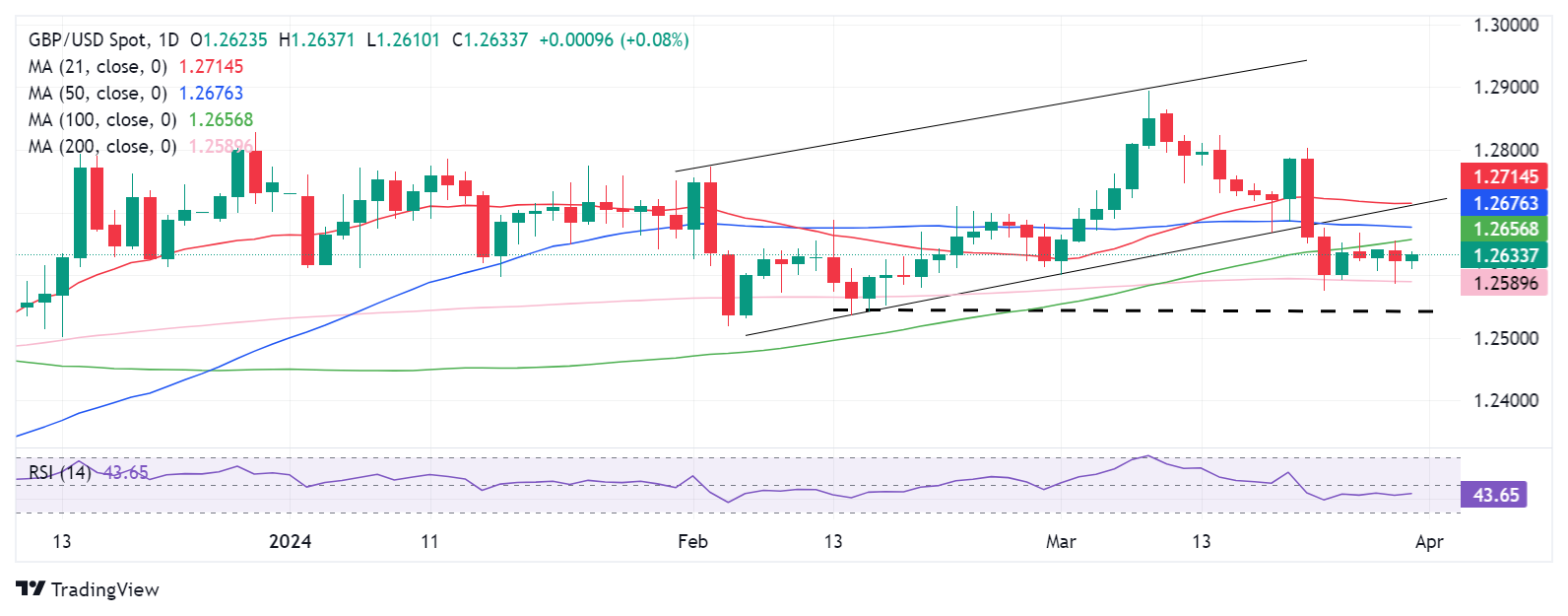
From a short-term technical perspective, GBP/USD is likely to extend the downside break from the rising channel into another week, as the 14-day Relative Strength Index (RSI) continues to hold below the midline near 40.00, pointing to more weakness ahead.
However, Pound Sterling sellers need to crack the horizontal 200-day Simple Moving Average (SMA) at 1.2589 on a decisive basis to resume the correction from seven-month highs in GBP/USD.
Acceptance below the latter will expose the mid-February low near 1.2540, followed by the 1.2500 round figure. If the selling pressure intensifies on a break below the latter, a test of the 1.2400 mark cannot be ruled out.
Should the 1.2540 support area hold the fort, GBP/USD could attempt a decent comeback toward the confluence zone of the 100-day and 50-day SMA around 1.2660.
The next topside target is seen at the channel-support-turned resistance at 1.2700. Further up, the pair could run into offers at the 21-day SMA at 1.2720. A sustained move above it will challenge the weekly top at 1.2803.
Pound Sterling price in the last 7 trading days
The table below shows the percentage change of Pound Sterling (GBP) against listed major currencies in the last 7 trading days. Pound Sterling was the weakest against the Canadian Dollar.
| USD | EUR | GBP | CAD | AUD | JPY | NZD | CHF | |
| USD | 0.60% | 0.67% | -0.25% | 0.00% | 0.12% | 1.10% | 1.40% | |
| EUR | -0.61% | 0.07% | -0.85% | -0.60% | -0.48% | 0.50% | 0.82% | |
| GBP | -0.67% | -0.07% | -0.93% | -0.67% | -0.58% | 0.39% | 0.73% | |
| CAD | 0.24% | 0.83% | 0.94% | 0.25% | 0.34% | 1.35% | 1.65% | |
| AUD | -0.01% | 0.60% | 0.68% | -0.27% | 0.12% | 1.09% | 1.39% | |
| JPY | -0.11% | 0.49% | 0.55% | -0.36% | -0.10% | 0.98% | 1.30% | |
| NZD | -1.12% | -0.52% | -0.46% | -1.35% | -1.10% | -1.02% | 0.29% | |
| CHF | -1.37% | -0.76% | -0.74% | -1.65% | -1.36% | -1.31% | -0.30% |
The heat map shows percentage changes of major currencies against each other. The base currency is picked from the left column, while the quote currency is picked from the top row. For example, if you pick the Euro from the left column and move along the horizontal line to the Japanese Yen, the percentage change displayed in the box will represent EUR (base)/JPY (quote).
Author

Dhwani Mehta
FXStreet
Residing in Mumbai (India), Dhwani is a Senior Analyst and Manager of the Asian session at FXStreet. She has over 10 years of experience in analyzing and covering the global financial markets, with specialization in Forex and commodities markets.