GBP/USD Weekly Forecast: Pound Sterling risks correction, eyes turn to US PCE inflation
- The Pound Sterling buyers were unstoppable against the US Dollar amid a Fed-BoE policy divergence.
- GBP/USD eyes more gains as top-tier US economic data are set to dominate the week ahead.
- The Pound Sterling flirts with overbought territory on the daily RSI, what's next?

The Pound Sterling (GBP) clinched a second consecutive weekly gain against the US Dollar (USD), as the GBP/USD pair reached its highest level since March 2022, above 1.3200.
Pound Sterling stands tall as US Dollar wilted
GBP/USD witnessed another blockbuster week, devoid of high-impact economic events from the United Kingdom (UK). The underlying positive tone around the major was mainly driven by the sustained weakness in the US Dollar against its major rivals.
Traders continued to retain their bearish outlooks on the Greenback, as dovish US Federal Reserve (Fed) expectations heightened in the Jackson Hole Symposium week. USD buyers stayed on the back foot in the run-up to the Minutes of the Fed’s July meeting and Chairman Jerome Powell’s speech due later in the week.
Despite a risk-averse market environment, the US Dollar failed to find the safe-haven demand amid nervousness ahead of Powell’s appearance. The Greenback received a fresh blow following Wednesday's release of the outright dovish Fed Minutes.
Most policymakers thought that "if the data continued to come in about as expected, it would likely be appropriate to ease policy at the next meeting," the Minutes said. Further, the Minutes read that other policymakers would have even been willing to reduce borrowing costs in the July meeting itself.
The Nonfarm Payrolls Benchmark Revision further cemented a Fed rate cut for September. The US Labor Department said that the NFP for the period from April 2023 to March 2024 was lowered by 818,000. The revision represented a total downward change of about 0.5%.
Weak US S&P Global preliminary Manufacturing Purchasing Managers’ Index (PMI) and Jobless Claims data on Thursday bolstered bets for a dovish policy pivot as early as September.
Markets priced in a 27% probability of 50 basis points (bps) cut at the Fed's September 17-18 meeting and a 73% chance of a 25 bps reduction, according to the CME Group's FedWatch Tool.
With traders moving away from their US Dollar longs, GBP/USD hit a fresh 13-month high of 1.3130, also helped by strong UK S&P Global preliminary business PMIs. UK Manufacturing PMI improved from 52.1 in July to 52.5 in August. Markets had expected a 52.1 print. Meanwhile, the preliminary UK Services Business Activity Index rose to 53.3 in August, compared to July’s 52.5 and the estimated 52.8 figure.
The Fed-BoE monetary policy divergence remained in play and acted as a tailwind for the Pound Sterling, as the US Dollar stood on thin ice, awaiting Powell’s words.
Powell noted that the time has come for the monetary policy to adjust and said that they do not welcome a further cooling in labor market conditions. “We will do everything we can to support a strong labor market as we make further progress toward price stability,” he added. The USD came under renewed selling pressure with the immediate reaction, allowing GBP/USD to climb above 1.3200 for the first time since March 2022.
Week ahead: US growth and inflation data on tap
Following the volatility in the Jackson Hole Symposium week, Pound Sterling traders catch their breath amid a holiday-shortened week.
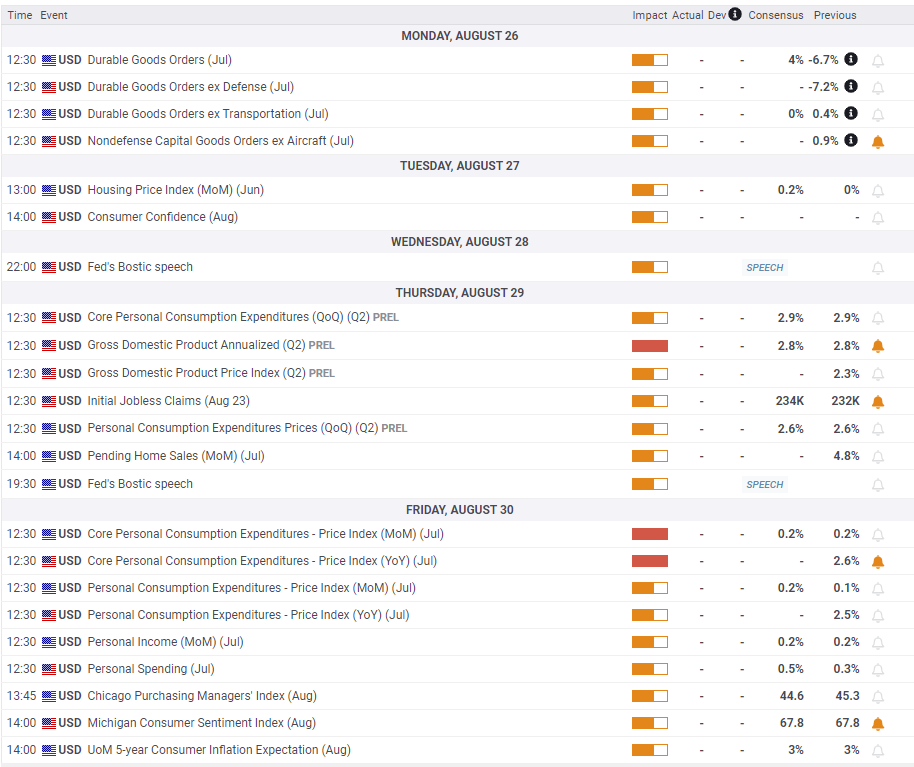
The UK markets closed on Monday in observance of the Summer Bank Holiday. Later that day, the US economic calendar will feature the Durable Good Orders but the data is unlikely to have a significant impact on the value of the US Dollar and the GBP/USD pair.
The main highlight of the week is expected to be the second estimate of the US Gross Domestic Product (GDP) report and the core Personal Consumption Expenditures (PCE) Price Index, the Fed’s preferred inflation measure.
In the first half of the week, the UK CBI Realized Sales and the US Conference Board Consumer Confidence data will offer some trading incentives.
Sentiment around the central banks’ policy expectations, speeches from Fed officials and the Middle East geopolitical risks will continue to drive the GBP/USD price action.
GBP/USD: Technical Outlook
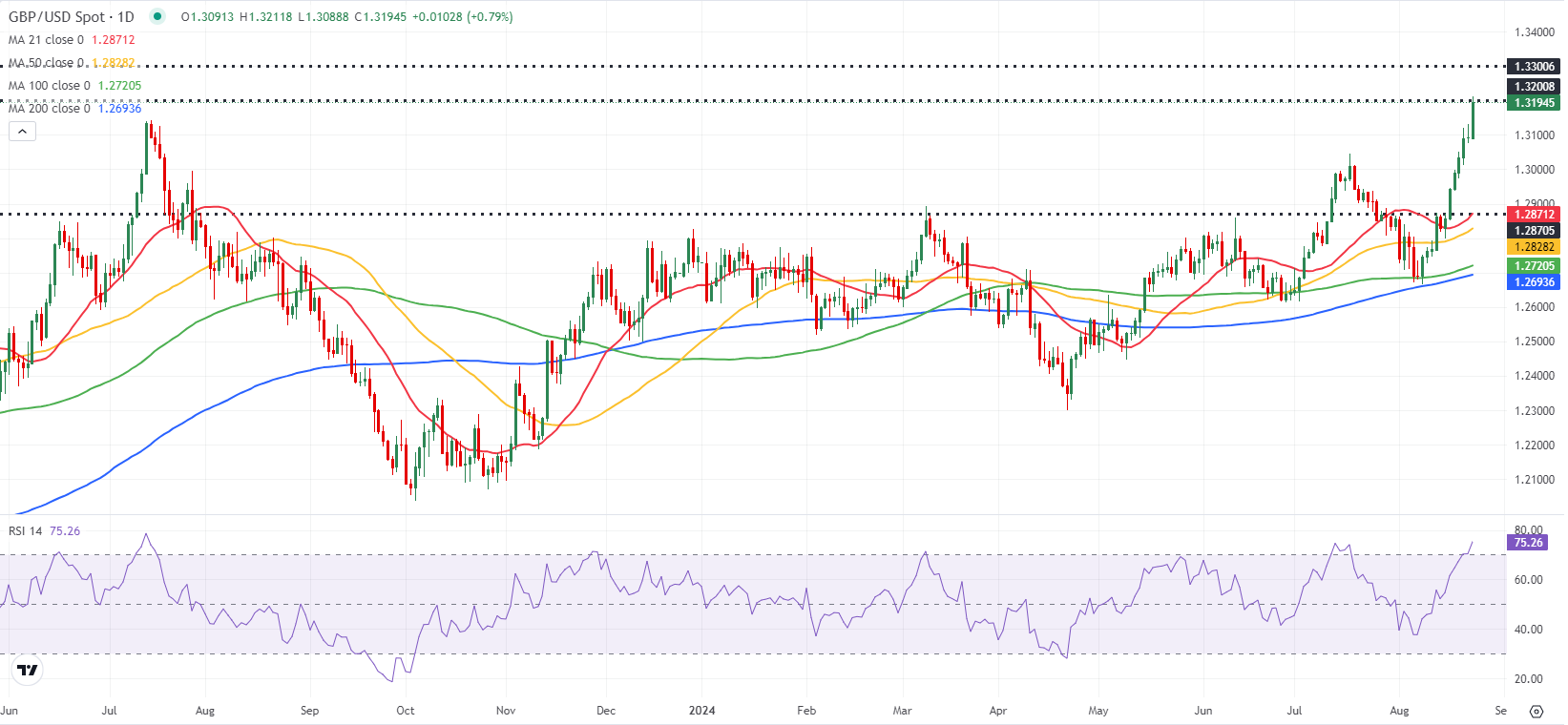
The GBP/USD recovery from five-week lows of 1.2665 gathered strength in the past week, as buyers stormed through the previous year-to-date (YTD) high at 1.3045 to reach a 29-month-high above 1.3200.
In doing so, Pound Sterling went further beyond all the key daily Simple Moving Averages (SMA). The 14-day Relative Strength Index (RSI) entered the overbought territory, currently near 75.
With overbought conditions, Pound Sterling traders could see a brief correction, with every pullback likely to be bought into so long as the leading indicator holds above the 50 level.
GBP/USD could meet interim resistance at 1.3250 before buyers aim for the 1.3300 round level.
In case of a corrective downside, the previous YTD high at 1.3045 will be the initial contention point, below which the 1.3000 key level will be tested.
If the selling momentum intensifies, the 1.2900 level will be threatened, followed by the confluence zone around 1.2850. At that level, the 50-day SMA and the 21-day SMA hang around.
Pound Sterling FAQs
The Pound Sterling (GBP) is the oldest currency in the world (886 AD) and the official currency of the United Kingdom. It is the fourth most traded unit for foreign exchange (FX) in the world, accounting for 12% of all transactions, averaging $630 billion a day, according to 2022 data. Its key trading pairs are GBP/USD, aka ‘Cable’, which accounts for 11% of FX, GBP/JPY, or the ‘Dragon’ as it is known by traders (3%), and EUR/GBP (2%). The Pound Sterling is issued by the Bank of England (BoE).
The single most important factor influencing the value of the Pound Sterling is monetary policy decided by the Bank of England. The BoE bases its decisions on whether it has achieved its primary goal of “price stability” – a steady inflation rate of around 2%. Its primary tool for achieving this is the adjustment of interest rates. When inflation is too high, the BoE will try to rein it in by raising interest rates, making it more expensive for people and businesses to access credit. This is generally positive for GBP, as higher interest rates make the UK a more attractive place for global investors to park their money. When inflation falls too low it is a sign economic growth is slowing. In this scenario, the BoE will consider lowering interest rates to cheapen credit so businesses will borrow more to invest in growth-generating projects.
Data releases gauge the health of the economy and can impact the value of the Pound Sterling. Indicators such as GDP, Manufacturing and Services PMIs, and employment can all influence the direction of the GBP. A strong economy is good for Sterling. Not only does it attract more foreign investment but it may encourage the BoE to put up interest rates, which will directly strengthen GBP. Otherwise, if economic data is weak, the Pound Sterling is likely to fall.
Another significant data release for the Pound Sterling is the Trade Balance. This indicator measures the difference between what a country earns from its exports and what it spends on imports over a given period. If a country produces highly sought-after exports, its currency will benefit purely from the extra demand created from foreign buyers seeking to purchase these goods. Therefore, a positive net Trade Balance strengthens a currency and vice versa for a negative balance.
Author

Dhwani Mehta
FXStreet
Residing in Mumbai (India), Dhwani is a Senior Analyst and Manager of the Asian session at FXStreet. She has over 10 years of experience in analyzing and covering the global financial markets, with specialization in Forex and commodities markets.