GBP/USD to remain above 50 day moving average until US debt ceiling crisis resolved

Previous three months
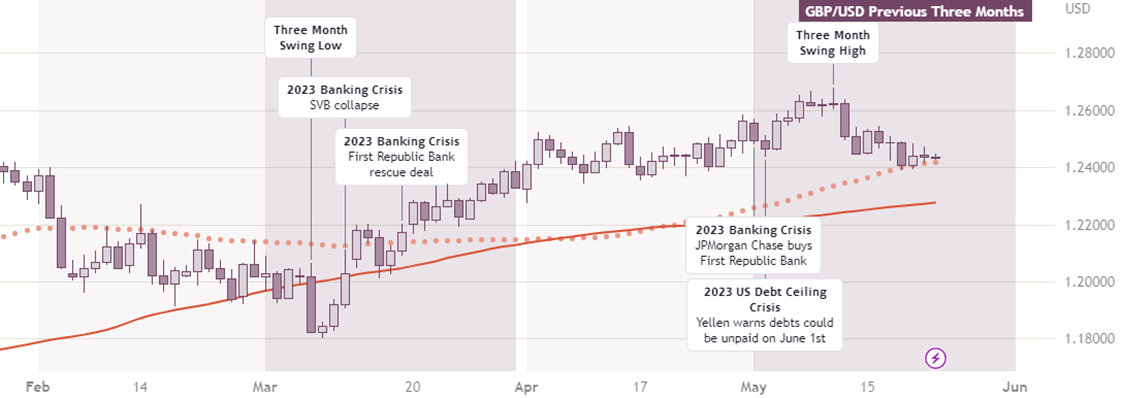
In March, the value of the British pound reached a low of 1.18 against the US dollar, which strengthened after Federal Reserve Chair Jerome Powell commented that higher interest rates are needed to control inflation.
However, a few days later, the Silicon Valley Bank (SVB) collapsed, which began the ‘2023 Banking Crisis’. This weakened the USD, as investors theorised that the Federal Reserve would need to cut rates to avoid deepening the crisis. As a result, the GBP has been increasing in value against the USD since then.
On the 1st of May, Treasury Secretary Janet Yellen said that due to the ‘2023 US Debt Ceiling Crisis’, the government may start to default by the 1st of June. This further weakened the USD although ha since strengthened as talks between leaders work towards a deal.
Previous three weeks
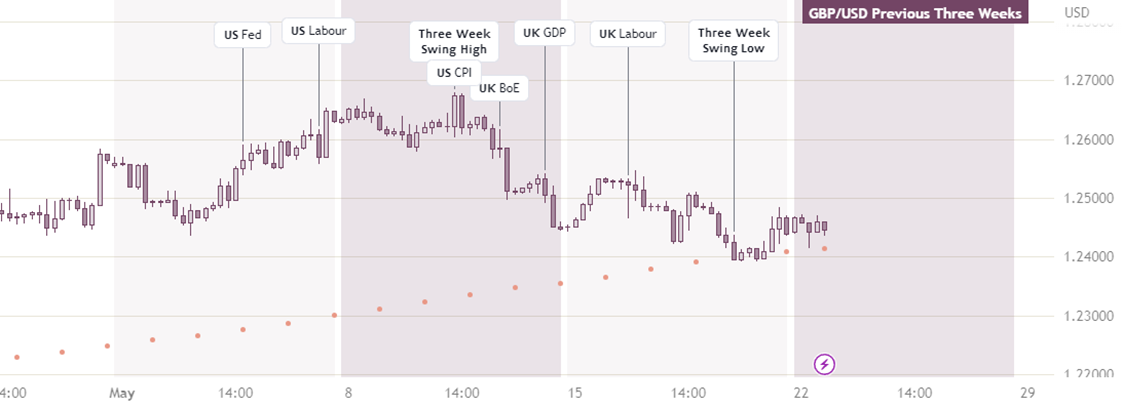
The value of the British pound has been weakening in recent weeks. After reaching a high of 1.26 on the 10th of May, the exchange rate has since fallen to the 1.24 area.
The strength of the GBP in the previous three months was due to a number of factors, including rising expectations that the Bank of England would raise interest rates to combat inflation, as well as concerns about the US debt ceiling. However, sentiment about the debt ceiling has recently improved, and the US dollar has regained some value as a result.
Short term outlook
Strength in the US dollar is being held back by the ‘2023 US Debt Ceiling’ narrative and so a resolution of this issue will likely pressure the GBP/USD lower although some pound strength is possible from the central bank divergence. The Bank of England remains committed to higher rates while the Fed have signalled that they are taking a pause. The CME FedWatch Tool indicates an 85% chance of a hold in June, falling to 70% in July. Cuts are being priced in from September although the odds have fallen from 40% to 25%.
The events to keep an eye on:
-
May 24th: US FOMC Meeting Minutes; UK CPI; BoE Gov. Bailey ‘Inflation and the Economy.
-
May 25th: US Prelim GDP q/q.
-
June 2nd: US NFP, Unemployment.
-
June 9th: US Treasury Currency Report.
The GBP/USD is expected to remain above the 50 day moving average of 1.24 until the ‘2023 US Debt Ceiling’ crisis is resolved. This then has the potential to see a move below the 1.24 area although could be subdued until the US NFP report next week on Friday the 2nd of June.
Author

Gavin Pearson
Independent Analyst
Gavin Pearson of Jeepson Trading is a currencies speculator from the UK focused on the G7 economies and is a recognized member of the eToro Popular Investor Program as well as being a funded prop trader with The 5%ers.














