|

GBP/USD: Looks cheap for good reason

  • GBP/USD buy zone of 1.24 to 1.16 could be deceiving
  • Monetary policy, recession, and inflation present downside risks
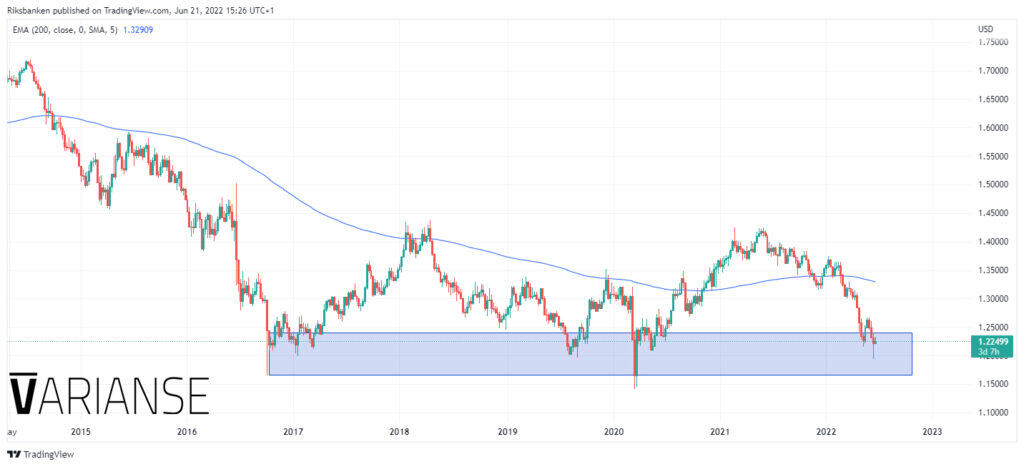
I’m tempted to look at a higher time frame chart of GBP/USD and say it looks cheap. Whether the pound has fallen due to the flash crash or COVID-19 concerns, buyers have always been quick to snap up GBP/USD anywhere between 1.24 and 1.16 levels. That might ultimately hold out to be true, but I’m not completely convinced that history will repeat itself.

UK inflation is my top concern for the British pound. Economic theory suggests that relatively higher inflation should put downward pressure on the nominal exchange rate, all other considerations being equal. Wednesday’s May UK CPI release is expected to show UK CPI rose to 9.1% y/y, which would put UK inflation ahead of that for the US for a second consecutive month.

Furthermore, the Bank of England looks for the time being less inclined than the Fed to do something about inflation. The Fed raised interest rates by 75 bps in June to take the Fed funds rate to a range of 1.5% to 1.75% and signalled its willingness to do what it takes to control inflation.

In contrast, the Bank of England raised by 25 bps in June to take bank rate to 1.25% as the majority of the MPC resisted a 50 bps hike. Even if the Bank of England does seek to tightening monetary policy more aggressively going forward, it may face more of an uphill climb in terms of convincing markets that it is serious about inflation.

GBP/USD buyers also need to contend with heightened fears of recession on both sides of the Atlantic, which would most likely disfavour the British pound more than the US dollar, as global investors seek the safety of US assets versus the rest of the world. In summary, GBP/USD looks cheap but for good reason.     

Author

Carl Paraskevas

Carl Paraskevas has over twenty years’ experience in finance and banking, primarily in research related roles at several institutions.


More from Carl Paraskevas
Share:

Markets move fast. We move first.

Orange Juice Newsletter brings you expert driven insights - not headlines. Every day on your inbox.

By subscribing you agree to our Terms and conditions.

Editor's Picks

EUR/USD bounces toward 1.1750 as US Dollar loses strength

EUR/USD returned to the 1.1750 price zone in the American session on Friday, despite falling Wall Street, which indicates risk aversion. Trading conditions remain thin following the New Year holiday and ahead of the weekend, with the focus shifting to US employment and European data scheduled for next week.

GBP/USD nears 1.3500, holds within familiar levels

After testing 1.3400 on the last day of 2025, GBP/USD managed to stage a rebound. Nevertheless, the pair finds it difficult to gather momentum and trades with modest intraday gains at around 1.3490 as market participants remain in holiday mood.

Gold trims intraday gains, approaches $4,300

Gold retreated sharply from the $4,400  area and trades flat for the day in the $4,320 price zone. Choppy trading conditions exacerbated the intraday decline, although XAU/USD bearish case is out of the picture, considering growing expectations for a dovish Fed and persistent geopolitical tensions.

Cardano gains early New Year momentum, bulls target falling wedge breakout

Cardano kicks off the New Year on a positive note and is extending gains, trading above $0.36 at the time of writing on Friday. Improving on-chain and derivatives data point to growing bullish interest, while the technical outlook keeps an upside breakout in focus.

Economic outlook 2026-2027 in advanced countries: Solidity test

After a year marked by global economic resilience and ending on a note of optimism, 2026 looks promising and could be a year of solid economic performance. In our baseline scenario, we expect most of the supportive factors at work in 2025 to continue to play a role in 2026.

Crypto market outlook for 2026

Year 2025 was volatile, as crypto often is.  Among positive catalysts were favourable regulatory changes in the U.S., rise of Digital Asset Treasuries (DAT), adoption of AI and tokenization of Real-World-Assets (RWA).












